

You can unlock the full potential of your website by learning how to effectively analyze your SEO performance with AI insights. In this guide, you’ll discover necessary techniques to harness AI tools that can identify weaknesses, optimize your content, and improve your search rankings. By utilizing these advanced insights, you’ll gain a competitive edge in the digital landscape, enabling you to make data-driven decisions that enhance your online visibility and drive sustainable growth. Let’s investigate into the fascinating world of AI-enhanced SEO analysis.
Key Takeaways:
- Leverage AI Tools: Utilize artificial intelligence-based tools to gather and analyze vast amounts of SEO data efficiently, allowing for better decision-making.
- Monitor Key Metrics: Focus on necessary performance indicators such as organic traffic, bounce rates, and keyword rankings to gauge your SEO effectiveness.
- Content Optimization: Use AI insights to identify which content pieces are performing well and forecast opportunities for improvement in underperforming areas.
- Competitor Analysis: Analyze competitors’ SEO performance using AI to uncover strategies that may enhance your own positioning in search rankings.
- Continuous Improvement: Embrace an iterative approach to SEO by continuously refining your strategies based on AI-generated insights to stay ahead of trends.
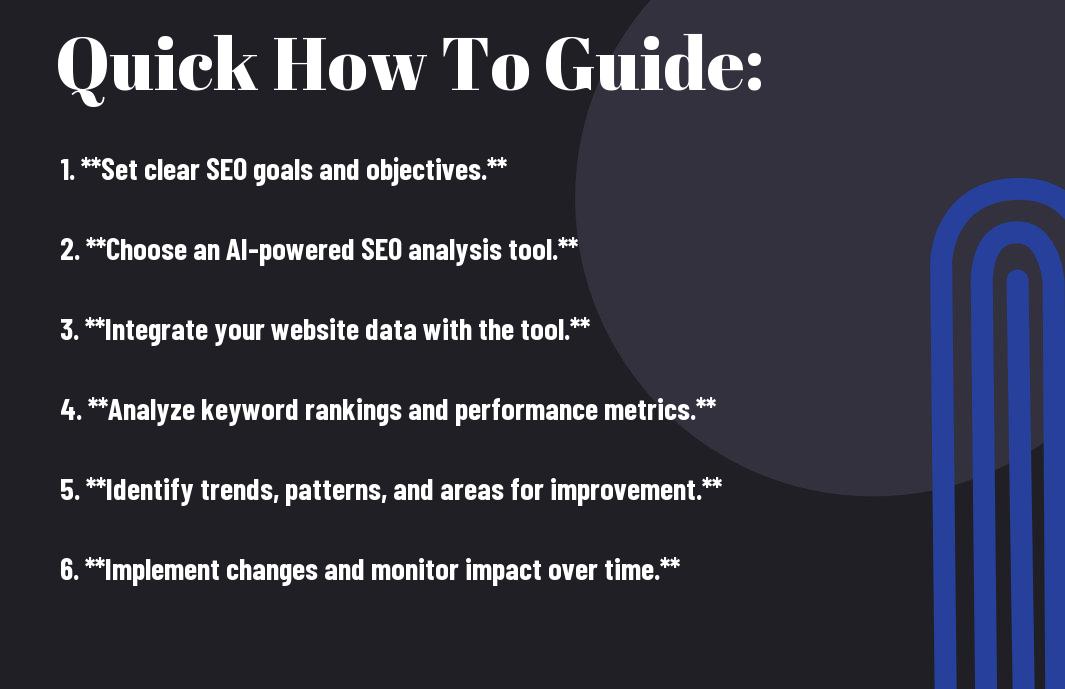

Understanding SEO Performance
While stepping into SEO performance, you must first recognize the importance of having a solid understanding of what it entails. Different from mere website traffic, SEO performance measures how well your site ranks on search engines, how effectively it converts visitors, and how satisfying the overall experience is for your audience. Essentially, it’s the health check for your digital presence, allowing you to evaluate whether your SEO strategies are working or require adjustments.
What is SEO Performance?
Little attention may be given to the concept of SEO performance in the hustle of daily optimizations, yet it forms the backbone of your online growth. SEO performance encompasses many factors such as organic visibility, page rankings, and engagement metrics—all of which indicate how well your strategies are resonating with users and search engines alike. Evaluating these metrics is vital for ongoing campaigns, as they provide practical insights that can steer your efforts toward successful outcomes.
Key Metrics to Monitor
An effective way to gauge your SEO performance is by keeping a close eye on specific key metrics. These may include organic traffic, bounce rates, keyword rankings, conversion rates, and click-through rates (CTR). Each of these metrics offers unique insights into how potential customers interact with your content and how your site performs in search results. Regularly monitoring these will allow you to identify strengths and weaknesses in your SEO strategy and adapt accordingly.
This data-driven approach is crucial for ensuring that your SEO tactics are not only yielding results but are also positive for user engagement and business growth. Paying close attention to your organic traffic helps you understand the volume of visitors coming from search engines, while bounce rates can reveal if users are finding what they’re looking for on your site. Additionally, monitoring keyword rankings can inform you about the performance of your targeted keywords, potentially highlighting areas for improvement. By keeping track of these key metrics, your ability to analyze and enhance your SEO strategy becomes more refined, therefore enabling you to take informed actions toward better performance.

The Role of AI in SEO Performance Analysis
One of the most transformative aspects of digital marketing in recent years has been the integration of artificial intelligence (AI) into SEO performance analysis. AI technologies enable you to process vast amounts of data at incredible speeds, providing insights that were previously labor-intensive to obtain. By leveraging machine learning algorithms, AI can identify patterns in user behavior, search trends, and content effectiveness, allowing you to refine your SEO strategies and improve your website’s overall performance. Understanding this role of AI is crucial for making data-driven decisions that can elevate your search engine rankings.
How AI Enhances Data Analysis
With the advent of AI, you can analyze your SEO performance metrics in a more sophisticated manner. Traditional data analysis often involves manual processes, where you sift through spreadsheets to interpret results, but AI tools automate this process. This means you can spend less time on number-crunching and more time developing strategies based on actionable insights. AI algorithms can detect anomalies and trends you might overlook, highlighting opportunities that can significantly enhance your SEO efforts.
Moreover, AI can predict outcomes based on historical data, enabling you to make informed decisions about your SEO tactics. For example, if certain keywords are trending, AI tools can notify you to adjust your content accordingly. Ultimately, this not only improves the accuracy of your analysis but also helps you stay ahead of the competition.
Common AI Tools for SEO
Assuming you’re interested in incorporating AI into your SEO strategy, there are several tools available that can assist you in performance analysis. Tools like SEMrush, Ahrefs, and Google Analytics now offer AI-powered features that provide unique insights tailored to your specific needs. These platforms can analyze backlinks, keyword rankings, and site performance, all while delivering comprehensive reports that save you time and effort. Additionally, tools like MarketMuse focus on content optimization, using AI to assess your existing content’s effectiveness and provide recommendations for improvements.
It’s important to recognize that while these AI tools are powerful, they should complement your expertise rather than replace it. For example, AI can automate the data collection process and highlight areas for improvement, but only you can provide the context and creativity necessary to implement successful SEO tactics. Leveraging AI in conjunction with your own insights and strategies can lead to a more comprehensive understanding of your SEO performance, enabling you to make smarter, more effective decisions for your online presence.
Factors Influencing SEO Performance
Not all factors influencing your SEO performance are equal, but understanding them can greatly enhance your strategy. Here are some critical areas you should look into:
- Keyword Research
- Content Quality
- Backlink Profiles
- User Experience
- Page Speed
Perceiving these factors will help you identify where you can make improvements and leverage your strengths.
On-Page SEO Factors
If you want to maximize your site’s visibility, start with understanding on-page SEO factors. These pertain to elements you can control directly on your website. This includes aspects like:
- Meta Tags
- Heading Structure
- Keyword Placement
- Image Optimization
- Internal Linking
Assume that by optimizing these elements, you’ll not only improve your search rankings but also enhance user experience and engagement metrics.
Off-Page SEO Factors
For boosting your site’s authority, it’s crucial to concentrate on off-page SEO factors as well. This category includes actions taken outside of your website that impact its visibility and ranking. Key components include:
- Backlinks
- Social Media Engagement
- Online Reputation
- Guest Blogging
- Influencer Partnerships
The quantity and quality of your backlinks are particularly significant, as they are a core factor search engines use to assess the credibility of your site.
In addition to backlinks, social media engagement and online reputation management play vital roles in determining your overall SEO effectiveness. These factors not only drive traffic but also enhance your brand awareness and authority.
- Social Signals
- Domain Authority
- Referral Traffic
- Content Shares
- Brand Mentions
The best strategy involves a balance of both on-page and off-page SEO tactics to ensure your efforts yield optimal results.
Technical SEO Factors
Now, let’s discuss technical SEO factors, which can have a substantial impact on your site’s performance. This involves the backend and infrastructure elements that can affect how search engines crawl and index your site. Key aspects include:
- XML Sitemap
- Robots.txt File
- Website Architecture
- Mobile Responsiveness
- Site Speed
Knowing these factors can aid in ensuring search engines can easily access and understand your site’s content, leading to better rankings and visibility.
Moreover, website architecture plays a critical role in how efficiently search engines crawl your pages. Features such as a clean URL structure and a well-organized sitemap can significantly improve how your site’s content is indexed.
- Structured Data
- Content Delivery Network (CDN)
- Secure Sockets Layer (SSL)
- Page Load Times
- Schema Markup
Knowing how these factors interact provides a clear path to optimize your technical SEO, ensuring that your site’s infrastructure supports, rather than hinders, your overall SEO goals.
How to Set Up Your SEO Analysis Framework
To successfully analyze your SEO performance, it’s crucial to establish a well-defined framework. This begins with setting clear objectives and goals, which will guide your analysis and actions moving forward. By having a framework, you can methodically evaluate what is working, what needs improvement, and how to leverage AI insights to enhance your SEO strategies.
Defining Your SEO Goals
For any effective SEO analysis, your first step should be to define specific goals. Are you aiming to increase organic traffic, boost conversion rates, or enhance your keyword rankings? Set SMART goals—Specific, Measurable, Achievable, Relevant, and Time-bound—that resonate with your overall business objectives. This way, your efforts in analyzing SEO performance can be aligned with tactical actions that support your long-term vision.
For instance, if your goal is to increase organic traffic, clarify by how much you want to grow this metric and in what timeframe. This gives you a concrete target to work towards and assists you in understanding the KPIs you need to measure during your SEO analysis.
Selecting the Right AI Tools
Your next step involves selecting the appropriate AI tools that can enhance your SEO analysis. With a plethora of options available, you need to consider tools that can provide valuable insights tailored to your specific goals. Look for solutions that offer advanced data analytics, keyword tracking, and competitor analysis to give you a comprehensive view of where your website stands in the SEO landscape.
Tools such as Google Analytics, Moz, and Ahrefs are excellent choices, but they may not be enough on their own. Understanding your unique needs, such as monitoring specific SEO metrics or analyzing user behavior, can help you identify the tools that will deliver the best insights for your analysis.
Tools can significantly influence the quality of your analysis. Therefore, ensure you integrate platforms that utilize AI to analyze complex data sets and generate insights that may be too time-consuming or overwhelming for you to do manually. This ability will empower you to make informed decisions based on real-time data, further enhancing your SEO strategies.
Creating a Data Collection Plan
There’s a necessity in developing a robust data collection plan that outlines what data you need to track, how you will gather it, and the frequency of data updates. Determine which metrics are key to your goals, whether it’s organic search traffic, bounce rates, page loading speeds, or backlinks. Having this structured approach will ensure that you capture relevant data efficiently, making your analysis more effective.
There’s also the importance of considering various channels through which you can gather your data. You can leverage tools like Google Search Console for keyword performance, use social media analytics to gauge engagement, and employ heatmaps to understand user interactions on your website. By diversifying your sources of data, you enrich your analysis and gain deeper insights into your SEO performance.
Collection of data isn’t just about gathering numbers; it’s about discerning patterns that emerge from them. By prioritizing an organized approach in how you collect and analyze your SEO-related data, you can develop a quicker, more efficient way to measure success and adapt your strategies as necessary.
Tips for Analyzing AI Insights Effectively
Unlike traditional methods of SEO analysis, leveraging AI insights can provide you with a more nuanced and data-driven understanding of your performance. To make the most of this powerful technology, consider the following key tips:
- Understand the metrics that matter most to your business goals.
- Segment your audience data to get insights specific to different demographics.
- Compare your data against industry benchmarks to gauge your performance.
- Track changes over time to identify long-term trends in your SEO performance.
- Engage with visualization tools provided by AI to simplify complex data.
Interpreting Key Data Points
Tips for interpreting key data points involve focusing on specific metrics like organic traffic, bounce rates, and conversion rates. AI insights can highlight correlations that are not immediately visible, allowing you to ask more targeted questions about your website’s performance. For instance, if your organic traffic increases but your bounce rate remains high, it may indicate issues with your content quality or relevancy.
Additionally, it’s crucial to prioritize the data points that align with your overall SEO strategy. Not all metrics are created equal; understanding which ones directly correlate with your business outcomes can help you tailor your analysis effectively. You should always keep an eye on your keyword rankings, as this can be a primary driver of traffic and revenue.
Identifying Actionable Insights
While you sift through the abundance of data presented by AI, identifying actionable insights hinges on distinguishing between what is important and what is merely noise. Begin by drilling down into your SEO performance metrics to uncover patterns and causations that could drive future actions. For example, if a specific keyword is driving significant traffic but has a low conversion rate, it could signal the need for a content overhaul or a more focused landing page.
Furthermore, consider the impact of your insights through the lens of your overall marketing strategy. Are your AI-generated data points suggesting shifts in user behavior that demand changes in your outreach or content creation? Sometimes the most compelling insights come from aligning your SEO goals with the broader objectives of your business, ensuring that your actions are driving value on multiple fronts.
Data from AI tools can often reveal opportunities for optimization that may not be obvious. An effective approach is to combine your intuition about your market with the data-driven insights presented to you, creating a robust strategy that promotes continuous improvement in your SEO performance.
Monitoring Trends Over Time
Effectively monitoring trends over time requires you to establish a regular review schedule for your AI insights. By routinely checking your performance metrics, you will be able to identify both upward and downward trends in your SEO efforts. This allows you to respond swiftly to fluctuations in traffic, keyword ranks, and user engagement metrics, ensuring that your strategy remains agile.
It’s also important to compare data across various time frames—such as week-over-week and month-over-month analyses—to gain a deeper understanding of your performance fluctuations. This granular approach ensures that you are not only aware of seasonal changes but also able to attribute success to specific actions you’ve implemented in your strategy.
Over time, maintaining a consistent review process of your SEO performance will help you to remain informed of patterns that could indicate broader shifts within your industry, allowing you to adapt your approach accordingly. By recognizing and responding to these trends, you can position your website for sustained success in an ever-evolving digital landscape. Thou should not underestimate the power of ongoing analysis combined with actionable insights!
How to Implement Changes Based on AI Insights
Now that you’ve gathered valuable insights from your AI tools, it’s time to take action. Transforming insights into tangible results requires a structured approach to ensure that the changes you implement are effective and directly aligned with your SEO goals.
Prioritizing Recommended Changes
Assuming you have a list of recommended changes from your AI analysis, the next step is to prioritize these recommendations based on impact and feasibility. Start by identifying which changes will have the **greatest impact on your SEO performance**. This might mean focusing on keywords that have the highest search volume or fixing site speed issues that could cause user drop-off. You can use metrics like potential traffic increase or search rank improvement to help determine priority.
Additionally, consider the ease of implementation for each recommendation. **Some changes may require minimal effort** and yield quick wins, while others may need a significant investment of time or resources. Balancing high-impact changes with those that are quick to implement can create a roadmap for **ongoing SEO improvement** without overwhelming yourself or your team.
Testing New Strategies
Changes in your SEO strategy should not be implemented haphazardly. Instead, focus on **testing new strategies** to assess their effectiveness. Start small by introducing one or two changes at a time, and monitor the results closely. This method allows you to attribute changes in your SEO performance directly to specific actions, providing clarity on what works and what doesn’t.
A systematic approach to testing may involve setting clear benchmarks and utilizing A/B testing. For example, if you’re changing the title tags, create two versions and see which one drives more traffic. Monitor key metrics such as **click-through rates (CTR)**, bounce rates, and conversion rates to gauge the success of each new strategy.
Tracking Results Post-Implementation
The effectiveness of your implemented changes hinges on robust tracking post-implementation. Once you deploy a new strategy, regularly check your performance metrics to ensure that you are seeing the **anticipated results**. Utilize tools like Google Analytics to assess traffic patterns, user engagement, and keyword rankings as you progress. It’s necessary to maintain a vigilant eye on your SEO performance after changes are made, as immediate results may fluctuate over time.
Based on this ongoing analysis, you can refine your strategies further. If a particular approach didn’t yield the expected outcomes, it might be worth revisiting the initial AI insights for alternative recommendations. This loop of **continuous evaluation and improvement** is key to adapting your SEO strategy to remain competitive in an ever-changing digital landscape.
Summing up
Now that you understand the importance of analyzing your SEO performance using AI insights, it’s crucial to develop a structured approach to leverage these technologies effectively. By utilizing AI tools, you can gain deeper visibility into your website’s performance metrics, user behavior, and competitive landscape. This comprehensive analysis enables you to identify your strengths and weaknesses, allowing for data-driven decisions that enhance your overall SEO strategy. Regularly tracking these insights ensures that you stay ahead of the competition and adapt to changing algorithms and market conditions.
Moreover, by integrating AI insights into your SEO performance evaluation, you can streamline your optimization efforts and focus on high-impact areas. As you implement the recommendations derived from your AI analysis, you should remember that SEO is an ongoing process. Continuously monitoring your performance, testing new strategies, and adjusting your approach based on the insights gained will ultimately lead to sustained growth in organic traffic and better search engine rankings. Embrace AI as a powerful ally in your SEO journey, and watch your digital presence flourish.
Comments