

SEO has evolved dramatically, and leveraging AI tools can significantly enhance your strategies. By using these advanced technologies, you can analyze data more efficiently, identify keyword opportunities, and improve your content creation process. In this post, you will discover how to integrate AI into your SEO efforts, leading to better rankings and increased visibility. Understanding the potential of AI not only saves you time but also empowers you to make informed decisions, keeping your SEO strategies ahead of the competition.

Key Takeaways:
- Keyword Analysis: Utilize AI tools to conduct in-depth keyword research, identifying high-volume and low-competition keywords to enhance your content strategy.
- Content Optimization: Leverage AI for generating and optimizing content by ensuring that it aligns with SEO best practices, including readability and keyword placement.
- SEO Audits: Implement AI-driven site audits to regularly assess your website’s SEO health, pinpointing areas for improvement and optimizing performance.
- Competitor Analysis: Use AI tools to analyze competitors’ SEO strategies, uncovering valuable insights that can inform your own tactics and help you stay ahead.
- Predictive Analytics: Take advantage of predictive analytics capabilities in AI tools to forecast trends, enabling proactive adjustments to your SEO strategies before the competition.
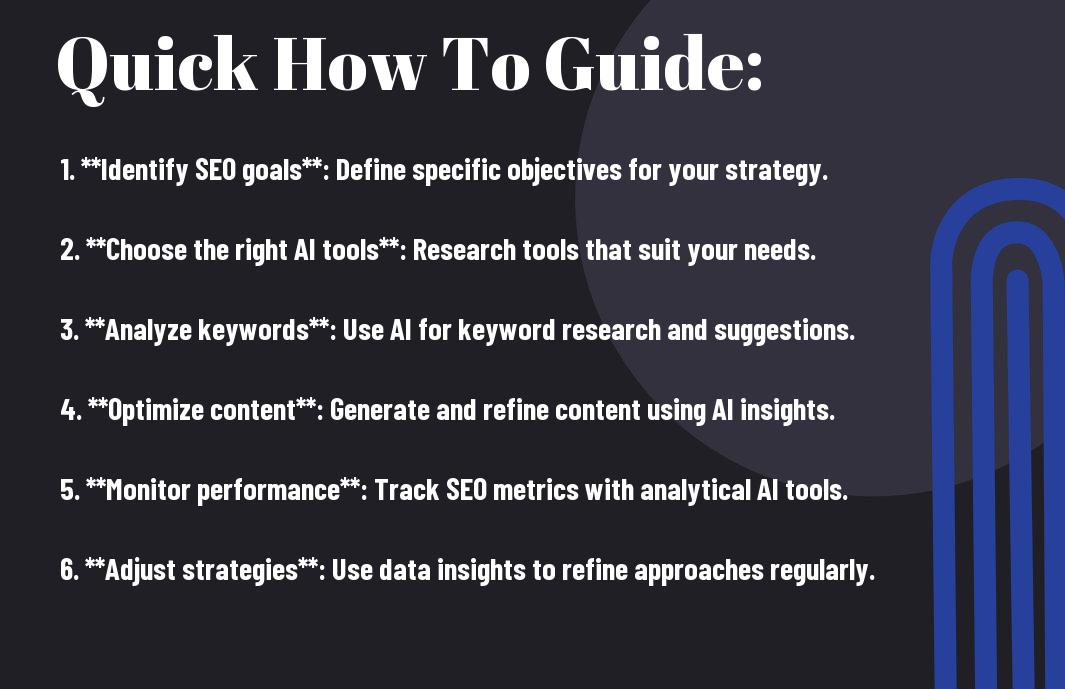
Understanding AI Tools and Their Role in SEO
Before stepping into the specifics of how to leverage AI tools effectively, it’s crucial to grasp the broader concepts of AI and its relationship with Search Engine Optimization (SEO). AI, or Artificial Intelligence, refers to the simulation of human intelligence in machines that are designed to think and act like humans. SEO, on the other hand, is the practice of optimizing your website to rank higher in search engine results, thereby increasing visibility and traffic. By combining AI’s adeptness at processing vast amounts of data with the strategic methodologies of SEO, you cultivate a potent synergy that can elevate your digital marketing efforts to new heights.
Defining AI and SEO: A Synergistic Relationship
Even though AI tools can seem complex, their application in SEO is surprisingly intuitive. These tools utilize algorithms to analyze data patterns, predict user behaviors, and improve decision-making in real time. This means that when you leverage AI in your SEO strategies, you not only enhance your optimization technique but also enrich your understanding of market dynamics, allowing you to create content that resonates with your audience.
Moreover, AI has the unique ability to streamline various SEO processes, such as keyword research, on-page optimization, and link building. By automating repetitive tasks and providing deeper insights, you can focus your efforts on developing creative strategies and high-quality content that captivate your audience, giving you a competitive edge in the digital landscape.
Key AI Technologies Transforming SEO
Assuming you want to stay relevant in the ever-evolving world of SEO, understanding the key AI technologies is imperative. Natural Language Processing (NLP) and machine learning algorithms are two technologies that are actively changing the landscape. NLP helps in understanding user intent behind search queries, allowing for more personalized content curation. Machine learning, on the other hand, analyzes patterns from user interactions to continuously adjust and improve your SEO strategies, making them more effective over time.
Transforming your SEO approach with AI technologies allows for a heightened level of adaptability. One popular AI technology in use today is predictive analytics, which helps you forecast trends and consumer preferences by analyzing big data. This foresight can be invaluable when planning your content marketing strategy, giving you the ability to stay one step ahead of your competitors.
Benefits of Integrating AI into SEO Strategies
Any marketer or business owner should consider the myriad benefits that come with integrating AI into your SEO strategies. With AI, you can optimize keyword targeting, enhance content generation, and refine audience segmentation, which ultimately improves your engagement and conversion rates. By leveraging AI’s data-driven decision-making tools, you will not only save time but also achieve better results in less time.
Another significant advantage of AI integration in SEO is the ability to personalize user experiences. AI algorithms can analyze user behaviors, preferences, and search patterns, allowing you to create tailored content and recommendations that resonate more effectively with your audience. This nuanced understanding leads to higher user satisfaction and loyalty, ultimately boosting your website’s performance and authority in the eyes of search engines.
How-to Identify the Right AI Tools for Your SEO Needs
There’s no denying that utilizing AI tools for SEO can significantly enhance your online presence. However, to fully harness the benefits of these technologies, you must first identify the right tools based on your specific needs and existing challenges. This task can seem daunting, especially with the myriad of options currently available on the market. By refining your focus on the areas where you face the most difficulty, you can better align your efforts with the ideal AI solutions for your strategy.
Assessing Your Current SEO Challenges
Any effective approach to choosing the right AI tools starts with a thorough assessment of your current SEO challenges. Consider factors such as your website’s visibility in search engines, the quality of your content, and the effectiveness of your link-building strategies. Ask yourself: Are you struggling with keyword research, or is content optimization your main hurdle? Understanding your pain points is crucial to narrowing down the tools that can address these specific issues.
Another aspect to analyze is your current SEO process. How long does it take you to analyze your competitors or track keyword performance? Are there repetitive tasks that consume valuable time? By thoroughly assessing these challenges, you will not only gain insights into your current workflow but also identify areas where AI tools can provide significant boosts in efficiency.
Evaluating AI Tools Based on Features
Howto effectively evaluate AI tools requires understanding their core features and how they cater to your specific needs. For example, do you require a tool that specializes in keyword analysis, content generation, or link tracking? Make a list of important features that are vital to your strategy and look for tools that excel in these areas. Each tool may have its unique strengths, so it’s important to match these with your objectives to ensure you are acquiring the most suitable option.
Evaluating the features of potential AI tools will also allow you to prioritize which aspects of your SEO strategy need the most support. Some tools may offer comprehensive analytics dashboards, while others may focus on automating specific tasks. Understanding the breadth and depth of each tool’s offerings can give you a clearer picture of how well it aligns with your SEO needs.
Comparing Popular AI Tools in the Market
Little research into popular AI tools can reveal the variety of options available, allowing you to make a more informed decision. Below is a comparison table highlighting some of the top AI tools currently favored by SEO professionals along with their key features:
| Tool | Key Features |
|---|---|
| SEMrush | Keyword research, site audit, traffic analysis |
| Ahrefs | Backlink analysis, content explorer, rank tracking |
| Surfer SEO | Content optimization, SERP analysis, keyword suggestions |
| Frase | AI content generation, topic research, optimization recommendations |
Needs to be taken into account when comparing AI tools is the overall user experience and support provided. Consider not just the features but also the interface, ease of use, and customer service options available. It can make a significant difference in your experience and effectiveness when adopting a new tool. Always prioritize those that offer comprehensive training resources or customer support, as they are important for ensuring a smooth adoption process.
How-to Utilize AI Tools for Keyword Research
To effectively craft your SEO strategies, you need to understand the significance of keywords in driving organic traffic to your website. Keywords serve as the bridge connecting your content to user search queries. Choosing the right keywords ensures that your audience finds your content easily, thereby enhancing the visibility of your website and increasing engagement. As search engines evolve with complex algorithms, it’s imperative to leverage the power of AI tools to ascertain the most valuable keywords for your niche.
Importance of Keywords in SEO
There’s no question that the right keywords can make or break your SEO efforts. They not only help search engines understand the theme of your content but also establish its relevance to users’ search intentions. By focusing on the appropriate keywords, you can target specific demographics, allowing you to connect with your audience more effectively. This involvement is key to improving your rankings and attracting the right traffic to your site.
Furthermore, keywords play a crucial role in content optimization, contributing to the overall structure and effectiveness of your online presence. Utilizing AI tools for keyword research enables you to discover unique insights into search trends and user behavior, giving you the upper hand in crafting compelling and strategically optimized content.
Using AI for Identifying Long-Tail Keywords
Clearly, long-tail keywords are instrumental in capturing niche traffic that often converts into leads or sales. These keywords, typically longer and more specific phrases, allow you to align your content closely with what users are actually searching for. AI tools can streamline this process by analyzing vast datasets to unearth high-potential long-tail keywords that may not be immediately obvious through traditional keyword research methods.
With AI-powered keyword research tools, you can gain insights into user intent and preferred search phrases. They can provide you with relevant long-tail variations that have lower competition, making it easier to rank on search engine results pages. By integrating these keywords into your content, you can enhance your chances of capturing the attention of users who are ready to engage with your offerings.
Analyzing Keyword Competitiveness with AI
Some of the most challenging aspects of keyword research involve understanding the competitive landscape. Analyzing keyword competitiveness with AI empowers you to determine which keywords have high search volumes but are not overly saturated with content, giving you a better chance of ranking higher in search results. AI tools can provide detailed metrics on keyword difficulty, allowing you to make informed decisions on where to focus your efforts.
Moreover, you can evaluate competitors’ rankings and strategies using AI, which equips you with critical information about which keywords they are targeting. This intelligence enables you to refine your approach and find gaps in the market that you can exploit effectively. By mastering keyword competitiveness analysis through AI, you can carve out your niche and strategically position yourself against your competitors.
Keyword richness is at the heart of your SEO strategy. The careful selection and analysis of keywords ensure that your content reaches the right audience while competing effectively. Understanding keyword competitiveness using AI equips you to not only elevate your rankings but also achieve sustained organic growth for your brand.
How-to Enhance Content Creation Using AI
Not only can AI streamline your SEO strategies, but it can also unleash a world of possibilities in content creation. As you integrate AI into your workflows, you’ll find that it can significantly enhance your output while ensuring that your content remains engaging and relevant for your audience.
AI-Powered Content Generation Tools
Content generation can often feel like an uphill battle, especially when trying to maintain quality while keeping up with demand. Fortunately, with the emergence of AI-powered content generation tools, you can transform your writing processes. These tools are designed to understand the context of your prompts and create unique articles, blog posts, and marketing copies that resonate with your target audience.
Such tools can analyze vast amounts of data, learning from existing content to produce articles that meet SEO criteria and engage readers. These innovative applications can save you valuable time and allow you to focus on other important aspects of your SEO strategies, ensuring that your content not only reaches but also captivates your audience.
Tips for Creating SEO-Optimized Content with AI
Generation of high-quality content that adheres to SEO best practices requires a thoughtful approach, even when leveraging AI tools. Here are several tips to ensure your output aligns with SEO principles:
- Identify and use relevant keywords that your audience is searching for.
- Craft engaging titles and headers that include target keywords.
- Ensure your AI-generated content maintains high readability while optimizing for SEO.
Perceiving the full potential of AI can significantly help you in the content creation process, allowing you to focus on strategy and analysis rather than getting bogged down in the writing process.
Understanding how to effectively utilize AI in generating SEO-optimized content is key to staying ahead. The capabilities of AI-powered tools allow you to automatically generate articles, but the true value lies in crafting your content so that it appeals to both users and search engines. Therefore, continuous improvements in your content’s information architecture, keyword distribution, and overall engagement metrics will help optimize your visibility on search platforms.
- Utilize AI tools to analyze trends that may benefit your content strategy.
- Implement feedback mechanisms to gather insights on your content’s performance.
- Make iterative improvements based on the analytics provided by AI.
Perceiving these aspects will guide you toward creating a long-lasting impact online.
Using AI to Analyze Content Performance
On your journey to mastering content creation, it’s imperative to understand how AI can help analyze your content’s performance. With advanced data analytics, AI can provide critical insights into how your content is performing across different platforms. You can track key metrics such as page views, bounce rates, and user engagement, which are all imperative for your SEO strategy. Additionally, AI can identify areas where your content may be faltering, enabling you to make informed adjustments promptly.
It is crucial to keep an eye on these performance indicators. Using AI technologies to track them can bring about positive impacts in not only enhancing your current content but also in shaping your future strategies. By consistently evaluating how well your content meets SEO objectives and adjusting accordingly, you position yourself to build an impressive online presence. Keep in mind, understanding the nuances of content performance is an ongoing process that benefits greatly from the insights AI delivers.

How to Optimize On-Page SEO with AI
Despite the rapidly changing landscape of digital marketing, optimizing your on-page SEO remains a critical factor in ensuring your website’s visibility and success. Leveraging AI tools can provide valuable insights and automate tedious tasks, allowing you to focus on your core business objectives. From crafting the perfect meta tags to enhancing user experience, AI tools can be invaluable allies in your SEO strategy.
Utilizing AI for Meta Tags and Descriptions
While creating compelling meta tags and descriptions may seem trivial, they play a pivotal role in increasing your click-through rates. Utilizing AI tools can help you analyze existing meta data and compare it against high-ranking competitors. This data-driven approach allows you to generate optimized meta descriptions that not only include target keywords but also resonate with your audience, encouraging them to click on your link when it appears in search results.
Moreover, these AI tools can predict the performance of various wording styles, enabling you to refine your choices based on expected engagement rates. By continuously updating and testing your meta tags with AI insights, you can ensure that your website remains relevant and appealing in an ever-competitive digital arena.
AI Tools for Improving Website Structure
Assuming you have a basic structure in place, AI tools can significantly enhance your website architecture for better SEO performance. These tools are capable of analyzing user navigation patterns and suggesting optimal internal linking strategies that improve user experience and contribute to better search engine rankings. By understanding how users interact with your content, AI can help you design a logical and intuitive website layout that keeps visitors engaged longer, reducing your bounce rates.
How to maximize your website’s structure with AI involves identifying the most effective category hierarchies and content arrangements. For instance, AI can evaluate how similar content pages are linked and suggest changes that could improve their discoverability. Investing in these AI tools will not only streamline your site’s architecture but also enhance overall SEO performance if you prioritize user engagement and content accessibility.
Enhancing User Experience through AI Insights
There’s no denying the importance of user experience in your SEO strategy. By leveraging AI analytics, you can gain insights into user behavior on your site, including which pages they visit most frequently and where they drop off. These insights enable you to make data-driven decisions about your content, navigation, and layout to create a more engaging experience for your audience. Addressing user needs effectively can lead to increased dwell time and lower bounce rates—both imperative metrics for SEO success.
Furthermore, AI can help in personalizing the user experience by recommending relevant content based on visitor behavior. This targeted personalization encourages visitors to explore more of your site, ultimately helping to foster customer loyalty and enhance conversion rates. By applying AI insights, you’re not just improving your site’s SEO but also creating a more meaningful relationship with your audience.
Meta analysis using AI goes further by suggesting features such as chatbots or personalized experiences that can guide users through your content. This enhancement caters to user expectations and keeps them engaged, thereby optimizing your site’s performance on various search engines.
How-to Leverage AI for Link Building
After venturing into the world of SEO, you may quickly realize the significance of backlinks in enhancing your website’s authority and visibility. They serve as votes of confidence from other websites, signaling to search engines that your content is credible and valuable. For many SEO professionals, acquiring quality backlinks is a pivotal part of their strategy, making it important to understand how to effectively build and manage these links. Without a solid link-building strategy, your hard work in creating quality content may not yield the desired results.
Understanding the Importance of Backlinks
Some industry studies suggest that over 90% of web pages do not receive any organic traffic from Google, primarily due to a lack of quality backlinks. This statistic underscores the need for you to develop a robust link-building strategy as part of your overall SEO approach. Not only do backlinks help improve your search engine rankings, but they also drive referral traffic and enhance your brand reputation, positioning you as an authority in your niche.
Furthermore, backlinks play a crucial role in your website’s success and sustainability. If you want to scale your SEO efforts, leveraging AI as a means to identify and acquire high-quality backlinks can dramatically improve your chances of standing out in a highly competitive digital landscape.
AI Techniques for Identifying Link Opportunities
An effective way to streamline your backlink-building efforts is by utilizing AI techniques to identify potential link opportunities. AI tools can analyze extensive datasets, helping you find relevant websites in your niche that are more likely to link to your content. This powerful capability allows you to focus on prospects that align most closely with your target audience, increasing the likelihood of securing high-quality links.
Backlinks from relevant and reputable sources can significantly boost your site’s authority and search rankings. By leveraging AI to sift through data, you can discover outreach targets based on factors like niche relevance, domain authority, and audience engagement levels. This means you can prioritize your efforts on sites that have a genuine interest in your content, thereby increasing your chances of successful link acquisition.
Automating Outreach Strategies with AI
For many SEO practitioners, outreach can be one of the most time-consuming aspects of link building. Fortunately, AI allows you to automate various outreach strategies, freeing up your time to concentrate on other components of your SEO marketing. With AI-driven outreach tools, you can send personalized emails and follow-ups at scale, ensuring that your communication remains relevant and engaging.
Moreover, utilizing AI for outreach not only increases efficiency but also enhances your potential to secure valuable backlinks. By analyzing responses and interactions from your outreach campaigns, AI tools can optimize your messaging and suggest improvements for future outreach efforts. This data-driven approach ensures that your outreach remains focused and impactful.
Understanding how to leverage AI for your outreach strategies can significantly enhance your link-building efforts. By employing AI-driven tools for personalization and data analysis, you can create tailored outreach campaigns that resonate better with your target audience. The goal is to build authentic relationships that not only generate backlinks but also foster long-term partnerships.
How-to Measure the Effectiveness of AI in SEO
Once again, the implementation of AI tools in your SEO strategies requires precise measurement to determine how well they are working. You can’t simply adopt advanced technologies and expect positive results without assessing their impact on your SEO efforts. By systematically measuring the effectiveness of AI in your strategy, you can make informed decisions that not only reflect the current performance but also help in predicting future outcomes.
Key Performance Indicators for SEO Success
Even though using AI tools can streamline various processes, it is vital to focus on the right Key Performance Indicators (KPIs) to evaluate your success. KPIs such as organic traffic, bounce rate, time spent on page, and conversion rates should be at the forefront of your measurements. These metrics provide insights into user engagement, which is fundamental for assessing your SEO effectiveness.
Additionally, tracking keyword rankings and backlinks gained from your AI initiatives can give clarity on how well your content resonates with your target audience. This data can substantiate whether your AI tools are successfully optimizing your SEO strategies and allowing you to stay ahead of the competition.
Using AI for Tracking SEO Metrics
Now that you understand the key metrics to track, you can leverage AI tools specifically designed for monitoring SEO performance. These tools can automate data collection and offer real-time analytics, allowing you to receive updates without delays. AI dashboards aggregate relevant information and present it in an easily digestible format, which helps you keep your finger on the pulse of your SEO efforts.
Another advantage of using AI for tracking is the capability to analyze large datasets quickly. This enables you to identify trends and anomalies that you may have missed manually. With such comprehensive insights at your disposal, you can make timely adjustments to enhance your strategy further.
Interpreting Data for Continuous Improvement
Continuous improvement is the name of the game when it comes to SEO. Once you have collected ample data from your AI tools, the next step is to effectively interpret this information. Understanding the data will help you identify which strategies are yielding results and which are falling short, thus guiding your future actions. By regularly reviewing your KPIs, you can pinpoint areas needing attention and develop tailored solutions that cater to the specific challenges you face in your SEO efforts.
Effectiveness lies in your ability to act on the insights you glean from your data analysis. Establish a routine for revisiting your SEO metrics, and don’t be hesitant to shift your strategies if the data indicates a different path is necessary. Stay adaptable and informed, and remember that the key to ongoing success with SEO is a cycle of measurement, analysis, and refinement.
To Wrap Up
Summing up, leveraging AI tools for effective SEO strategies can significantly enhance your online presence and drive valuable traffic to your website. By integrating AI technologies into your SEO practices, you enable yourself to analyze vast amounts of data quickly, pinpoint relevant keywords, optimize content, and personalize user experiences. This allows you to stay ahead of the competition, ensure your content is aligned with user intent, and makes your strategies more adaptive to changing algorithms.
Furthermore, embracing these tools not only streamlines your workflow but also provides insights that can refine your overall marketing strategy. You can utilize AI-powered analytics to monitor your website’s performance in real time, allowing for agile adjustments as needed. In a digital landscape that is continuously evolving, utilizing AI tools gives you the power to make informed, data-driven decisions that can elevate your SEO efforts and ultimately achieve your business goals.
Comments