

Research shows that leveraging artificial intelligence (AI) can significantly enhance your keyword research process, making it more efficient and effective. In this comprehensive guide, you will learn how to utilize AI tools to identify high-traffic keywords, analyze competitor strategies, and uncover emerging trends in your niche. By following these strategies, you can avoid common pitfalls and maximize your SEO efforts, ultimately boosting your content’s visibility and engagement. Let’s investigate the transformative power of AI in keyword research and empower your digital marketing initiatives.
Key Takeaways:
- Understanding AI Tools: Familiarize yourself with various AI-driven keyword research tools that leverage algorithms to analyze search trends and generate relevant keywords.
- Data Analysis: Use AI to sift through large datasets, enabling the identification of high-potential keywords by evaluating search volume, competition, and user intent.
- Competitor Insights: Utilize AI to analyze competitors’ keyword strategies, uncovering valuable keywords that are driving traffic to their websites.
- Long-Tail Keywords: Focus on long-tail keywords as AI can assist in finding niche phrases that may have lower competition yet offer high conversion potential.
- Continuous Optimization: Implement AI tools for ongoing keyword tracking and optimization, ensuring your content remains relevant as search behaviors evolve over time.
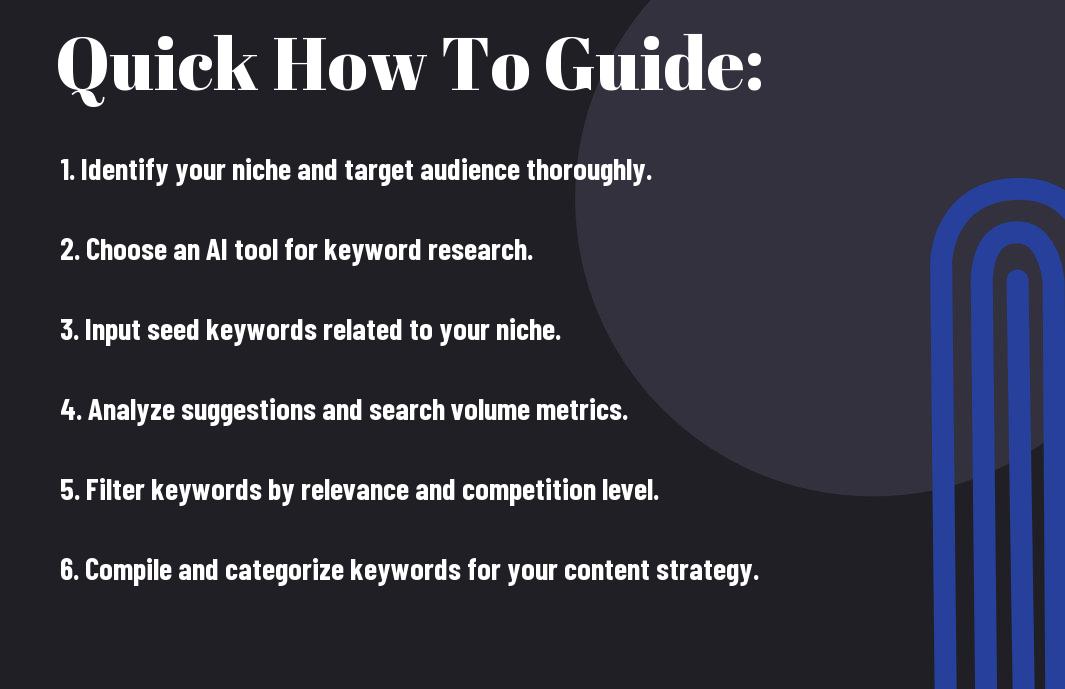

Understanding the Basics of Keyword Research
Before submerging into the world of AI-powered keyword research, it’s crucial to establish a solid understanding of what keyword research entails. Effective keyword research serves as a foundational strategy for any successful SEO campaign, guiding your content creation and ensuring that your efforts align with what your audience is searching for.
What is Keyword Research?
To put it simply, keyword research involves identifying the words and phrases that users enter into search engines when looking for information, products, or services. By understanding these keywords, you gain insights into your audience’s needs and preferences, allowing you to tailor your content accordingly. This not only enhances your likelihood of ranking higher on search engine results pages (SERPs) but also increases relevant traffic to your website.
Importance of Keywords in SEO
Understanding the role of keywords in SEO is crucial for your online visibility. Keywords act as the bridge between your content and search engine algorithms, helping search engines classify and rank your site. By selecting the right keywords, you can significantly boost your website’s chances to attract the right visitors, which ultimately translates to higher conversion rates and increased revenue.
Furthermore, keywords help you establish your niche and differentiate your content in crowded search spaces. Choosing the correct keywords allows you to reach the audience who is actively searching for what you offer, making it easier to convert leads into customers.
Different Types of Keywords
Keywords come in various types, each serving a different purpose in your SEO strategy. To optimize your keyword research, it’s important to understand these differences:
| Type of Keyword | Description |
| Short-Tail Keywords | General terms usually consisting of one or two words. |
| Long-Tail Keywords | More specific phrases often containing three or more words. |
| Geo-Targeted Keywords | Keywords that include geographical locations, increasing local visibility. |
| LSI Keywords | Latent Semantic Indexing keywords that are semantically related to your main keyword. |
| Transactional Keywords | Keywords that indicate a user’s intent to make a purchase. |
Keywords play a vital role not just in driving traffic but also in enhancing the relevance of your content. To effectively segment your keyword strategies, utilizing various types ensures that your approach is comprehensive. Each keyword type targets different aspects of user intent and behavior, which is important for a successful SEO campaign. This diversity in keyword strategies allows you to connect with a broader audience base while fulfilling specific search intents.
More on Different Types of Keywords
Keywords include not just the main search terms, but various categories that can elevate your SEO planning. While focusing on main keywords, consider variations and related terms that will also attract visitors to your page:
- Informational Keywords: Used by users seeking information or answers.
- Commercial Keywords: Indicating a buyer’s intent to purchase or compare products.
- Competitor Brand Keywords: Using brand names of competitors in your strategy.
- Question-Based Keywords: Keywords incorporating questions relevant to your industry.
- Niche-Specific Keywords: Tailored keywords that cater specifically to your niche market.
This comprehensive understanding of keyword types enables you to craft focused and impactful SEO strategies that resonate with your audience and fulfill their search needs.
How to Use AI Tools for Keyword Research
Even though traditional keyword research methods have been effective, leveraging AI tools can significantly enhance your approach by making it more efficient and data-driven. These advanced tools allow you to uncover valuable insights that you might have missed through manual processes. By harnessing the power of AI, you can identify high-traffic keywords, analyze competitors, and discover emerging trends in your niche.
Identifying Quality AI Tools
To start your journey in using AI tools for keyword research, it’s crucial to identify quality AI tools that align with your specific goals. Look for tools that offer comprehensive data analytics, user-friendly interfaces, and the ability to integrate with your existing platforms. Popular AI-driven tools like Ahrefs, SEMrush, or Ubersuggest can elevate your keyword research by providing detailed metrics, historical search data, and semantic search capabilities that reveal related keywords.
Moreover, check for user reviews and testimonials to assess the efficiency of these tools. Seek a platform that allows you to explore long-tail keywords and analyze keyword competition effectively. The right tool will provide a wealth of information that not only aids in optimizing your current content but also helps you plan your future content strategy.
Setting Up AI Tools for Optimal Use
On the technical side, setting up your chosen AI tools is vital for achieving optimal results. Start by creating an account and familiarizing yourself with the dashboard and features. Make sure to input your website information accurately to allow the tool to analyze data effectively. Additionally, input your competitors’ URLs to gain insights into their keyword strategies, which can provide you with a solid foundation for your research.
Quality configuration of these tools can drastically improve the accuracy of the keyword suggestions you receive. Regularly update your preferences, filter settings, and areas of focus in the tool to ensure that the keywords generated are relevant to your niche and audience. Daily usage and staying alert to updates from the tool will help you stay ahead in your keyword strategy.
Data Input: Providing Context to AI
One key aspect of using AI tools for keyword research involves the data input process. When configuring your settings, it’s important to provide context regarding your industry, target market, and overall content goals. This input plays a significant role in how effectively the AI tool will generate relevant keywords tailored to your needs. The more specific you can be about the subjects you’re aiming to improve, the better your results will likely be.
By fine-tuning your inputs, you can enhance the quality of the suggestions generated, ensuring they align with your business objectives. This will not only save you time but also help you direct your efforts toward content that resonates with your audience.
Identifying the right characteristics of AI tools allows you to maximize their potential. Consider whether the tools allow for customization in the input process, letting you experiment with different datasets and keyword variations. The flexibility of data input is vital in ensuring that the results you obtain from the AI tools remain relevant and impactful.

Analyzing Keywords with AI
Unlike traditional keyword research methods that largely rely on manual analysis, leveraging AI technology provides a dynamic approach to understanding how specific keywords can boost your content’s visibility. By utilising sophisticated algorithms and data-processing capabilities, AI can streamline your workflow, allowing you to focus on crafting your content while the technology handles the complex analysis of keyword potential.
Exploring Search Volume and Difficulty
The first step in your keyword analysis journey is to investigate search volume and keyword difficulty. Search volume indicates how often a keyword is searched within a specific timeframe, providing you with insights into its popularity. AI tools can aggregate data from various search engines, making it easy for you to compare the frequency of different keywords and identify trends. Meanwhile, keyword difficulty gives a sense of how competitive a keyword is, making it important for you to pinpoint which terms are worth targeting based on your current domain authority and SEO strategy.
With the help of AI, you can not only understand the current search volume trends but also forecast potential changes over time. This long-term perspective can be vital in enabling you to stay ahead of your competitors, ensuring that your keyword strategy remains effective and relevant. By focusing on keywords that are less competitive yet have a high search volume, you can position your content to attract more organic traffic with relative ease.
Understanding Competitor Analysis
Any successful keyword research strategy involves a thorough examination of your competitors. By understanding which keywords your competitors are ranking for, you can identify gaps in your own content strategy and discover new opportunities. AI tools can automate the process of analyzing competitor domains, revealing the specific keywords they are targeting effectively and their corresponding search volumes. You can then use this information to refine your own keyword lists, ensuring that you are capitalising on untapped potential.
Analyzing your competitors seriously empowers you to strategize around their weaknesses. By identifying what your competitors are doing well, you can gain insights into best practices and trends but also pinpoint areas where they might be lacking. This lets you create content that fills those gaps, targeting specific keywords that your competitors may have overlooked. With AI assisting in this analysis, you can significantly reduce the time and effort spent on manual research, allowing you to develop a more comprehensive and data-driven SEO strategy.
Using AI for Long-Tail Keywords
You should focus on long-tail keywords as they often have lower competition and can yield higher conversion rates. AI tools can help you identify these specific phrases that potential users are typing into search engines. By analyzing patterns in user search behavior, AI can reveal not only the long-tail keywords that are trending but also those that are highly relevant to your niche. This targeted approach enables you to craft focused content that meets users’ specific needs.
This strategy is particularly effective because long-tail keywords often reflect the intent behind the search. When users enter long-tail keywords, they are usually further along in the buying cycle and are seeking specific information or solutions. By leveraging AI to identify these keywords, you can tailor your content’s messaging to resonate directly with your target audience’s needs, significantly enhancing your chances of capturing valuable organic traffic.
Tips for Effective Keyword Selection
All successful keyword research hinges on selecting the right keywords that align with your content goals and audience needs. Incorporating main keywords into your strategy can significantly enhance your search performance. Here are some tips to guide you through effective keyword selection:
- Focus on high-volume keywords that attract substantial traffic.
- Include relevant long-tail keywords for niche targeting.
- Analyze the competition for your selected keywords.
- Utilize SEO tools to track keyword trends.
- Consider user intent behind a keyword search.
Recognizing the right approach to keyword selection can offer significant advantages in maximizing your content’s reach and engagement.
Balancing Short vs. Long-Tail Keywords
Now, when delving into your keyword strategy, it’s crucial to balance short-tail keywords with long-tail keywords. Short-tail keywords can drive high volumes of traffic due to their broad nature but often come with high competition levels. In contrast, long-tail keywords are more specific phrases that may not attract as much overall traffic but can yield higher conversion rates due to their targeted nature. Finding the right blend allows you to capitalize on wide search interest while also capturing specific audience needs.
In practice, using a mix of both types means you expose your content to a wider audience while ensuring you attract visitors who are likely to engage with your content. Consider starting with more short-tail keywords for brand awareness, but shift your focus on long-tail keywords that demonstrate clear intent and voice your unique value proposition.
Importance of Relevance and Intent
Importance of relevance and intent cannot be overstated when selecting your keywords. By focusing on keywords that truly resonate with your audience’s needs, you position yourself to provide valuable content. Relevance ensures that your content matches the expectations set by the keywords used, while considering user intent helps you understand why users are searching for specific terms. This synergy allows you to craft content that not only attracts traffic but also meets the needs of your visitors.
To solidify this strategy, you must conduct thorough research on your audience’s preferences and behaviors. This may involve analyzing popular queries related to your niche or employing tools that reveal user intent behind specific keywords. By doing this, you will ensure that your content is not only visible but also meaningful to your audience.
Evaluating Trends Over Time
Evaluating trends over time is important for staying ahead in your keyword strategy. Now, keeping a close eye on how certain keywords fluctuate in popularity can inform your decisions. Utilize tools like Google Trends or other SEO analytics platforms to track which keywords experience seasonal spikes or changes in user interest. By staying informed, you can tweak your content plans and capitalize on emerging trends that align with your audience’s evolving needs.
This approach helps you maintain relevance in a continuously changing digital landscape. By analyzing patterns, you can also make educated predictions about which keywords might become important in future searches, thus positioning your content to capture new audiences before your competitors do.
LongTail keywords often present untapped opportunities within your niche. By catering to specific queries, you not only enhance your chances of ranking higher but also ensure that your content is reaching an audience eager for expert insights. Understanding the importance of evaluating keyword trends will keep your content strategy fluid and responsive to the market’s needs.
Factors Influencing Keyword Effectiveness
Once again, when it comes to optimizing your content for better visibility and engagement, understanding the factors that influence keyword effectiveness is crucial. Key elements include:
- Search Engine Algorithms
- Changes in User Behavior
- Seasonal and Geographic Variations
Knowing about these factors can greatly help you in selecting the most effective keywords for your content strategy.
Search Engine Algorithms
Assuming you want to enhance your visibility online, you must consider how search engine algorithms work. These algorithms are complex formulas that determine how content is ranked in search results. They take into account various metrics such as relevance, quality of content, and user engagement. Understanding these factors will guide you in selecting the right keywords that align with what search algorithms prioritize.
Moreover, adhering to the evolving nature of search engine algorithms is crucial. Keeping your keywords updated not only improves relevance but also ensures alignment with the latest ranking criteria. As algorithms change frequently, being aware of how these alterations affect keyword effectiveness will put you at a significant advantage.
Changes in User Behavior
Keyword research also requires an understanding of how user behavior evolves over time. Changes in what users search for can greatly impact the effectiveness of your keywords. Whether it’s the increasing use of voice search or shifts in query styles, staying updated allows you to align your keyword strategy with consumer trends. You’ll need to constantly reassess which keywords are resonating with your audience.
To address the shifts in user behavior, your keyword strategy should be flexible. Being responsive to what your audience is currently looking for—whether through common phrases or emerging slang—can significantly boost your rankings. By doing detailed research into popular queries and search patterns, you can anticipate these changes and adjust your keywords accordingly.
Seasonal and Geographic Variations
One of the critical factors to consider is the seasonal and geographic variations in keyword effectiveness. For instance, various products or services may have peak search times around holidays or events, as well as specific trends that may be dominant in certain regions. Understanding these patterns will allow you to target your audience more precisely and boost engagement and conversions.
Moreover, recognizing the significance of geography in keyword performance is equally important. Certain keywords may perform well in specific regions but not in others. Adapting your keyword strategy based on local trends and cultural nuances can lead to more effective marketing efforts and better results for your content.
Variations in keyword relevance based on these factors emphasize the importance of ongoing research and adaptation. Keeping an eye on seasonal trends and local preferences will ensure that your keyword choices remain effective throughout the year.
Integrating Keywords into Your Content Strategy
For effective integration of keywords into your content strategy, you need to consider how your identified keywords align with the topics and themes of your website. By incorporating relevant keywords, you not only improve your search engine rankings but also ensure that your content resonates with your audience. This means tailoring your content to address the needs and interests of your target demographic while weaving in keywords naturally.
On-Page Optimization Techniques
Optimization is crucial in ensuring that your content is not only keyword-rich but also engaging and user-friendly. When you optimize your on-page elements such as headings, images, and internal links, you enhance your content’s visibility on search engines. Use your primary keywords in the title tags, meta descriptions, and header tags, making sure they fit seamlessly into the natural language of your content. This helps search engines understand the context of your pages and improves user experience.
Utilizing Keywords in Meta Tags and Descriptions
Techniques for utilizing keywords in meta tags and descriptions are indispensable for maximizing your content’s reach. Meta tags, including title tags and meta descriptions, serve as a preview of your content to potential visitors. Ensure that your primary keywords are included in these tags, as they are often the first thing search engines and users see. Craft compelling descriptions that not only include keywords but also encourage clicks by highlighting the value of your content. This will help improve your click-through rate.
Content should always be crafted with not just SEO in mind but also the user experience you’re providing. Clear, concise, and compelling meta descriptions that include your target keywords can significantly enhance your visibility and attract more qualified traffic to your website.
Tracking Keyword Performance
Utilizing tracking tools and analytics is crucial for measuring the performance of your keywords. By monitoring which keywords are driving traffic to your website, you can refine your content strategy to focus on those that yield the best results. Utilizing tools like Google Analytics allows you to evaluate metrics such as organic traffic, bounce rates, and conversion rates based on specific keywords. This data will guide you in optimizing and adjusting your keyword strategy, ensuring that you continue to attract and retain your audience effectively.
With regular performance reviews, you can see how your keywords perform in real-time and make data-driven decisions to improve your strategy. Consistently updating your keyword list based on trends and performance insights keeps your content relevant and boosts your overall SEO efforts.
Future of AI in Keyword Research
Despite the rapid advancements in AI technology, the future of keyword research presents exciting opportunities and potential challenges for digital marketers. As AI systems continue to evolve, they will likely become more adept at understanding context, user intent, and semantic nuances in search queries. This shift will push you as a marketer to rethink your keyword strategies and embrace innovative methods that leverage AI’s capabilities. The integration of AI into keyword research tools will enable you to identify not only high-ranking keywords but also emerging trends and niche topics that resonate with your target audience.
Emerging Trends in AI Technology
One important trend you’re likely to observe is the rise of predictive analytics in keyword research. AI algorithms are becoming increasingly proficient at analyzing vast quantities of data to forecast which keywords may rise in popularity based on current user behavior and market trends. This proactive approach can allow you to stay ahead of the competition by optimizing your content strategy around keywords even before they gain traction.
Another notable trend is the incorporation of natural language processing (NLP) in AI-driven keyword tools. As AI becomes more skilled at understanding human language, you’ll be able to generate keyword ideas that are more aligned with everyday speech and conversational queries. This enhancement is crucial, given the proliferation of voice search and the increasing demand for content that resonates with users’ intents more accurately.
Potential Changes in SEO Practices
On the horizon, changes in SEO practices influenced by AI-driven keyword research are just around the corner. As AI improves its understanding of user intent and content relevance, traditional keyword stuffing methods will likely become obsolete. Instead, you will need to focus on creating high-quality, contextually relevant content that aligns with user expectations. This evolution will require you to prioritize the value and experience you provide over mere keyword placement.
Trends indicate that optimizing for featured snippets and voice search will become necessary. As AI interfaces become more sophisticated, search engines will prioritize content that answers questions directly or fits seamlessly into users’ conversational search patterns. This shift means you must consider not only the keywords you target but also how your content can be structured to answer specific queries effectively, allowing you to capture more organic traffic and visibility.
Preparing for the Future of Keyword Research
Research indicates that to prepare for the future of keyword research, embracing continuous learning and adapting to AI tools will be pivotal. You should familiarize yourself with the latest AI-driven keyword research platforms and understand their features. Being proactive in honing your skills will allow you to utilize these tools effectively, ensuring you can adapt to fast-changing landscapes in both keyword selection and content creation.
With a deeper understanding of AI’s evolving capabilities, you can position yourself as a forward-thinking marketer. By embracing these advancements and being open to experimentation, you will not only enhance your keyword research capabilities but also set yourself on a path to greater success in the competitive digital landscape. The future of keyword research is bright, and being prepared will give you the edge you need to navigate it successfully.
Final Words
To wrap up your journey into using AI for keyword research, it’s important to recognize that harnessing this technology can significantly enhance your SEO strategy. By utilizing AI tools, you can efficiently uncover high-potential keywords that align with your target audience’s search intent. Moreover, these tools can analyze competition and search trends, enabling you to refine your content strategy and gain a competitive edge in your niche. Keep in mind, the data-driven insights provided by AI can help you produce content that not only ranks well but also resonates with your audience.
As you implement these AI techniques in your keyword research, remain agile and adaptable. The landscape of search engine optimization is continually evolving, and staying updated with the latest AI advancements will ensure your strategies remain effective. Give yourself the advantage of technological innovation, and feel empowered to take your keyword research to new heights. By combining your creativity and AI’s analytical prowess, you can create optimized content that drives traffic and captivates your audience.
Comments