

This guide will empower you to enhance your SEO strategies with the integration of AI technology. You’ll discover ten impactful guide-style headlines that not only grab attention but also provide practical insights into using AI for your search engine optimization efforts. By incorporating the keywords “how-to,” you’ll ensure your content ranks higher in search results, ultimately driving more traffic to your site. Let’s dive in and elevate your online presence today!
Key Takeaways:
- Guide-style headlines can effectively capture the audience’s attention, especially when focused on AI for SEO.
- Incorporating how-to keywords in headlines enhances relevance and searchability in SEO content.
- Utilizing numbers, such as ’10’, in a headline adds a sense of structure and clarity, making the content approachable.
- AI-driven SEO strategies can significantly optimize online content and improve visibility.
- Crafting headlines with actionable insights ensures that readers know they will gain valuable knowledge from the article.
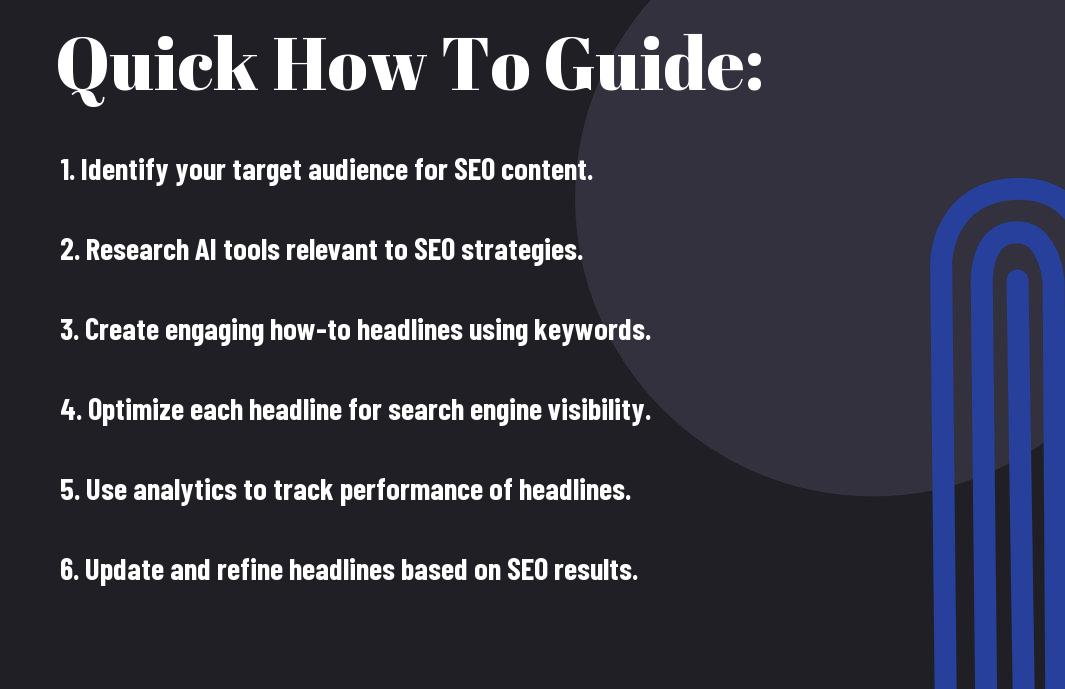
Understanding AI in SEO
While the landscape of digital marketing continues to evolve, artificial intelligence (AI) has emerged as a transformative force, reshaping how businesses approach search engine optimization (SEO). You may wonder how AI fits into this equation and what implications it holds for your SEO strategies. In simple terms, AI refers to the simulation of human intelligence processes by machines, especially computer systems. This includes learning, reasoning, and self-correction. In SEO, AI can analyze vast amounts of data to identify patterns and trends, helping businesses optimize their website content and structure to align with search engine algorithms.
While implementing AI might seem like a daunting task, it actually provides valuable insights that can enhance your SEO efforts. For instance, AI tools can help you predict user behavior by analyzing browsing habits, ensuring that your content is tailored to meet the needs of your audience. Additionally, AI-driven algorithms can enhance user experience through personalized content recommendations, thus increasing engagement and boosting your rankings in search results.
The Importance of SEO in Digital Marketing
With the rapid advancement of technology, it’s crucial for you to understand that SEO is no longer just a luxury but a necessity in digital marketing. A solid SEO strategy allows your business to appear prominently in search engine results, making it easier for potential customers to find you. As the online marketplace grows more competitive, incorporating effective SEO tactics helps you outshine your competitors, driving more organic traffic to your site. You should also be aware that consumers often trust organic search results over paid ads, enhancing your credibility and authority.
Understanding the importance of SEO in digital marketing means recognizing its role in building brand awareness and increasing conversion rates. As you optimize your website for search engines, your visibility improves, effectively attracting relevant traffic that is more likely to convert into leads or sales. Thus, establishing a robust SEO framework is necessary for long-term growth and success in the digital landscape.
How to Leverage AI Tools for SEO
It is crucial for modern businesses to harness the power of AI tools for effective SEO strategies. Leveraging these tools can not only enhance your online visibility but also help you stay ahead of competitors. With the right approach, you can use AI to optimize your content, analyze user behavior, and even automate some of your SEO processes, ultimately leading to increased traffic and conversions.
Choosing the Right AI Tools for Your Needs
Little can be achieved without selecting the right AI tools tailored to your specific SEO needs. First, consider the type of SEO activities you are focusing on—are you prioritizing content creation, keyword research, or backlink analysis? Once you have narrowed down your focus, look for tools that specialize in those areas. You also want to think about your budget and the scalability of the tool as your needs evolve.
Furthermore, the usability of the tool matters greatly. You should choose tools that fit into your workflow easily and are intuitive to use. Reading reviews and possibly taking advantage of free trials can give you insight into how effective the tool will be for your specific circumstances.
Step-by-Step Guide to Implementing AI in SEO
Tools can greatly streamline your SEO efforts, but implementing them requires a structured approach. Here’s a step-by-step guide:
| Step | Action |
| 1 | Identify your SEO goals and challenges. |
| 2 | Research and select the appropriate AI tools. |
| 3 | Integrate the AI tools into your existing workflow. |
| 4 | Train your team on how to use these tools effectively. |
| 5 | Monitor the performance and make necessary adjustments. |
To maximize the effectiveness of your AI tools, continuously analyze the data they provide. Many tools offer dashboards that showcase key performance indicators. Regularly assessing this data will allow you to make informed decisions about your SEO strategy. This attention to detail will also help you catch any potential issues before they escalate.
| Action | Benefits |
| Regular SEO audits | Detect and remedy issues promptly. |
| Performance tracking | Understand what strategies are working. |
| Feedback loops | Continuously improve your approach. |
By carefully choosing the right tools and following a systematic implementation guide, you can leverage AI effectively to improve your SEO efforts. This can lead to significant gains in your website’s visibility and user engagement, ultimately driving sales and growth for your business.
Essential Tips for Optimizing Content with AI
Once again, leveraging AI for SEO can significantly enhance your content optimization efforts. Here are some crucial tips to keep in mind as you refine your approach:
- Utilize AI tools to analyze and improve your keywords.
- Incorporate trending topics to stay relevant.
- Focus on long-tail keywords for better targeting.
- Use AI-driven content analyzers for readability and engagement.
- Prioritize user intent when creating content.
The effective deployment of these strategies can lead to improved search engine rankings and higher engagement rates.
Creating Keyword-Rich Content
There’s a growing need for you to focus on creating content that is not only engaging but also rich in keywords. With the use of AI, you can identify which keywords your target audience is searching for the most. This means analyzing search behavior and preferences, which can guide you in crafting content that resonates with your audience. In addition, make use of AI tools that suggest related keywords and phrases to broaden your content’s reach.
As you develop your content, remember to include both primary and secondary keywords naturally. The goal is to enhance your content’s relevance while ensuring it remains readable. Overstuffing your content with keywords can lead to penalties from search engines, so balance is key.
Using AI for Trend Analysis
Analysis indicates that staying updated on market trends is crucial for your content strategy. AI can significantly aid this process by providing insights into emerging topics and shifting audience preferences. You can use machine learning algorithms to scan social media, forums, and websites to identify what is currently popular in your niche. This allows you to create timely and relevant content that aligns with your audience’s interests.
When utilizing AI for trend analysis, you should consider the historical data that the algorithms provide. This allows you to spot patterns and predict future trends. AI tools can highlight positive trends that you should capitalize on, as well as potential risks associated with certain topics, ensuring that your content remains both relevant and safe for your brand.
Using AI to stay informed about industry trends not only empowers your content creation but also positions you as a thought leader in your niche. As you harness the power of AI for trend analysis, you’ll gain valuable insights that enhance your overall content strategy.

Key Factors to Consider When Integrating AI in SEO
Your journey towards integrating AI into your SEO strategy involves several important factors that can significantly influence your outcomes. By focusing on these key areas, you can enhance performance, increase efficiency, and ensure that your initiatives align with your overarching goals. Here are some imperative considerations:
- Data Quality: The foundation of effective AI applications.
- Automation vs. Human Insight: Striking the right balance is crucial.
- User Experience: Prioritize customer satisfaction alongside SEO
- Continual Learning: Embrace a culture of adaptability.
- Ethical Considerations: Maintain transparency and integrity.
Assume that each of these factors plays a pivotal role in shaping your SEO landscape; understanding their nuances can lead to better decision-making and successful results.
The Role of Data Quality in AI Success
Role of data quality in the implementation of AI in SEO cannot be overstated. High-quality data acts as the backbone upon which AI algorithms operate. Inaccurate or outdated data can lead to biased conclusions and poor SEO strategies, ultimately jeopardizing your ability to compete effectively in the market. To ensure success, it’s imperative to conduct regular audits of your data sources and maintain a high standard of information integrity.
Furthermore, investing in proper data management tools and practices not only enhances the quality of your input data but also facilitates better machine learning outcomes. When your data is accurate and comprehensive, AI can more effectively analyze user behavior, predict trends, and optimize your content; this leads to improved rankings in search engines and more satisfied users.
Balancing AI Automation with Human Insight
There’s a fine line between relying heavily on AI automation for SEO tasks and incorporating valuable human insight into the decision-making process. While AI tools can handle massive datasets and perform complex analyses at lightning speed, they might lack the contextual understanding that comes from human experience. This insight can be particularly critical when evaluating algorithms for content creation or adjust marketing strategies based on nuanced user interactions.
Another aspect to consider is the inherent danger of over-automation, which could lead to complacency and a loss of the human touch in your marketing efforts. Conversely, fully dismissing the power of AI could leave you behind in a rapidly evolving digital landscape. The key lies in blending AI capabilities with your unique insights to create a robust SEO strategy that leverages both the efficiency of technology and the intuition of human creativity. This balanced approach ensures that your SEO efforts are both data-driven and contextually relevant, leading to sustainable growth and success.
How to Conduct an AI-Powered SEO Audit
Not many people realize the profound impact that an AI-powered SEO audit can have on your website’s performance. This process can unveil hidden insights that traditional methods may overlook, helping you optimize your content and improve your online visibility. In this guide, we will walk you through the crucial steps of conducting a comprehensive SEO audit using the power of AI tools.
Tools Needed for an Effective Audit
An effective audit begins with the right tools that leverage AI technology. First, you will need an advanced analytics platform, such as SEMrush or Ahrefs, which can analyze your website’s backlink profile, keyword rankings, and overall SEO health. These tools utilize AI algorithms to provide valuable insights and automate the data collection process, making it easier for you to interpret results.
In addition to analytics platforms, consider using an AI-powered content optimization tool like Surfer SEO or Clearscope. These tools help you refine your content based on real-time data and competitive analysis, ensuring that your site resonates well with search engines. Together, these tools create a comprehensive toolkit to set the foundation for your audit.
Interpreting Audit Results and Making Adjustments
If you’re unsure about how to interpret the results from your AI-powered audit, start by identifying key performance indicators (KPIs) that matter most to your site’s goals. Look for patterns in your data that reveal strengths and weaknesses. For example, notice which keywords are driving the most traffic and which pages have high bounce rates. These insights will guide you in refining your content and enhancing your overall strategy.
Once you’ve gathered and analyzed your audit results, it’s crucial to make actionable adjustments. Your findings may indicate that some of your pages require better optimization for specific keywords or that certain backlinks need to be disavowed. Take immediate action on these insights to improve your site’s performance. Be mindful of, neglecting the results can lead to lost traffic or decreased visibility, so ensure that you continually update and refine your SEO strategies.
It’s important to stay proactive in your approach. Adjustments made after interpreting your audit results should be an ongoing process, not a one-off task. Regularly revisit your strategies and continue to leverage AI tools for continuous improvement. Embrace the insights provided by AI to remain competitive and ensure that your efforts yield a positive impact on your website’s SEO performance.

Advanced Techniques Using AI for SEO
Many businesses are leveraging advanced techniques that utilize AI for SEO to enhance their online presence and improve search rankings. By integrating these innovative approaches, you can take your SEO strategies to the next level. Here are some advanced techniques that can significantly impact your SEO effectiveness:
- Utilizing AI-powered keyword research tools
- Implementing predictive analytics in your SEO strategies
- Enhancing user experience through AI insights
- Automating on-page SEO optimizations
- Analyzing competitor strategies using AI
- Optimizing content with natural language processing
- Improving link-building tactics through AI analysis
- Implementing AI chatbots for customer engagement
- Utilizing AI for local SEO
- Tracking and analyzing SEO data with AI algorithms
| Technique | Description |
|---|---|
| Predictive Analytics in SEO | Utilizing AI to forecast trends and user behavior to optimize content strategy. |
| Enhancing User Experience through AI Insights | Leveraging user data and behavior analysis to improve website interactions. |
Predictive Analytics in SEO Strategies
One of the most powerful applications of AI in SEO is predictive analytics. By analyzing historical data, you can identify patterns that allow you to anticipate future trends and changes in user behavior. This means you can create content that aligns with what your audience is searching for before they even start looking. For instance, AI algorithms can process vast datasets to determine emerging topics in your industry, making it easier for you to stay ahead of the competition.
Additionally, predictive analytics can assist you in adjusting your SEO strategy based on forecasted market shifts. For example, if predictions suggest a decline in demand for a specific topic, you can pivot your content focus to more relevant, high-demand areas. This proactive approach not only saves you time but also enhances your overall online presence and authority.
Enhancing User Experience through AI Insights
One of the cornerstones of effective SEO is delivering a superior user experience. AI tools can provide critical insights into user behavior, preferences, and pain points, enabling you to tailor your website to meet users’ needs better. By analyzing heatmaps, click patterns, and dwell times, you gain a deeper understanding of how users interact with your content, leading to optimized layouts and paths that engage visitors more effectively.
Using AI insights means you can constantly refine your content and site architecture to ensure maximum engagement. This adaptability keeps your audience interested and encourages them to spend more time on your website, which can significantly boost your SEO performance. Moreover, a user-centric approach is likely to result in higher conversion rates, as potential customers find value in their experience on your site.
Techniques for enhancing user experience through AI insights are ever-evolving, and it’s important that you stay updated on the latest tools and practices. By regularly incorporating these insights into your SEO strategy, you can ensure that your website not only ranks well but also resonates with your audience, leading to increased traffic and better business outcomes.
Future of AI in SEO
Now, as we look to the horizon, it’s clear that the future of AI in SEO is poised for significant transformation. Artificial intelligence continues to evolve rapidly, shaping not only how search engines understand content but also how you optimize your digital presence. Understanding the emerging trends that AI will usher in will empower you to stay ahead of the curve and maximize your online visibility.
Emerging Trends to Watch
Little do many realize, AI is not just about algorithm updates; it’s also about transforming the content creation and curation process. For example, advancements in natural language processing (NLP) are making AI tools more adept at understanding context and user intent. This means that your content must be more nuanced, focusing on delivering real value to the reader rather than just ticking off SEO checkboxes. Additionally, expect to see AI-powered tools that assist in real-time optimization based on continually evolving user behaviors.
Furthermore, as personalization becomes increasingly critical, AI-driven technologies will enable you to create content tailored to user preferences and search behaviors at a granular level. This move toward hyper-personalization will not only enhance user experience but also lead to improved engagement metrics, which search engines are beginning to prioritize more heavily in their ranking decisions.
Preparing for Changes in SEO Algorithms
Future-proofing your SEO strategies against the backdrop of shifting algorithms is paramount. As the landscape continues to evolve, making informed choices now can set you apart from the competition. AI algorithms are growing more sophisticated in their ability to sift through large volumes of data and understand patterns, which might lead to a change in how ranking is determined. By staying updated with the latest AI developments, you can adapt your strategies proactively.
It’s imperative to recognize that the SEO algorithms are becoming increasingly influenced by AI, which can lead to some dangerous pitfalls if you’re unprepared. For instance, relying too heavily on outdated practices can result in diminished visibility and traffic. Conversely, a positive shift towards embracing AI means that if you leverage data effectively, you can optimize your content strategy for long-term success. Keep yourself informed and agile to embrace these innovations, and you’ll likely find your performance elevating in the search rankings.
Final Words
So, as you navigate the ever-evolving world of AI for SEO, incorporating effective guide-style headlines into your strategy is indispensable. Utilizing the keywords “how-to” can significantly enhance your content’s visibility, allowing you to attract a broader audience eager for actionable insights. By focusing on creating valuable and targeted content, you empower your digital presence and attract users seeking practical advice on leveraging AI tools for their SEO efforts. Remember that engaging titles are the first step in drawing your audience in; the substance of your content will keep them coming back for more.
Moreover, by consistently delivering how-to guides that address various facets of AI in SEO, you not only position yourself as an authority in the field but also foster trust among your readers. This dynamic approach will ultimately support your objectives, whether you’re aiming for higher traffic, improved rankings, or greater user engagement. Embrace the opportunity to educate your audience, and you’ll find that your efforts will yield significant dividends in both performance and reputation.
Comments