

Most individuals often underestimate the potential of generative AI and its impact on various industries. In this guide, we will research into the key strategies to optimize generative AI for success. By understanding the fundamentals and implementing best practices, you can harness the power of generative AI to drive innovation and business growth. Let’s unlock the full potential of this game-changing technology together.
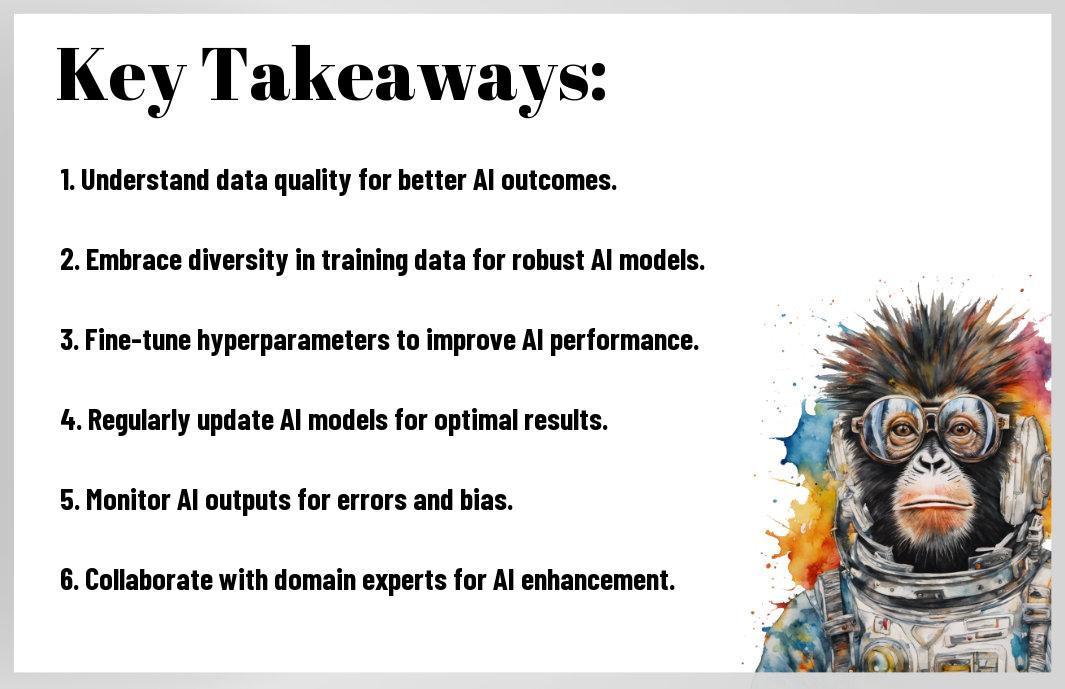
Key Takeaways:
- Understand the Basics: For success in harnessing the power of generative AI, it is crucial to have a strong grasp of the fundamental concepts and processes involved in this technology.
- Optimize Training Data: The quality and quantity of training data play a significant role in the performance of generative AI models. Ensuring diverse, relevant, and clean datasets can greatly enhance the outcomes.
- Fine-Tune Parameters: Adjusting and fine-tuning the parameters of generative AI models can lead to improved accuracy, efficiency, and desired outcomes. Experimenting with different settings can help optimize performance for specific tasks.
Laying the Foundation
Defining Generative AI and Its Potential
One crucial step in optimizing Generative AI is to understand its capabilities and potential. Generative AI refers to technology that can create new data, such as images, text, or even music, based on patterns it has learned from existing data. This technology has the power to revolutionize various industries, from art and design to healthcare and finance. By leveraging Generative AI, businesses can automate tasks, enhance creativity, and even discover new solutions to complex problems.
Setting Clear Goals for AI Optimization
The key to successfully optimizing Generative AI lies in setting clear and achievable goals from the outset. It is important to define what success looks like for your AI implementation, whether it’s improving efficiency, driving innovation, or enhancing customer experience. By establishing specific metrics and objectives, you can effectively measure the impact of your AI initiatives and make informed decisions to drive further optimization.
It is crucial to involve stakeholders from various departments in this goal-setting process to ensure alignment and buy-in. By fostering a shared understanding of the goals and benefits of AI optimization, you can create a roadmap for success that is supported across the organization.

Choosing the Right Tools
Now that you’ve decided to harness the power of generative AI, it’s imperative to choose the right tools to optimize your success. Selecting the appropriate generative AI model is crucial in achieving your desired outcomes.
Overview of Popular Generative AI Models
To begin, let’s take a look at an overview of popular generative AI models. Some of the most widely used models include GPT-3, OpenAI’s DALL-E, and DeepMind’s AlphaFold. Each of these models has its strengths and weaknesses, so understanding their capabilities is key to selecting the best one for your specific needs.
Selecting the Best Model for Your Needs
Your choice of generative AI model should be driven by the nature of the task at hand. Consider factors such as the complexity of the data, the desired output format, and the level of control you need over the generated content. A thorough evaluation of these factors will help you narrow down the options and select the model that aligns best with your objectives.
A careful analysis of your project requirements is imperative to ensure that you are choosing the right generative AI model. By understanding the nuances of each model and how they align with your goals, you can set yourself up for success in leveraging the power of AI for your projects.
Evaluating Model Performance Metrics
Performance metrics are crucial in assessing the effectiveness of a generative AI model. Metrics such as perplexity, BLEU score, and F1 score can provide valuable insights into the model’s performance in generating accurate and coherent outputs. Evaluating these metrics will help you determine which model is best suited for your specific use case.
Right tools to optimize generative AI are not only important but necessary for achieving success in your projects. By carefully selecting the best model for your needs and evaluating its performance metrics, you can ensure that you are on the right track towards harnessing the full potential of generative AI technology.
Data Preparation and Quality
All How to harness the power of generative AI for better jobs begins with data. Concerning optimizing generative AI for success, data preparation and quality are paramount. Poor quality data can lead to inaccurate models and flawed outcomes. Therefore, ensuring the data used for training is of high quality is vital for the success of generative AI applications.
The Importance of High-Quality Training Data
To achieve optimal results with generative AI, the quality of the training data must be prioritized. High-quality data sets are crucial for the model to learn effectively and generate accurate outputs. Investing time and effort into curating and cleaning the data will ultimately pay off in the form of more reliable and precise AI-generated content.
Data Preprocessing Techniques for AI Optimization
Preparation is key to unlocking the full potential of generative AI. Data preprocessing techniques such as normalization, feature scaling, and data augmentation are vital for optimizing AI models. These techniques help in standardizing the data, making it more suitable for the AI algorithms to process efficiently.
For instance, normalization can help scale the input features to a uniform range, preventing certain features from dominating the training process. By applying these preprocessing techniques, AI models can produce more accurate and consistent results.
Strategies for Data Augmentation and Enrichment
Quality data augmentation and enrichment are key strategies for improving the performance of generative AI models. By augmenting existing data sets with variations and enriching them with additional relevant information, AI models can become more robust and versatile in their outputs.
Data augmentation techniques such as rotation, flipping, or adding noise to images can help diversify the training data set, leading to a more robust model that can handle a wider range of inputs and scenarios.
Overall, prioritizing data quality, preprocessing, and augmentation are vital steps in optimizing generative AI for success. By focusing on these aspects, businesses and organizations can harness the full potential of AI technology and drive innovation in various fields.
Fine-Tuning and Hyperparameter Optimization
Introduction to Hyperparameter Tuning
Not all AI models are created equal. While the architecture of a generative AI model plays a crucial role in its performance, hyperparameters are equally important. Hyperparameters are the configuration settings that dictate how the model learns and the final output it produces. One of the key challenges in training generative AI models is finding the optimal set of hyperparameters that maximize performance.
Techniques for Fine-Tuning Generative AI Models
For generative AI models, fine-tuning is the process of adjusting hyperparameters to improve model performance. Techniques such as grid search, random search, and Bayesian optimization can be employed to systematically explore the hyperparameter space and find the best configuration for a given dataset and model architecture. Fine-tuning is a crucial step in the training process that can significantly impact the quality of the generated output.
The key to successful fine-tuning lies in the balance between exploration and exploitation of the hyperparameter space. By carefully selecting the hyperparameters to tune and leveraging techniques that efficiently search the space, developers can achieve optimal model performance. Fine-tuning is an iterative process that requires experimentation and analysis to understand how each hyperparameter affects the model’s output.
Best Practices for Hyperparameter Search
Search For hyperparameter optimization to be successful, developers must adhere to best practices that ensure efficient and effective search strategies. Some of the key best practices include setting appropriate search boundaries, logging and tracking experiments, and leveraging parallel processing to speed up the search process. By following these best practices, developers can streamline the hyperparameter search process and improve the overall performance of generative AI models.
FineTuning Hyperparameter optimization and fine-tuning are critical components in the success of generative AI models. By carefully selecting hyperparameters, utilizing efficient search techniques, and following best practices, developers can unlock the full potential of their models and achieve superior performance in generating high-quality outputs. The iterative nature of hyperparameter optimization requires patience and persistence, but the rewards of fine-tuning a generative AI model for success are well worth the effort.

Overcoming Common Challenges
Addressing Mode Collapse and Lack of Diversity
To address the challenges of mode collapse and lack of diversity in generative AI models, companies must focus on strategies that promote HARNESSING GENERATIVE AI FOR UNPRECEDENTED…. An important approach is to incorporate techniques like ensembling multiple models and using regularization methods to encourage diversity in generated outputs. By leveraging conditional training and exploring novel architectures, organizations can mitigate these issues and enhance the overall quality of AI-generated content.
Mitigating Bias in Generative AI Models
To diversify generative AI models and reduce bias, it is crucial to implement fairness measures and ethics guidelines in the development process. Companies can utilize data augmentation techniques, demographic parity constraints, and interpretability tools to ensure that AI systems produce inclusive and equitable outputs. By fostering diversity in training data and incorporating multistakeholder perspectives, organizations can build more responsible and unbiased AI models.
Collapse: When mode collapse occurs in generative AI models, it leads to the production of repetitive or limited variations in generated content, reducing the overall quality and diversity of outputs. Mode collapse can hinder the effectiveness of AI applications and limit their ability to generate novel and realistic content.
Handling Out-of-Domain Inputs and Edge Cases
For organizations to effectively handle out-of-domain inputs and edge cases in generative AI models, it is important to diversify training data and incorporate robust testing procedures. By employing anomaly detection techniques and transfer learning strategies, companies can enhance the generalization capabilities of AI models and improve their performance across diverse input scenarios.
Scaling and Deploying Generative AI
Once again, after developing and fine-tuning your generative AI models, the next crucial step is scaling and deploying them effectively in real-world applications. This process involves ensuring that your models can handle larger datasets, more complex tasks, and increased demands for outputs.
Strategies for Scaling Generative AI Models
One of the key strategies for scaling generative AI models is leveraging distributed computing resources such as cloud platforms to train and deploy models more efficiently. By distributing the workload across multiple nodes, you can significantly reduce training times and handle larger datasets with ease. Additionally, optimizing your algorithms and architecture for parallel processing can help improve performance and scalability.
Deploying AI Models in Real-World Applications
Strategies for deploying AI models in real-world applications involve considerations such as choosing the right deployment environment, monitoring model performance, and ensuring seamless integration with existing systems. It’s necessary to test your models thoroughly in different scenarios to ensure they perform accurately and reliably before deployment.
One critical aspect of deploying AI models in real-world applications is the need for continuous monitoring and updates to ensure optimal performance and adaptability to changing conditions. Leveraging automated monitoring systems and feedback loops can help identify issues early on and facilitate timely adjustments to prevent disruptions in operations.
Ensuring Model Explainability and Transparency
Scaling generative AI models also requires ensuring model explainability and transparency, especially in sensitive applications such as healthcare or finance. By implementing techniques such as feature visualization, attention mechanisms, and model interpretability tools, you can provide insights into how your models make decisions and enhance trust among users and stakeholders.
Ensuring model explainability and transparency is crucial for gaining regulatory approval, building user confidence, and addressing potential biases or ethical concerns in AI systems. By prioritizing transparency and interpretability in your AI development process, you can mitigate risks and foster responsible AI deployment in real-world applications.
RealWorld scenarios and applications require not only high performance but also accountability and ethical considerations when deploying generative AI models. Ensuring transparency and explainability is necessary for building trust and confidence in AI technologies among users and stakeholders.
To wrap up
Presently, after exploring the intricacies of optimizing generative AI for success, it is evident that employing these advanced technologies can revolutionize various industries. By following the comprehensive guide provided in this article, individuals and organizations can harness the power of generative AI to unlock new opportunities and achieve remarkable results.
Embracing innovation and staying abreast of the latest developments in AI will be crucial for those looking to remain competitive in a rapidly evolving landscape. With the right strategies and a commitment to continuous learning, anyone can leverage generative AI for success and unlock its full potential in today’s dynamic world.
FAQ
Q: What is Generative AI?
A: Generative AI refers to a type of artificial intelligence that produces new content, such as images, text, or music, by learning patterns from existing data.
Q: How can Generative AI be harnessed for success?
A: Generative AI can be optimized for success by training it on high-quality data, fine-tuning the model parameters, and implementing effective evaluation techniques to ensure the generated content meets desired criteria.
Q: What are some key strategies for optimizing Generative AI?
A: Some key strategies for optimizing Generative AI include regular model maintenance, monitoring for bias in the generated content, and leveraging human feedback to improve the quality of the AI outputs.
Comments