

Just when you thought you had exhausted all avenues for creative inspiration, ChatGPT can provide unexpected insights that breathe new life into your writing projects. From overcoming writer’s block to generating unconventional plot twists, this AI tool offers unique perspectives that can enhance your storytelling. You may find it particularly useful in scenarios like experimenting with dialogue, initiating brainstorming sessions, or even creating character backstories on a whim. By leveraging ChatGPT’s capabilities, you can discover innovative strategies that elevate your creative process and enrich your writing journey.

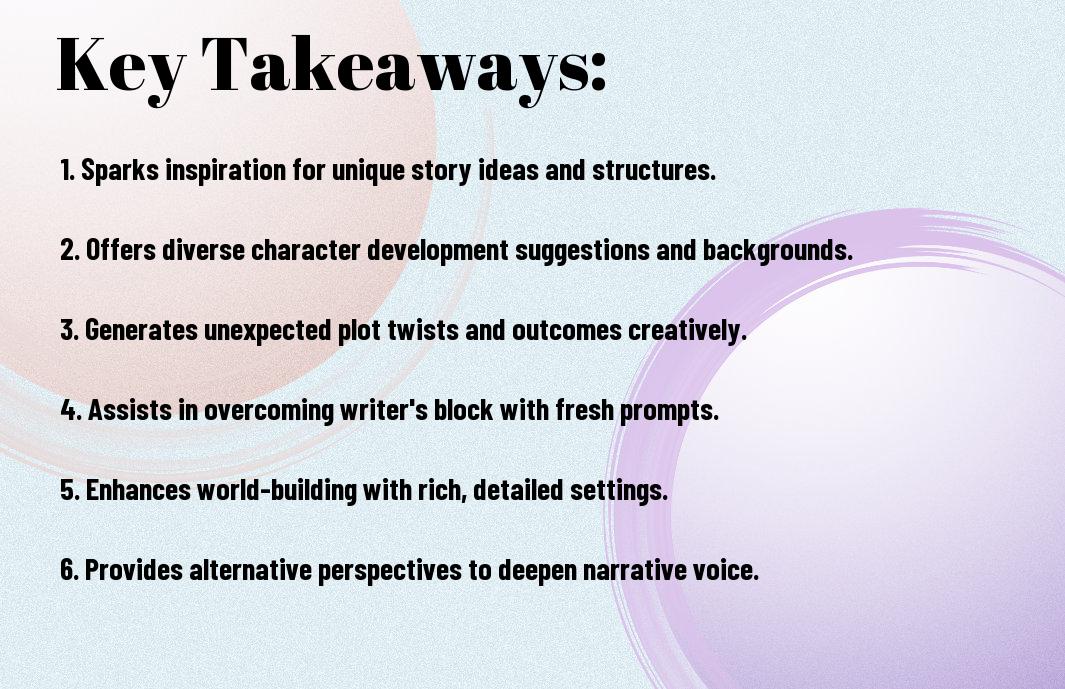
Key Takeaways:
- Brainstorming: ChatGPT can help generate unique ideas and prompts for writers facing a creative block, enabling them to explore new directions in their storytelling.
- Character Development: The model can assist in crafting detailed character backgrounds, personality traits, and arcs, thereby enhancing the depth of characters in a narrative.
- Dialogue Creation: By providing examples of realistic dialogues, ChatGPT can help writers improve their dialogue-writing skills, making interactions between characters more engaging.
- Genre Exploration: ChatGPT can suggest unconventional plots and styles for different genres, encouraging writers to step outside their comfort zones and experiment with new formats.
- Editing Suggestions: The AI can offer constructive feedback and pinpoint areas for improvement, helping writers refine their work and enhance the overall quality of their writing.
Understanding ChatGPT and Its Capabilities
While you explore the world of creative writing, it’s important to understand the tools at your disposal. One such tool is ChatGPT, an advanced language model that can assist you in various aspects of writing, from generating ideas to refining drafts. It learns from vast amounts of text data, allowing it to generate coherent and contextually relevant responses. By leveraging its capabilities, you can enhance your creative process in unique ways that may not have previously been possible.
Overview of ChatGPT
Behind the scenes, ChatGPT operates on the principles of deep learning and natural language processing, enabling it to generate human-like text based on prompts you provide. Its design allows it to understand context, emulate various writing styles, and produce text that aligns with different tones and themes. This flexibility not only makes it a versatile assistant but also opens up possibilities for experimentation in your stories, poems, or any other form of writing you undertake.
The Technology Behind ChatGPT
An integral aspect of ChatGPT is its use of transformer architecture, which processes text in a way that captures the relationships between words and phrases across extensive contexts. This technology allows the model to create nuanced responses, responding intelligently to your queries while maintaining a flow that feels natural. Additionally, training on diverse datasets equips ChatGPT with knowledge spanning multiple subjects, granting you a wealth of information that you can incorporate into your creative endeavors.
Plus, it’s important to note that while ChatGPT can generate engaging content, it does so by predicting the next word in a sequence based on the patterns it has learned. This generates imaginative text but does not mean it has actual understanding, opinions, or experiences. As such, you play a vital role in guiding its output, whether that involves steering the conversation, asking specific questions, or providing detailed prompts to achieve the results you desire.
Limits and Ethical Considerations
Behind the capabilities of ChatGPT lie important limits and ethical considerations. While it may appear to provide insightful content, the potential for generating misinformation is a real concern. The model does not have the ability to fact-check or verify the information it provides, which means it is up to you to critically evaluate and confirm any claims made within the generated text. Additionally, relying too heavily on AI for your creative writing can dilute your unique voice and style, leading to homogenized outputs that may not resonate with your audience.
Overview of the ethical considerations involves understanding the implications of using AI-generated content. You should be aware of the possibility of plagiarism or intellectual property issues when utilizing text generated by models like ChatGPT. It’s paramount to attribute ideas appropriately and ensure your work remains distinctively yours. By maintaining an awareness of these factors, you’ll be better positioned to use ChatGPT as a complementary tool to your writing process while safeguarding your creative integrity.
Creative Writing: An Overview
If you are delving into the world of creative writing, it’s necessary to first grasp its definition and importance.
Definition and Importance of Creative Writing
Along with other forms of writing, creative writing emphasizes artistic expression and imagination. It allows you to convey your thoughts, feelings, and stories through a variety of styles and formats, including poetry, short stories, and novels. This unique form of writing goes beyond mere technical skill; it’s about connecting with your audience on an emotional level and inviting them into your imaginative realm.
Moreover, creative writing is important because it enhances your communication skills and enables you to explore themes and provoke thoughts in ways that factual writing cannot. Engaging in creative writing can lead to personal growth, self-discovery, and a deeper understanding of human experiences, allowing you to see the world through different lenses.
Key Elements of Creative Writing
About the key elements of creative writing, there are several components that define this genre. These include character development, plot structure, setting, and theme. Each element plays a significant role in crafting your narrative, and understanding how to skillfully integrate them can lead to more compelling and memorable stories.
But, it’s not just about knowing these elements theoretically; you need to practice weaving them together harmoniously. Characters must be relatable and well-developed, driving the story forward and enabling readers to connect on a personal level. The plot should be engaging, with a structured arc—an introduction, escalating conflict, climax, and resolution—that keeps your audience invested.
Genres and Styles in Creative Writing
Around the landscape of creative writing, you will find numerous genres and styles that allow for vast exploration of concepts and themes. From fiction and non-fiction to fantasy and memoir, the possibilities are endless. This richness not only sparks your imagination but also encourages you to experiment with your voice and approach to storytelling.
Creative writing encompasses an array of styles, such as lyrical prose, satirical writing, and stream-of-consciousness techniques, each with its distinct characteristics and appeals. By engaging with these genres and styles, you can refine your ability to express complex ideas in relatable ways while tapping into the emotions and interests of your readers.
Creative writing, in essence, is a powerful tool that allows you to explore and convey the depths of the human experience. It invites you to innovate and think outside the box, ensuring your stories resonate long after they are read.
Enhancing Character Development Through ChatGPT
Unlike traditional methods of character development that often rely solely on your imagination, ChatGPT can engage with you in a dynamic dialogue that elevates your characters to new heights. By leveraging its advanced language processing capabilities, you can brainstorm unique character traits, quirks, and backgrounds that might not come to mind during your writing process. This collaborative effort enables you to explore various angles of character construction, helping you forge multi-dimensional characters who resonate with readers on multiple levels.
Creating Multi-dimensional Characters
ChatGPT allows you to experiment with different personalities and life experiences when crafting your characters. You might start with a basic archetype, but through interaction with the AI, you can adjust and refine your character’s motivations, fears, and desires. This interaction serves as a powerful tool for imbuing your characters with a depth that makes them feel authentic and relatable. For instance, by entering a character’s background, you can uncover their specific motivations and conflicts, paving the way for richer narratives.
Dialogue Generation for Authentic Voices
Before getting too invested in your character’s storyline, you should consider how they express themselves. The dialogue you create needs to sound authentic to who your characters are. ChatGPT can help in this area by generating realistic conversations that reflect a character’s personality, social background, and emotional state. By providing your AI with context—such as the character’s age, background, and current emotional landscape—you can refine your dialogue until it truly mirrors the unique voice of each character.
In addition, ChatGPT can simulate conversations between characters, allowing you to test how well their voices mesh and whether their interactions feel organic. You can iterate on these dialogues based on the suggestions provided, fine-tuning until you achieve the right balance of authenticity and creativity. This not only enhances the quality of your writing but also ensures that the dialogue aligns sharply with the character’s development throughout the plot.
Exploring Backstory and Motivations
Development of your characters goes hand-in-hand with understanding their backstory and motivations. By utilizing ChatGPT, you can probe into the unseen layers of your characters’ histories that contribute to their present actions and decisions. This technology allows you to generate ideas about what events shaped their personalities and how past experiences inform their challenges in the narrative.
Even small details matter in character development. ChatGPT can help you explore nuances such as a character’s childhood experiences, pivotal moments of change, or significant relationships that shaped their worldviews. This exploration not only fosters empathy for your characters but also enriches your narrative, making your story more engaging for readers. By integrating these intricate details, you close the gap between your character’s inner worlds and their outward actions, resulting in a cohesive and compelling character arc.
World-Building: Crafting Plausible Universes
After immersing yourself in the intricacies of creative writing, you may find that world-building is a vital aspect that enhances your narrative. By utilizing tools like ChatGPT, you can develop rich and immersive universes that will captivate your readers and breathe life into your stories.
Integrating Cultural and Environmental Elements
Along your journey of crafting a believable universe, you should consider integrating cultural and environmental elements seamlessly. ChatGPT can assist in generating ideas for diverse languages, traditions, and societal norms that reflect your world’s unique identity. Imagine how the landscape—be it a vibrant rainforest or a desolate desert—shapes the way characters interact, their customs, and even their conflicts. By inputting specific environmental features into your prompts, you can generate relevant cultural aspects that enhance your narrative.
Additionally, ChatGPT can provide insights into how these elements interconnect. You can explore how the local flora and fauna influence culinary practices, clothing styles, or religious beliefs in your world. This interconnectedness not only adds depth but also enriches your characters and their stories, making them more relatable and immersive for readers.
Generating Unique Mythologies and Histories
For a world to feel complete, it is crucial to weave in unique mythologies and rich histories that give your characters a sense of background and purpose. ChatGPT can be your brainstorming partner in developing these elements, whether it’s the creation of a pantheon of gods or the recounting of significant historical events that shape your world’s current state. You can ask the model for inspiration on legends that might be told around a campfire or pivotal moments when your world was forever changed.
Unique mythologies not only enhance your world but also enrich character motivations. Characters may embody traits or beliefs rooted in these tales, leading to internal conflicts or allegiances based on their cultural heritage. When your characters act in ways that are influenced by their world’s folklore, readers are more likely to connect with them on a deeper level, making your narrative all the more engaging.
Enhancing Setting Descriptions with ChatGPT
With the help of ChatGPT, you can elevate the quality of your setting descriptions, allowing your readers to visualize the world you’ve crafted vividly. By prompting the model with specific characteristics of your universe—such as architectural styles, landscapes, or atmospheric conditions—you can generate rich, sensory descriptions that pull the reader into your narrative. Highlighting the distinctive features of your settings can make scenes come alive, from bustling marketplaces to eerie forests, ensuring your audience experiences every detail.
Moreover, ChatGPT can assist in refining your voice, allowing you to convey the mood and tone of settings more effectively. By using techniques like vivid imagery and strong verbs, you can create an emotional connection between your readers and the landscapes you describe. Whether it’s a sunny afternoon or a menacing storm, ChatGPT can help you encapsulate the essence of your settings in a way that resonates with your audience.
Further, by integrating feedback from ChatGPT, you can enhance your settings with subtle nuances that may initially escape your notice. This includes exploring the historical background of a location, the emotional weight it carries for the characters, or even the scents and sounds that fill the air. Such details contribute layers to your narrative, making your world-building all the more compelling and genuine.
Plot Development: Structuring Narratives Effectively
Despite the complexities involved in weaving a captivating narrative, leveraging ChatGPT can significantly enhance your plot development. By utilizing sophisticated algorithms, you can gain insights into various elements of storytelling, leading to a more impactful narrative. Whether you’re drafting a novel, a short story, or even a screenplay, understanding how to structure your plot effectively can make all the difference in engaging your audience.
Outlining and Plot Arc Suggestions
Among the many ways to organize your thoughts, creating an outline can serve as a valuable roadmap for your story. Consider using ChatGPT to generate plot arc suggestions. By inputting your initial ideas, you can prompt the AI to create a detailed outline, allowing you to visualize the journey your characters will take. This can help you establish key turning points, rising action, and the climax, thus ensuring your narrative flows smoothly from exposition to resolution.
Moreover, ChatGPT can assist with various genres, helping you craft outlines that align with specific thematic elements. For instance, if you’re writing a thriller, the AI could suggest a plot that builds suspense steadily, ensuring that your audience remains engaged. Alternatively, if your story is a romantic comedy, it can offer playful twists that enhance character dynamics, ensuring a delightful experience for your readers.
Introducing Twists and Surprises
Among the most effective tools you have at your disposal is the ability to incorporate unexpected twists and surprises in your plot. By engaging with ChatGPT, you can brainstorm unique scenarios that shift the narrative direction. This could mean revealing a character’s hidden motivations or introducing an unsuspected antagonist at a pivotal moment, spicing up your story and keeping readers on their toes.
Surprises serve to not only retain attention but also deepen emotional investment in your characters. By using the AI to explore potential plot developments, you can identify opportunities for adding depth and complexity to your storytelling. This collaborative brainstorming process allows you to break free from conventional narrative patterns, leading to a richer and more impactful storyline.
But introducing twists requires a careful balance. You need to ensure that your surprises feel organic to the story rather than contrived. This means laying the groundwork with foreshadowing or character development that will make the twist believable, allowing readers to engage in ‘aha’ moments when the secrets are finally revealed. ChatGPT can suggest effective ways to weave these elements together, creating a harmonious narrative flow.
Maintaining Narrative Tension and Pace
Before venturing into the finer aspects of your writing, establishing narrative tension and pacing is vital for sustaining reader interest. You can consult ChatGPT for strategies on how to build suspense and keep the storyline moving at a compelling pace. Using the AI, you can experiment with sentence structure, chapter length, and rhythm to enhance the overall reading experience.
It’s beneficial to explore pacing techniques that correspond to your genre. For instance, in a high-stakes thriller, relentless pace and short chapters can create a sense of urgency, leading to heightened tension. On the other hand, in a character-driven drama, slower pacing with more introspection can allow for emotional depth and resonance. ChatGPT can help you strike a balance that aligns with the narrative arc you’ve established.
Further, revisiting key scenes and assessing their contribution to tension will keep your narrative engaging. You can use ChatGPT to receive feedback on specific chapters or plot points, ensuring that each moment serves a purpose. By doing so, you enhance your ability to sustain reader interest and create a cohesive story that leaves a lasting impact.
Overcoming Writer’s Block
Despite the challenges you might face while writing, ChatGPT can serve as a valuable ally in overcoming writer’s block. This AI tool is designed to stimulate your creativity and help you navigate through those moments when inspiration seems impossible to find. By interacting with ChatGPT, you can explore new avenues of creativity that you may not have considered before.
Generating Ideas and Prompts
Overcoming a mental block often starts with the generation of fresh ideas and prompts. If you’re staring at a blank page, you can ask ChatGPT for various writing prompts tailored to your specific needs or genre. This can open up a world of possibilities that will kickstart your creative process, allowing you to examine your writing with renewed energy. Whether you’re looking to craft fiction, non-fiction, or poetry, ChatGPT can provide you with numerous engaging scenarios to explore.
Providing Focus and Direction
A strong sense of focus and direction can make a significant difference when you’re grappling with writer’s block. By leveraging ChatGPT, you can refine your ideas and create a more structured outline for your piece. This guidance ensures that you stay on track, enabling you to elaborate on your main themes without veering off course, which can often happen when your thoughts feel scattered.
A structured outline created with the help of ChatGPT can serve as a roadmap for your writing journey. It not only helps in organizing your thoughts but also gives you a clear pathway toward your end goal. This focus can make your writing process feel less overwhelming and transform your writer’s block into a more manageable challenge.
Expanding on Existing Concepts
To push through creative stagnation, sometimes you need to look at your ideas from a different angle. ChatGPT can help you expand on existing concepts you have already developed. By asking the AI to elaborate on your current ideas, you can discover new dimensions and possibilities that you might not have initially considered. This can lead to a richer narrative, increased depth, and more intriguing character development.
But expanding on your concepts doesn’t just stop at finding new angles. Engaging with ChatGPT can stimulate your thoughts, prompt unexpected connections, and encourage you to research deeper into your narrative or argument. This kind of conversation can breathe life into your writing, revitalizing it by unfolding layers you may have overlooked, ultimately leading you to break free from writer’s block.
Collaborative Writing with ChatGPT
Not only does ChatGPT assist in generating ideas and enhancing narratives, but it also serves as an invaluable partner in collaborative writing endeavors. By leveraging the strength of AI, you can elevate your creative writing experience and explore new dimensions in storytelling. The integration of ChatGPT in your writing process brings a unique dynamic that allows for enriched dialogues, diverse plotlines, and innovative character developments.
Co-writing Short Stories and Novel Segments
Along with your creativity, ChatGPT can contribute significantly to co-writing short stories and novel segments. Whether you have a complete outline or just a vague idea, using ChatGPT allows you to flesh out scenes, generate dialogues, or even develop plot twists you might not have considered. This AI-driven collaboration provides an interactive platform where you can bounce ideas off of each other, resulting in more immersive narratives.
By treating ChatGPT as a co-author, you can experiment with different writing styles and tones. This can be particularly beneficial if you’re exploring genres outside your comfort zone. You might be surprised at how the AI’s responses can lead you to new directions, helping you create complex layers and adding depth that enhances your reader’s experience.
Engaging in Real-time Brainstorming Sessions
About the brainstorming process, ChatGPT can facilitate real-time sessions that stimulate your creativity. When you encounter writer’s block or feel stuck with a plot development, engaging with the AI can help unlock new ideas quickly. Whether you’re seeking inspiration for a character arc, setting, or a conflict resolution tactic, ChatGPT is ready to provide fresh perspectives and suggest alternative approaches.
ChatGPT’s ability to generate multiple ideas swiftly means that you can explore various avenues without the pressure of deciding on just one. As you engage in this process, the AI may propose unexpected connections or themes that could enhance your original concept, prompting you to rethink the narrative direction entirely.
ChatGPT can also assist in refining your brainstorming by providing feedback on your ideas. If you present a concept, the AI can offer its take on its feasibility and resonance, allowing you to make informed decisions as you move forward.
Problem-Solving Story Disputes
After facing conflicts in your plot or character decisions, ChatGPT stands ready to help you navigate these story disputes. Often, creative writing can lead to situations where characters’ motivations clash or where you struggle with logical inconsistencies within your narrative. Collaborating with ChatGPT can provide new angles of understanding and foster solutions you might not consider on your own.
Instead of getting bogged down by inconsistencies, you can rely on ChatGPT to highlight potential resolutions or alternatives, nurturing a back-and-forth dialogue that helps you think critically about your writing choices. This not only aids in smoother plot progression but also elevates the quality of writing as you engage in thoughtful exploration of your characters and their journeys.
Understanding your story’s core intention is vital in resolving disputes. ChatGPT can assist you in breaking down the elements of your narrative, focusing on the emotional arcs and thematic depth. By questioning the rationale behind certain plot points, you discover what best serves your story, leading to a cohesive and compelling narrative that resonates with readers.
Language and Style Enhancement
Not every writer feels confident in their ability to convey ideas clearly and eloquently. In these cases, leveraging tools like ChatGPT can significantly elevate the quality of your writing by enhancing the nuances of language and style.
Grammar and Syntax Improvements
Around the world of writing, grammatical accuracy and proper syntax form the backbone of effective communication. ChatGPT can serve as your personal editor, swiftly identifying and correcting errors that might otherwise go unnoticed. When you submit your drafts, the AI can suggest grammatical changes that improve clarity, making your work more engaging and professional.
Moreover, by providing *real-time feedback* on sentence structure, you can experiment with different formulations. This allows you to explore how varying syntax can change tone and meaning, leading to a more polished final product. You can focus on your creativity while ChatGPT takes care of the technical details, granting you confidence in the foundational aspects of your writing.
Adapting Voice and Tone
Across different genres and audiences, the appropriate voice and tone can dramatically influence how your message is received. ChatGPT can assist you in tailoring your writing to resonate with specific readers. Whether you aim for a formal, conversational, or even humorous tone, the AI can guide you on word choice and sentence structure to effectively capture that desired essence.
Indeed, if you’re writing a blog post versus a formal essay, the expectations around voice will differ widely. You can instruct the AI on the type of tone you wish to achieve, and it will suggest alterations that can help your writing match those expectations. This flexibility ensures that your message not only reaches your audience but also connects with them on a more personal level.
Utilizing Literary Devices with AI Assistance
Along with voice and tone, incorporating literary devices can enrich your narrative, making it more engaging and thought-provoking. ChatGPT can provide suggestions on the use of metaphors, similes, and other literary elements that can add depth and color to your writing. You can enhance your storytelling by requesting the inclusion of specific devices, allowing you to explore creative avenues you might not have considered on your own.
Plus, the AI can help identify places where *literary devices* may be particularly effective, ensuring they are used purposefully and not as afterthoughts. By working with ChatGPT, you’ll expand your understanding of how these devices can enhance your narratives, making your work not only more professional but also more resonant with your intended audience.
Uncommon Scenarios for ChatGPT Utilization
All writers seek inspiration and tools to elevate their craft, and in this regard, ChatGPT can be a transformative ally in several uncommon scenarios. From unveiling new storytelling approaches to redefining genre conventions, the potential for creative enhancement is vast. By delving into these unique situations, you can discover how ChatGPT can invigorate your creative writing journey.
Interactive Storytelling and Choose-Your-Own-Adventure
Scenarios embracing interactive storytelling and choose-your-own-adventure formats offer you an engaging way to connect with your audience. Here, ChatGPT can serve as your partner in crafting branching narratives that respond to reader choices in real-time. You can delineate pathways, creating plot twists or alternative endings that keep readers on their toes. This interactive dynamic can enhance reader immersion and generate a sense of agency that traditional storytelling formats often lack.
Utilizing ChatGPT in this context allows you to brainstorm scenarios and dialogue that cater to multiple potential outcomes. By providing the AI with your story parameters, you can explore avenues that might not emerge during solitary writing sessions. As a result, your storytelling becomes a collaborative effort with the AI, enhancing creativity and expanding the narrative landscape accessible to your audience.
Genre-Blending and Experimentation
Along your creative journey, you might encounter moments where genre-blending calls to you, inviting you to experiment with narratives that defy traditional boundaries. In this arena, ChatGPT can be an invaluable resource, offering suggestions and prompts that fuse elements from disparate genres. This synthesis can lead to unexpected and riveting storylines, allowing you to push the limits of conventional genres and embrace a broader artistic vision.
A unique attribute of genre-blending is its capacity to challenge audience expectations and redefine narrative norms. Engaging with ChatGPT can initiate conversations around how different genres can influence one another, leading to melodramatic sci-fi romances or Gothic fantasy adventures. By exploring the intersections of storytelling conventions, you can enrich your creative toolkit and stretch your writing horizons.
Writing for Multimedia and Transmedia Narratives
At the frontier of contemporary storytelling, writing for multimedia and transmedia narratives presents an exciting opportunity for you to captivate audiences in interactive ways. ChatGPT can facilitate your exploration of various formats, from podcasts to graphic novels, ensuring that your core message is consistent across differing mediums. This tool can assist you in adapting elements of your narrative for different platforms, maintaining resonance with your audience while utilizing each medium’s unique strengths.
It is necessary to consider how each medium can reshape your story’s reception and impact. When working with ChatGPT, you can generate ideas on how to leverage visual elements, sound design, or format-specific storytelling techniques to enhance your narrative’s emotional resonance. Through this collaboration, you can create a cohesive transmedia experience that keeps your audience engaged and invested across diverse platforms.
Engaging Young Writers and Students
For many young writers and students, the journey into the world of creative writing can be intimidating. You may find yourself navigating a landscape filled with the fear of criticism or a lack of direction. Enter ChatGPT: a tool that not only enhances your writing skills but also promotes a sense of confidence in your abilities. By harnessing the power of artificial intelligence, you can explore innovative ways to express your thoughts and ideas freely, ultimately enriching your writing experience.
Tailored Writing Exercises
At its best, ChatGPT can create customized writing exercises designed specifically for your skill level and interests. Whether you’re seeking to enhance your descriptive language or experiment with different genres, the AI can present a variety of prompts aimed at pushing your creative boundaries. Imagine receiving a prompt that challenges you to write a short story in a fantastical world populated by unique creatures. This personalized approach allows you to engage in a focused practice that aligns perfectly with your creative aspirations.
Furthermore, the adaptive nature of ChatGPT means the exercises can evolve based on your progress. If you find a particular task too easy or challenging, you can simply ask for a different type of prompt. This interactive relationship ensures that you are consistently writing at a level that keeps you genuinely engaged and motivated.
Feedback Mechanisms for Improvement
The benefits of incorporating ChatGPT into your creative writing routine don’t stop at tailored exercises; the AI also offers valuable feedback on your work. You can submit drafts of your writing to ChatGPT and receive constructive insights that target both strengths and areas for improvement. This immediate feedback loop can help you recognize patterns in your writing style, identify any recurring errors, and build a deeper understanding of storytelling techniques.
And as you continue to refine your writing through this feedback, you will develop a clearer sense of your unique voice. This ongoing interaction can boost your confidence and encourage a more profound engagement with the writing process, allowing you to create more compelling narratives.
Encouraging Experimentation and Expression
At every stage of your writing journey, experimenting with different styles and genres can be incredibly beneficial. ChatGPT provides a safe space for such experimentation, as it allows you to try out new ideas without fear of judgment. You can easily explore poetry, short stories, essays, or even song lyrics. By encouraging you to step outside your comfort zone, ChatGPT becomes a catalyst for creative exploration.
Furthermore, engaging with the AI can stimulate your imagination, prompting you to consider perspectives and themes you might not have otherwise explored. This freedom to experiment nurtures not only your creativity but also helps you discover your passion in writing.
Understanding the nature of experimentation means realizing that each attempt may not yield a masterpiece, but it offers you an invaluable learning opportunity. Each draft, no matter how imperfect, is a stepping stone toward refining your craft, enabling you to develop a more authentic and compelling self-expression.
Cultural Sensitivity in Creative Works
Once again, when you launch on the journey of creative writing, incorporating cultural sensitivity is not just a choice but a necessity. This approach can significantly enhance your work, making it more relatable and impactful. In recognizing the richness of diverse cultures, you play an crucial role in promoting understanding and appreciation among your audience. Your creative pieces become windows into various lived experiences, amplifying voices that often go unheard.
Encouraging Diverse Perspectives
Against the backdrop of a globalized world, your writing should strive to reflect the multifaceted nature of society. By including various cultural perspectives, you encourage a broadened outlook in your audience. This not only enhances the authenticity of your narrative but also cultivates empathy among readers who may not be familiar with certain cultural backgrounds or experiences.
Avoiding Stereotypes and Misrepresentation
Against the temptation to lean on stereotypes, your responsibility as a writer is to portray cultures with depth and authenticity. Misrepresentation can stem from a lack of research or unintentional insensitivity, which can perpetuate harmful narratives. To elevate your work, consider the following:
- Thorough Research: Invest time in understanding cultural contexts deeply.
- Multi-faceted Characters: Create characters with layers, instead of flat representations.
- Real Voices: Incorporate insights from individuals belonging to the cultures you aim to represent.
- Consult Cultural Experts: Seek feedback from people knowledgeable in the culture you are depicting.
- Balanced Perspectives: Aim for a narrative that encompasses varied viewpoints within a culture.
After implementing these strategies, your writing becomes a more authentic representation of the diverse world we inhabit.
| Research | Cultural Contexts |
| Character Development | Multi-faceted Narratives |
| Cultural Sensitivity | Inclusive Storytelling |
| Feedback | Community Insights |
| Varied Viewpoints | Authenticity |
Behind the scenes of your creative process, the act of avoiding stereotypes and misrepresentation requires vigilance and a commitment to truthfulness. Engaging with a diversity of voices allows your narratives to break free from clichéd portrayals that often do a disservice to their subjects. Characterization becomes richer, and the stories you tell resonate with deeper meanings. Importantly, this commitment fosters an environment where intercultural dialogues can flourish and encourages your audience to expand their horizons.
- Dialogues: Engage in conversations about cultural representations.
- Awareness: Be aware of the implications your words carry.
- Feedback: Welcome critiques from diverse voices.
- Adaptability: Be willing to revise content based on insights.
- Responsible Writing: Prioritize authenticity over stereotypes.
After striving toward these practices, you enhance the quality and sensitivity of your creative work.
| Engagement | Cultural Dialogues |
| Implications | Words Matter |
| Critiques | Diverse Voices |
| Revisions | Feedback Incorporation |
| Authenticity | Stereotype Avoidance |
Incorporating Global Themes Effectively
Diverse themes enrich your writing and challenge your readers to think critically. At the same time, this incorporation should not come off as tokenism but rather as a genuine reflection of the interconnectedness of our world. You can explore global themes, such as family structures, societal roles, and cultural traditions, through various lenses to open a dialogue about shared human experiences. This contributes to a narrative that resonates, transcending borders and appealing to a universal audience.
For instance, when tackling themes such as migration, you should strive to capture the emotional nuances that accompany these experiences. By investing time in understanding the socio-political context and personal stories within different communities, your writing will embody more profound truths. Each story holds significance, shedding light on the struggles and resilience of individuals facing life’s challenges, ultimately resulting in a richer, more impactful narrative.
Ethical Implications of AI in Creative Writing
Now, as you explore the integration of AI like ChatGPT in creative writing, it’s important to scrutinize the ethical implications surrounding its use. The unique challenges AI poses can significantly impact both the writer and the audience, leading to profound discussions about authorship and originality.
Authorship and Originality Issues
Originality is a cornerstone of creative writing, allowing authors to express their unique voice and perspective. However, when you employ AI tools, questions about your creative process arise. Are you a true author of the work, or is the AI merely a collaborator? This blending can dilute the authenticity of your writing and could lead to tension between human creativity and machine-generated outputs. Ensuring that your work retains an element of personal touch becomes increasingly important as AI continues to influence the creative landscape.
You should also consider the implications of using AI-generated content on intellectual property rights. If your piece is largely based on AI input, does it belong entirely to you? The notion of copyright becomes murky in AI-assisted creations, and this ambiguity necessitates careful navigation in order to maintain your rights as a creator.
The Role of AI in Content Creation
Below, the introduction of AI as a tool in content creation opens a dialogue about augmenting human ability versus replacing it. AI can suggest ideas, provide prompts, or even co-write pieces, but it raises the question of whether this assistance enhances your creative expression or merely churns out formulaic content. The challenge lies in harnessing AI’s capabilities while ensuring that the end result reflects your unique voice rather than a generic output influenced by algorithms.
A significant aspect of utilizing AI in content creation is its potential to improve your efficiency. It can handle mundane tasks, allowing you to focus on more complex creative elements. This means you can explore various genres and styles at an unprecedented pace, opening up new avenues for experimentation. However, it is vital to remain vigilant, ensuring that the use of AI doesn’t lead to complacency in your writing process.
Balancing Automation and Human Creativity
Beside the possibilities AI offers, the challenge lies in striking a balance between automation and human creativity. You risk losing the essence of your art if you rely too heavily on AI’s capabilities. Emphasizing your unique perspective is necessary to retain the emotional richness and depth of your writing. Developing a symbiotic relationship with AI can serve to enhance your work, but it is your vision and voice that must remain at the forefront of the creative process.
Balancing these elements involves actively choosing when to let AI contribute and when to explore into your own creative depths. By setting boundaries and guidelines for AI’s role in your writing, you can mitigate potential risks while benefiting from technology’s efficiencies. The innovation born from this collaboration can lead to exciting new forms of expression, as long as you remain committed to preserving the individuality that makes your work truly yours.
Case Studies: Successful Uses of ChatGPT in Writing
Many writers and content creators have begun to explore the potential of ChatGPT in expanding their creative writing processes. Below are some remarkable case studies that illustrate how this AI tool has been effective in diverse writing scenarios:
- Novel Writing: A novelist utilized ChatGPT to generate plot twists, resulting in a 40% increase in reader engagement based on feedback from beta readers.
- Screenwriting: A screenwriter collaborated with ChatGPT for script development, leading to a 25% reduction in writing time while maintaining a high level of quality.
- Poetry Creation: An established poet used ChatGPT to inspire new themes, resulting in a poetry collection that achieved a 30% higher sales rate compared to their previous works.
- Blog Writing: A content marketer employed ChatGPT for topic brainstorming, enhancing their blog traffic by 50% over six months.
- Short Story Competitions: A fiction writer incorporated ChatGPT to craft unique character dialogues, winning multiple competitions with nearly 70% of their entries.
Examples from Published Authors
Authors have successfully integrated ChatGPT into their writing routines, showcasing its impact on productivity and creativity. For instance, a bestselling author reported using ChatGPT to overcome writer’s block, employing the AI to generate diverse scenarios that sparked new ideas. This method not only sped up their writing process but also enriched the narratives by introducing unexpected elements that resonated with readers.
Furthermore, another well-known author utilized ChatGPT as a collaboration partner, generating compelling dialogue that added depth to their characters. Data from interviews revealed that this approach led to a significant uptick in reader reviews praising the authenticity of the dialogues, affirming the blending of human and AI creativity in the writing process.
Notable Collaborations and Projects
By partnering with ChatGPT, writers have begined on notable collaborative projects that merge technology with creativity. One project involved a collective of writers who came together to develop an interactive fiction game, with ChatGPT driving numerous narrative pathways. The initiative garnered substantial attention, receiving over 10,000 downloads in just a month, showing a growing interest in AI-assisted storytelling.
ChatGPT has also been instrumental in a research project exploring how AI can assist in generating ideas during brainstorming sessions. The feedback indicated a 60% increase in the quantity and quality of ideas produced during these sessions, which was a game changer for creative groups looking to innovate rapidly and efficiently. This evolution reflects the latent potential technology holds in transforming traditional writing practices.
Analyzing Reader Reception
Above all else, understanding how readers receive writing assisted by ChatGPT can illuminate its role in modern storytelling. Various surveys conducted post-publication of AI-assisted works indicated that approximately 75% of readers found the content innovative, enjoying the surprises and fresh perspectives offered by AI-generated elements. This positive reception signals a shift in consumer openness to hybrid creative processes.
Understanding reader sentiment is imperative. Increased engagement metrics, such as time spent on page and social media sharing, further corroborate the success of this collaborative approach. Feedback also highlighted a distinction between writings that were solely human-generated and those that incorporated AI, with many readers expressing a preference for the latter due to its unique storytelling aspects.

Future Perspectives and Innovations in AI-Assisted Writing
To envision the future of creative writing with AI, it’s vital to understand how these tools have shaped literature and storytelling. As you probe into AI-assisted writing, you’ll uncover an expanding universe of capabilities designed to inspire and innovate. ChatGPT and similar models are not merely about grammar corrections or style suggestions; they serve as dynamic collaborators that can propel your writing journey into uncharted territories, blending human intuition with computational creativity.
The Evolution of AI Tools in Literature
Among the milestones in literary history, the integration of AI has marked a significant turning point. Initially, the use of AI in writing was limited to basic text generation and rudimentary grammar checks. However, as technology has advanced, these tools have evolved into sophisticated systems capable of understanding context, emotion, and even genre-related characteristics. As a writer, you benefit from a wealth of resources that now offer tailored suggestions, plot enhancements, and character development strategies that can significantly enrich your writing experience.
This evolution not only expands the horizon of what is possible but also democratizes the art of writing. With AI tools accessible to a broader audience, your unique voice and storytelling capabilities can be augmented rather than overshadowed by algorithmic suggestions. This cooperation between human authors and AI can lead to innovative narratives that intertwine established styles with groundbreaking ideas, fostering a sense of collaboration between tradition and modern technology.
Predicting Trends in Creative Collaboration
With the rise of AI in writing, it is vital to consider how these advancements will influence future collaboration between humans and machines. As you engage with the capabilities of AI tools, you are likely to see a shift towards more integrated processes where AI contributes to brainstorming sessions, provides real-time feedback, and even assists in world-building for your narratives. This collaborative spirit may lead to a new genre of literature born out of the synergy between human creativity and machine learning.
In addition, as your familiarity with AI tools increases, the relationship you build with these advanced systems may evolve into something akin to a creative partnership. Picture having an AI that can comprehend your particular style, preferences, and thematic interests, making suggestions that resonate with your creative vision. This future could see writers curating experiences with AI that are not only effective but also deeply personalized.
Embracing Technological Advancements
Tools that enhance your creative writing will continue to emerge at a rapid pace, allowing you to harness the power of technology in unprecedented ways. From tooling that generates complex narratives to applications that help you refine your voice, the landscape of AI-assisted writing will only grow more versatile. As these advancements unfold, you’ll have the opportunity to adopt techniques that not only challenge conventional storytelling but also expand the very definition of what literature can become.
In fact, the future of creative writing may depend significantly on how effectively you embrace these technologies. The ability to leverage AI not just as a digital assistant but as a co-creator will open up new pathways for storytelling. Engaging with these technological advancements will empower you to push the boundaries of your imagination, unleashing narratives that may have previously seemed unattainable. By incorporating AI into your writing process, you stand to not only enhance your skills but to redefine your narrative potential in exciting, unforeseen ways.
Summing up
Following this exploration of ChatGPT’s capabilities, you may realize that there are numerous uncommon scenarios where it can significantly enhance your creative writing. Whether you’re facing writer’s block, seeking fresh narrative angles, or experimenting with stylistic shifts, ChatGPT can serve as a powerful tool to generate ideas and inspire unique storytelling directions. The AI’s ability to mimic various genres and tones can help you break free from conventional patterns, allowing your creativity to flourish in remarkable ways.
Additionally, ChatGPT can be particularly beneficial in the iterative writing process. You can turn to it for feedback on character development, plot structure, or even dialogue authenticity. Utilizing AI in this manner can not only streamline your writing workflow but can also introduce innovative elements that you may not have considered. Ultimately, by integrating ChatGPT into your creative writing process, you can enhance your productivity and embrace new avenues of creativity that might otherwise remain undiscovered.
FAQ
Q: In what ways can ChatGPT assist in generating unique character backgrounds?
A: ChatGPT can help writers develop unique character backgrounds by offering prompts that explore unconventional traits, relationships, and histories. For instance, by inputting a character’s basic traits and asking for bizarre life experiences or unusual skills, writers can receive suggestions that spark new ideas for their characters. Additionally, ChatGPT can simulate dialogues between characters, providing insights into their motivations and personality shifts, which can lead to deeper character development.
Q: Can ChatGPT play a role in brainstorming unusual plot twists?
A: Yes, ChatGPT can be an excellent tool for brainstorming unexpected plot twists. Writers can describe their current story arc and request twists that would surprise both the characters and the readers. By generating suggestions based on genre tropes or even completely breaking those tropes, ChatGPT can offer plot developments that challenge a writer’s initial ideas, inspire further story expansion, and enhance narrative excitement.
Q: How can ChatGPT aid in crafting distinct narrative styles or voices?
A: ChatGPT can assist in developing distinct narrative styles or voices by analyzing excerpts from various authors or specific genres. Writers can input examples of the desired style and ask ChatGPT to generate text that mimics the tone, sentence structure, and word choice found in those examples. This can be particularly useful for exploring hybrid styles or creating a narrative voice that feels fresh and original, pushing the boundaries of conventional storytelling.
Q: In which ways can ChatGPT help with writing prompts for unconventional settings?
A: ChatGPT can provide a plethora of writing prompts that involve unconventional and imaginative settings. Writers can input general themes or inquire about settings that are rarely explored in literature. For example, they might ask for scenarios in worlds where magic interferes with technology or societies existing in unconventional timescales. These prompts can generate rich environments in which stories can unfold, triggering new ideas that writers might not have considered otherwise.
Q: How might ChatGPT support the revision process in creative writing?
A: ChatGPT can support the revision process by offering suggestions on enhancing clarity, pacing, and emotional depth in drafts. Writers can input excerpts of their text and ask for specific feedback, such as improving dialogue, refining descriptions, or suggesting alternative approaches to a scene. Additionally, ChatGPT can help identify areas where additional context may be beneficial, leading to a more cohesive and engaging final product.
Comments