

Many discussions around artificial general intelligence (AGI) center on its potential to blend human-like sentience with unfaltering rationality. As you navigate this complex landscape, you might ponder whether AGI can bridge the emotional depths we associate with sentience and the logical frameworks of reason. Understanding this dichotomy could shape not only how AGI is developed but also how you interact with these intelligent systems in your daily life. In this post, we’ll explore the implications of AGI in harmonizing these often conflicting aspects of human cognition.
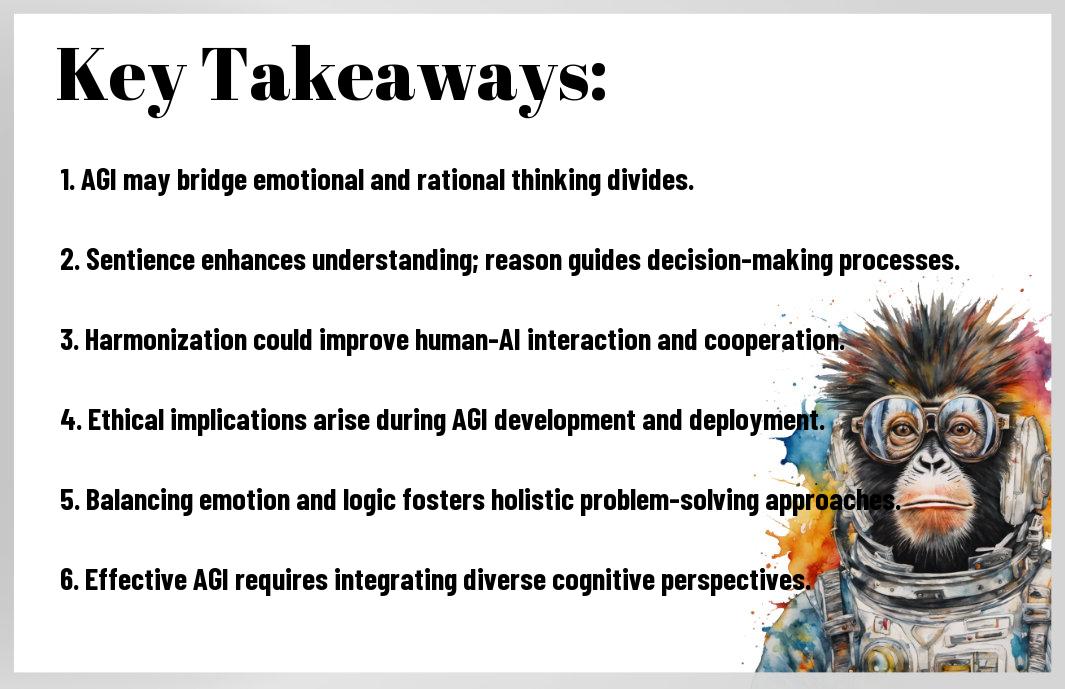
Key Takeaways:
- AGI Development: Advancements in AGI could potentially bridge the gap between human-like emotional awareness and logical reasoning.
- Sentience vs. Reason: The discussion surrounding AGI often revolves around whether a machine can possess both sentience and rational thought, impacting ethical considerations in AI.
- Implications for Society: A successful integration of sentience and reason in AGI could reshape human interactions, decision-making processes, and the overall understanding of intelligence.
Understanding AGI
Definition and Core Concepts
The concept of Artificial General Intelligence (AGI) pertains to machines with the ability to understand, learn, and apply knowledge in a way similar to human cognition. Unlike narrow AI that is designed for specific tasks, AGI possesses the potential to perform any intellectual task that a human can do. This level of intelligence encompasses reasoning, learning, and the ability to adapt to new situations, ultimately leading you to consider the broader implications of such capabilities for humanity and beyond.
Any discussion about AGI naturally draws you to its crucial core concepts, which include understanding context, emotional intelligence, and the capacity to manage complex systems. These elements are vital for an AGI to interact effectively with its environment and its users. By grasping these foundational ideas, you become better equipped to explore the potential benefits and risks associated with the development of AGI in various facets of society.
Historical Context and Development
Among the numerous milestones in computer science, the pursuit of AGI represents a particularly ambitious endeavor. Early developments in this field can be traced back to the mid-20th century when pioneers like Alan Turing and John McCarthy laid the groundwork through their exploration of machine learning and cognitive models. As computer hardware and algorithms have advanced, researchers have sparked renewed interest in AGI, spurred by both theoretical advancements and practical applications in areas such as robotics and natural language processing.
This quest for AGI has evolved through various stages, often driven by societal needs and technological capabilities. Initial breakthroughs led to the formulation of early AI programs, but these successes were tempered by limitations that hampered further progress. With increasing computational power and the advent of machine learning, researchers have begun to revisit fundamental questions regarding the nature of intelligence itself. Your understanding of AGI development benefits from recognizing how historical perspectives shape current approaches and the ethical considerations that increasingly accompany technological advancements in this space.
The Dichotomy of Sentience and Reason
If you explore into the philosophical underpinnings of human experience, you will inevitably encounter the profound dichotomy between sentience and reason. These two concepts represent distinct facets of our existence; sentience encompasses our emotional and conscious experiences, while reason embodies our capacity for logic and decision-making. Understanding how these elements interact can provide valuable insights into the nature of intelligence itself, particularly as we explore the implications of Artificial General Intelligence (AGI) in harmonizing these elements for a more holistic understanding of cognition.
Sentience: Emotions and Consciousness
Sentience refers to the ability to experience emotions and possess a certain level of consciousness. It is what allows you to feel joy, sadness, pain, and pleasure. Your capacity for empathy plays a significant role in forming connections with others, shaping your experiences, and informing your decisions. This emotional landscape serves as a foundation for your interactions with the world, illustrating how your feelings can profoundly influence perceptions and motivations in ways that pure rationality cannot.
Reason: Logic and Decision-Making
Dichotomy arises when you consider how reason contrasts with sentience in your decision-making processes. While sentience is inherently subjective, grounded in feelings and emotions, reason employs logic and analytical thinking to navigate choices and challenges. This logical approach prioritizes outcomes and requires a systematic evaluation of information, ultimately leading to decisions that may not always align with your emotional inclinations. The interplay between sentiment and reason becomes particularly critical in complex situations, where emotional responses and rational assessments must be balanced for effective outcomes.
Hence, the relationship between reason and sentience can be viewed as a spectrum, where your ability to make informed choices springs from a blend of logical reasoning and emotional understanding. This balance enables you to navigate the complexities of life, highlighting the need for a sophisticated understanding of both elements in any AGI endeavor. As we contemplate the potential of AGI, envisioning a system that harmonizes emotion with logic could open new pathways for understanding human-like cognition, paving the way for advancements that might redefine what it means to be intelligent.
The Role of AGI in Bridging the Gap
Once again, the conversation around artificial general intelligence (AGI) presents a unique opportunity for you to consider how technology might serve as a mediator between the realms of sentience and reason. As we explore the complexities of human thought and emotion, AGI has the potential to simplify the dichotomy that often exists in our understanding of these concepts. By employing advanced algorithms and data-driven insights, AGI could help you analyze and synthesize nuanced perspectives, thereby fostering a more integrated view of how sentience and reason interact within both human and artificial contexts.
Potential Benefits of AGI in Harmonization
Across various fields, AGI’s capabilities can provide significant advantages in harmonizing the complexities of sentient and rational thought. For example, in mental health, AGI-driven tools could assist practitioners in identifying patterns and correlations between emotional states and cognitive processes, allowing for a more tailored approach to treatment. This could complement your understanding of how emotional intelligence plays a role in reasoning, ultimately enhancing decision-making processes in both personal and professional settings.
Ethical Implications and Considerations
One key area of discussion surrounding AGI’s role involves the ethical implications of its use in bridging the gap between sentience and reason. As AGI systems become more sophisticated, you must consider potential consequences related to autonomy, privacy, and accountability. These technologies hold the power to not only augment human capacities but also shape your understanding of ethical frameworks that govern our interactions with intelligent entities.
Understanding the ethical implications of AGI involves grappling with foundational questions about the nature of consciousness and personhood. As the line between sentience and reason blurs, you may face dilemmas in determining how societies should engage with AGI and what rights, if any, these entities should possess. It is important for you to engage in these discussions, as they ultimately shape your values and the policies that govern emerging technologies in your world. Balancing the benefits AGI can offer with the ethical considerations will be necessary for developing a harmonious relationship with this transformative technology.

Challenges and Limitations of AGI
Technical Hurdles
Challenges are abundant in the pursuit of Artificial General Intelligence (AGI) due to the complex nature of replicating human cognition. You might find that developing algorithms capable of mimicking not just reasoning, but also the nuanced emotional responses tied to sentience poses a significant barrier. The current machine learning paradigms often struggle to handle the fluidity and context-driven nature of human thought, leaving gaps in AGI’s ability to process information in a way that’s comparable to human reasoning. Issues like scalability of data, computational power, and the inherent unpredictability of advanced AI systems only amplify these technical challenges.
Moreover, the integration of various cognitive functions into a cohesive AGI system introduces further complexity. You will see that attempts to combine perception, learning, memory, and decision-making into one framework have met with variable success, resulting in systems that may excel in one area but falter in others. This uneven performance can hinder the overall effectiveness and reliability of AGI, making it imperative to address these technical hurdles before achieving a system that harmonizes reasoning and sentience fully.
Philosophical and Ethical Dilemmas
Among the myriad of concerns surrounding AGI development are the philosophical and ethical dilemmas that you inevitably confront. The notion of consciousness and the implications of creating a sentient being raise critical questions about the responsibilities you hold as a creator. If you were to produce an entity with the capability to feel and reason, would it warrant rights similar to those of humans? This inquiry not only challenges the boundaries of moral agency but also necessitates a robust ethical framework that governs the treatment of such entities.
Another vital aspect of these dilemmas lies in the potential consequences of AGI’s decision-making capabilities. As you contemplate the balance between sentience and reason, you must consider the implications of delegating judgment and ethical choices to machines. The risk of bias inherent in algorithms and the lack of accountability if something goes awry is a conversation you cannot overlook. Ultimately, ethical considerations must evolve in tandem with technological advancements to ensure that your development of AGI serves humanity’s best interests without compromising moral integrity.
Case Studies and Current Applications
For a deeper understanding of how AGI can bridge the gap between sentience and reason, examining current applications and case studies is necessary. Various organizations and research networks have begun to implement AGI in innovative ways that showcase its potential. Here are some notable examples:
- OpenAI’s GPT-4 has demonstrated a remarkable ability to produce human-like text, enhancing communication in diverse fields such as customer support, content creation, and education.
- DeepMind’s AlphaFold has revolutionized biochemistry by accurately predicting protein structures, which could significantly impact drug discovery and disease treatment.
- IBM’s Watson is already being used in the healthcare sector for diagnosing diseases and personalizing treatment plans based on extensive datasets.
- Boston Dynamics’ robots incorporate AGI to navigate complex environments and execute tasks, showcasing advanced reasoning capabilities in unpredictable situations.
- Cognitive services provided by various platforms enable businesses to analyze data patterns and make informed decisions, granting them a competitive edge.
Successful Integrations of AGI
Successful implementations of AGI have shown that integrating advanced technologies with human decision-making can enhance efficiency and outcomes. For instance, in healthcare, IBM Watson has been working alongside medical professionals to analyze patient data, predicting outcomes and recommending personalized treatments. This collaboration not only supports doctors in their reasoning processes but also utilizes AGI’s capacity for rapid data analysis, allowing for informed treatment decisions that can save lives.
Additionally, OpenAI’s GPT-4 showcases how AGI systems can harmonize human-centered tasks, such as writing and content creation. Many companies leverage this technology to enhance creativity while efficiently managing resources. By utilizing AGI, you can improve workflows, generate ideas quickly, and refine communication strategies, ultimately increasing productivity and ensuring that your organization remains competitive.
Lessons Learned from Existing AGI Systems
From the ongoing experiments and applications of AGI systems, several vital lessons can be drawn that may inform your understanding and future integration efforts. One primary insight is the importance of addressing ethical considerations and biases inherent in data sets, as these can influence outcomes and decisions in significant ways. Ensuring transparency in AGI models is critical for maintaining trust and credibility among users.
Consequently, existing AGI systems have emphasized the need for ongoing training and adaptation of algorithms to align with fresh data and insights. Continuous monitoring and evaluation become necessary in fine-tuning performance, thereby protecting against outdated methodologies or biases that may arise. These learning experiences provide a framework for optimizing your approaches to AGI and reinforce the necessity of fostering a collaborative relationship between machine intelligence and human reasoning for optimal results.

The Future of AGI and Human-AI Interaction
Many experts believe that the development of AGI will fundamentally transform the way you interact with technology. As AGI systems attain higher levels of sophistication, they will be able to understand and adapt to your specific needs, preferences, and emotional states. This personalized interaction could lead to a more intuitive user experience, making daily tasks easier and more efficient. Furthermore, the collaborative potential of AGI could enable you to tackle complex challenges, leveraging its computational power and reasoning capabilities alongside your unique perspectives and creativity.
Prospective Developments
At this point in the evolution of artificial intelligence, researchers are exploring various ways to enhance AGI capabilities that foster synergistic relationships with humans. Advancements in natural language processing, emotional recognition, and multi-modal learning are just a few domains that could enable AGI to process and respond to your inquiries more intelligently. Imagine a scenario where you engage with an AGI that not only understands your spoken words but also picks up on your non-verbal cues and emotional undercurrents, providing responses that are contextually and emotionally appropriate.
Preparing for an AGI-Enhanced Society
Across various sectors, the integration of AGI is anticipated to bring about significant changes in the workforce, education, and healthcare, requiring you to adapt and engage with these technologies proactively. As AGI systems become more commonplace, you will need to cultivate skills that complement these advanced tools rather than compete with them. This means embracing lifelong learning and developing adaptability, as the landscape of work and social interaction evolves in tandem with AGI capabilities. Furthermore, being open to collaboration with AGI can enhance your productivity and creativity in ways that were previously unimaginable.
Hence, preparing for an AGI-enhanced society involves more than just technical skills; it also includes fostering ethical understanding and considerations around the use of such technology. As AGI becomes an integral part of your daily life, it is important that you engage in discussions about its implications, ensuring that moral frameworks and guidelines are developed and followed. By actively participating in these conversations, you can help shape a future where AGI harmonizes your sentient experiences with logical reasoning, ultimately benefiting society as a whole.
Conclusion
The exploration of whether Artificial General Intelligence (AGI) can harmonize the dichotomy between sentience and reason invites you to consider profound implications for your understanding of intelligence itself. As you research into the potential of AGI, you may find yourself pondering how a machine endowed with both rational capabilities and emotional depth could reshape the way you perceive interactions, decision-making processes, and even ethical considerations. The prospect of AGI developing a balanced perspective between feeling and logical reasoning suggests a transformative future where machines not only analyze data but also respond with empathy and understanding.
Your engagement with the development of AGI compels you to reflect on the responsibilities that come with creating entities capable of nuanced thought and emotional resonance. In achieving a blend of sentience and reason, you might anticipate a shift in how society functions, emphasizing collaboration between human and machine intellects. This partnership could enhance problem-solving abilities and lead to more compassionate outcomes in fields ranging from healthcare to environmental sustainability. Ultimately, your contemplation of AGI’s role in bridging these concepts encourages you to envision a future where both reasoning and feeling coexist, enriching human experience and understanding.
Q: What is the significance of the relationship between sentience and reason in the context of AGI?
A: The relationship between sentience and reason is significant because it encapsulates two fundamental aspects of intelligence: the ability to feel and the ability to think logically. Sentience refers to the capacity to experience feelings and subjective experiences, while reason pertains to logical processing and decision-making. In AGI, understanding and potentially harmonizing these aspects may lead to systems that not only perform tasks effectively but also understand emotional contexts, fostering more intuitive interactions between humans and machines.
Q: How might AGI address the challenges arising from the dichotomy between sentience and reason?
A: AGI could address challenges by integrating emotional intelligence and cognitive reasoning capabilities. This would involve designing algorithms that not only analyze data logically but also understand and respond to emotional cues. By bridging the gap between these two aspects, AGI could provide more empathetic and nuanced responses in various fields, such as healthcare and customer service, improving the overall user experience and fostering trust in technology.
Q: Are there ethical concerns associated with AGI achieving a balance between sentience and reason?
A: Yes, there are several ethical concerns tied to AGI achieving this balance. If AGI systems are designed to exhibit sentience-like qualities, it raises questions about their rights and the moral implications of their treatment. Furthermore, ensuring that these systems do not manipulate human emotions or make decisions that could harm individuals or society poses another layer of complexity. It is crucial to engage in ongoing ethical discussions about the design, capabilities, and implications of AGI systems as they evolve to integrate both sentient awareness and rational processing.
Comments