

With the rapid advancements in RAG (Retrieval-Augmented Generation) and AI technology, you may wonder how their synergy can shape the future of machine cognition. This intersection not only promises to enhance the intelligence of machines but also poses potential challenges to ethical standards in AI development. As these technologies evolve, they could pave the way for a new era, where machines not only understand data but can also utilize it in innovative ways to augment human thought processes and decision-making. Explore how this exciting convergence can impact your world.
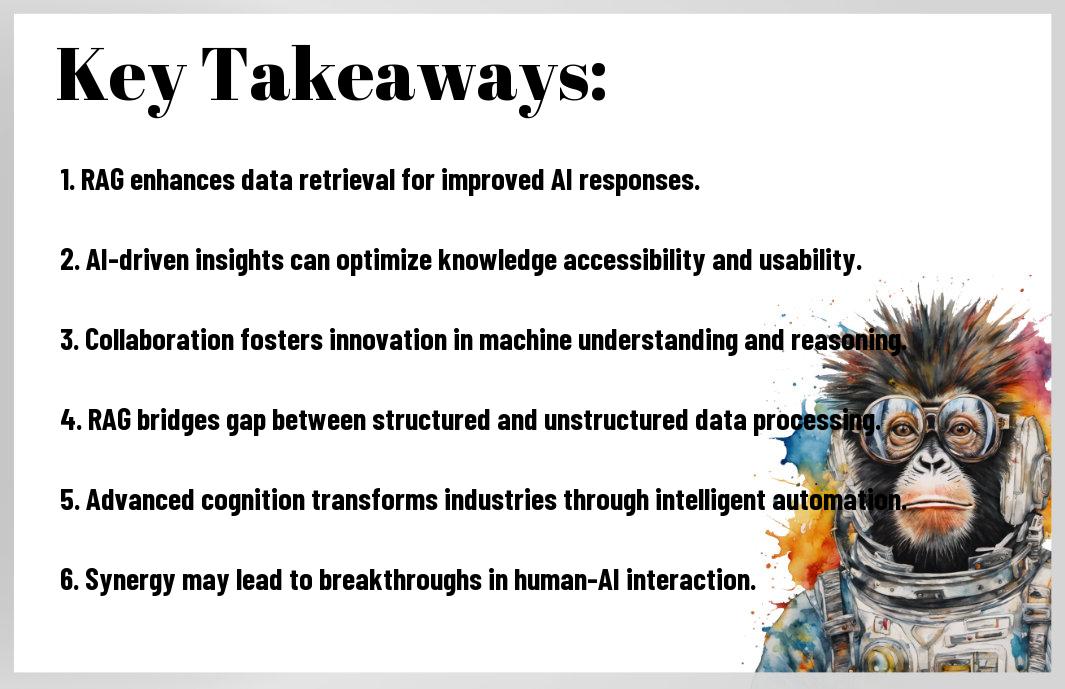
Key Takeaways:
- RAG Framework: RAG (Retrieval-Augmented Generation) enhances AI’s ability to provide more accurate and context-rich responses by integrating retrieval techniques with generative models.
- Improved Accuracy: By leveraging external knowledge sources, RAG helps mitigate common AI pitfalls, resulting in higher accuracy and relevance in responses.
- Machine Cognition: The combination of RAG with AI could enable a significant advancement in machine cognition, allowing AI systems to understand and process information more like humans.
- Enhanced Contextual Understanding: AI systems utilizing RAG benefit from a deeper contextual understanding, leading to more useful and nuanced interactions in applications like chatbots and virtual assistants.
- Potential Applications: The integration of RAG and AI holds exciting prospects in various fields, including healthcare, research, and customer service, enhancing decision-making processes.
- Challenges and Limitations: Despite its benefits, the integration of RAG and AI faces challenges, such as data quality, computational requirements, and ethical considerations in the use of retrieved information.
- Future Innovation: The synergy between RAG and AI presents opportunities for further research and innovation, potentially shaping the future landscape of machine learning and cognition.

Understanding RAG: Definition and Importance
To fully grasp the significance of RAG (Retrieval-Augmented Generation) in contemporary artificial intelligence, you must first comprehend its foundational elements. RAG represents a paradigm shift in how models process and generate information. Unlike traditional systems that rely solely on pre-existing training data, RAG integrates a retrieval mechanism to source updated information dynamically. This means that RAG can access a broader knowledge base on demand, making it invaluable in contexts where data is constantly evolving or where accurate answers require real-time information. As industries make greater demands on AI systems, understanding RAG allows you to appreciate its transformative potential in enhancing machine cognition.
To appreciate RAG’s importance, consider the potential pitfalls of relying exclusively on static datasets for machine learning models. Such models are invariably limited by the information available at the time of their training, which can lead to outdated or inaccurate responses in fast-paced environments. RAG addresses this limitation by enabling models to pull in relevant data during the generation process, ensuring that your AI systems remain not only relevant but also factually accurate. This dynamic interchange not only enriches the output but broadens the possible applications of AI across various fields like healthcare, finance, and content creation, enhancing the quality of interactions and the decisions made based on AI-generated insights.
Finally, the importance of RAG lies in its alignment with user expectations and demands for accuracy. As you engage with AI-driven interfaces, the need for reliable, up-to-date information becomes more pronounced. RAG is at the forefront of meeting this demand, allowing machine learning models to function not just as passive data repositories but as active knowledge agents. This evolution promotes user trust, enhancing engagement and satisfaction with AI applications in your daily life or professional activities. By fostering a more responsive and intelligent interface, RAG sets the stage for AI systems that better understand and serve your needs.
Overview of RAG Mechanisms
Between the integration of retrieval and generation lies the innovative heart of RAG mechanisms. At its core, RAG utilizes a two-step process: first, it retrieves information from a vast database or knowledge corpus, and secondly, it generates responses based on the context of that retrieved information. This dual approach allows for a more sophisticated understanding of queries and the production of answers that are not only relevant but also nuanced. You can think of this as having both a library at your disposal and a skilled librarian to help fetch and interpret the information efficiently.
By combining the strengths of information retrieval and natural language generation, RAG mechanisms create a seamless experience that significantly enhances machine cognition. This approach allows you to engage with AI in a more meaningful way, as the system evolves from merely presenting pre-stored data to more actively generating custom responses tailored to your specific inquiries. Whether you’re asking for historical data, current statistics, or answers to complex questions, RAG ensures that your AI is equipped to provide informed and immediate responses, thereby improving user experience and satisfaction.
In addition, RAG mechanisms are also designed to leverage large-scale datasets and advanced algorithms, enabling them to adapt and learn continually over time. This capability means that the more interactions your AI system has, the more refined and accurate its responses become. The iterative learning aspect of RAG reinforces the importance of ongoing input and feedback from users like you, thus transforming the interaction from a simple query-response model into a collaborative process where your needs and preferences are continuously considered and integrated into the system’s knowledge base.
Key Benefits of RAG in Machine Learning
By embracing the principles of RAG, you unlock numerous benefits that directly enhance machine learning capabilities. One of the most significant advantages of RAG is its ability to improve the accuracy of generated responses drastically. Traditional models often rely on outdated information, whereas RAG’s retrieval mechanism ensures that you receive not just relevant but also timely data. This immediacy is vital in a world where knowledge and context are continuously evolving, allowing your AI applications to provide answers that reflect the most current understanding of a subject.
Furthermore, RAG allows for greater context understanding, which empowers the AI to generate more coherent and contextually appropriate responses. You can expect more engaging and meaningful interactions with your AI systems as the model becomes adept at interpreting the nuances of your queries. This leads to enhanced user engagement and satisfaction, as the experiences become less rigid and more conversational, mirroring human-like interactions and opening up endless possibilities for applications across various sectors.
Benefits extend well beyond just improved accuracy and context comprehension. RAG also fosters adaptive learning, where the AI system evolves through its interactions. As you continue to engage with the AI, its ability to curate and respond to data improves, translating into an increasingly efficient resource for your professional or personal needs. This continuous feedback loop fundamentally enhances the overall user experience, driving the future of machine learning toward a model that not only learns but also thrives in real-world applications. With RAG at your disposal, consider the possibilities of direct interaction with intelligent systems that genuinely understand and respond to your requirements.

The Role of AI in Enhancing Machine Cognition
Some of the most significant advancements in machine cognition you’ll encounter today are intricately linked to the evolving landscape of Artificial Intelligence (AI). The incorporation of AI techniques into machine cognition has enabled machines not only to process vast amounts of data but also to interpret and apply that data in ways that emulate human reasoning. As AI systems become more sophisticated, you will observe that they can support complex tasks like natural language processing, image recognition, and even predictive analytics. This evolution is pivotal in helping machines improve their understanding and self-assessment, leading to a transformation in how we perceive both machine and human intelligence.
AI’s role in enhancing machine cognition is underscored by its advanced algorithms and deep learning methodologies. These techniques facilitate the extraction of patterns and insights from colossal datasets, allowing you to utilize the knowledge that machines gather. For example, algorithms that underpin AI systems can effectively ‘learn’ from newer data, thereby continuously refining their understanding. Such capabilities are foundational for achieving autonomous decision-making, where machines can analyse situations and make choices based on previously acquired information without the need for human intervention. As these systems evolve, you can expect to see significant improvements in how accurately and efficiently machines replicate cognitive functions.
Furthermore, this enhancement of machine cognition through AI has critical implications across numerous industries. In healthcare, AI-driven systems are aiding doctors in diagnostics and treatment recommendations, greatly improving patient outcomes. In the financial sector, AI offers predictive insights that lead to robust investment strategies or fraud detection. Beyond traditional industries, AI equips machines to participate in creative endeavors, such as generating art or music, thereby challenging established notions of creativity. As you explore the intersection of AI and machine cognition, the possibilities for innovation and transformation seem virtually limitless.
AI Techniques Supporting RAG
One of the most groundbreaking AI techniques supporting Retrieval-Augmented Generation (RAG) is transformer architectures, which enable very large language models to understand context and generate coherent responses. These models excel because they utilize self-attention mechanisms that allow them to weigh the importance of different words in a sentence, thereby improving the relevance and accuracy of generated content based on retrieved data. As you implement transformers within a RAG framework, the capacity to retrieve relevant information and enhance the generation process becomes remarkably efficient.
In addition to transformers, another important AI technique you should consider is memory augmentation. By integrating memory components into AI systems, data retrieved from previous interactions can be stored and reused in future conversations, significantly enhancing machine cognition. This feature equips machines with the ability to not merely generate responses from a static database but to evolve in their interactions with you as they learn more from diverse data inputs. When combined with RAG, this allows for a more dynamic and adaptive conversational agent that feels genuinely interactive.
Lastly, reinforcement learning plays a pivotal role in enhancing machine cognition as well. In a RAG framework, AI systems can be designed to learn from their mistakes and successes by interacting with their environments. This cycle of feedback improves their performance over time, rendering the machine more adept at both retrieving and generating relevant information. By harnessing these cutting-edge techniques, you position yourself on the frontline of machine cognition advancements, where machines evolve to not only process information but to understand it in profound ways.
Case Studies Demonstrating AI Advancements
An excellent way to grasp the transformative impact of AI on machine cognition is to look at relevant case studies. These real-world applications provide measurable examples of AI’s effectiveness. Here are several persuasive studies that illustrate the potency of AI techniques in enhancing machine cognition:
- Healthcare AI Solutions: A study from Stanford University’s School of Medicine showcased an AI system that accurately diagnosed skin cancer with an accuracy of 94.6%, which is comparable to dermatologists’ results.
- Financial Market Predictions: Fidelity Investments employed AI for predictive analytics, leading to a 30% increase in investment strategy efficacy, generating an additional $40 million in profits.
- Autonomous Vehicles: Waymo’s machine learning algorithms demonstrated a 10% improvement in navigation accuracy in urban environments, significantly reducing accident rates.
- Facial Recognition Technology: A project by Facebook AI Research showed that their facial recognition system achieved an accuracy rate of 98.3% in identifying individuals under diverse lighting conditions.
- Natural Language Processing: Google’s BERT model has dramatically enhanced search accuracy, with a reported 30% boost in comprehension over traditional search algorithms, transforming user experiences on a massive scale.
Consequently, these case studies reveal the profound impact of AI advancements on machine cognition across various sectors. The examples illustrate not only enhanced operational efficiency but also improved outcome accuracy, adding an invaluable dimension to how you can think about the future of AI. The implications of these developments are expansive: from improved patient outcomes in healthcare to safer autonomous transportation methods. As you analyze these advancements, it’s evident that the convergence of AI and RAG stands to unlock further potential, reshaping the conceptual landscape of machine cognition as we know it.
Convergence of RAG and AI: A New Paradigm
Now, as the digital landscape continues to evolve, you may find yourself contemplating the synergy between Retrieval-Augmented Generation (RAG) and Artificial Intelligence (AI). The unexpected combination of these two technologies has the potential to redefine how machines understand and interact with data. RAG, which allows AI to enhance its answers with information retrieved from external sources, rethinks traditional models of cognition and knowledge management. For those interested in exploring this concept further, taking a look at What is Retrieval Augmented Generation (RAG)? will provide you with foundational knowledge about this transformative paradigm. In the integration of RAG and AI, you stand at the frontier of knowledge expansion, poised to understand how these technologies can revolutionize machine cognition.
Between your curiosity about technological advancements and the complexities of AI-driven solutions, the synergistic effects of RAG and AI may stimulate a new age of machine cognition. When these two forces converge, they offer a remarkable ability for machines to glean insights from vast reservoirs of data, thus equipping themselves with a more nuanced understanding of the context in which they operate. This capability enhances not only the accuracy of AI responses but also enriches user experiences by delivering tailored, context-aware insights. By leveraging real-time data retrieval in conjunction with generative capabilities, the convergence of RAG and AI can enable interfaces that are not only reactive but also proactively insightful, revolutionizing how you interact with machines.
This new paradigm may also lead you to rethink your approach to data visualization and interpretation, as machines begin to generate not just responses but also ongoing discussions with the user. The relationship between machine and human is shifting from a simplistic question-and-answer dynamic to a collaborative exploration of knowledge. By working together with intelligent systems that utilize RAG, you might find that the potential for deeper insights and innovative solutions becomes not just a possibility but a tangible reality. Leveraging this partnership can open pathways to groundbreaking discoveries, making your journey through knowledge, learning processes, and decision-making profound and enriched.
Synergistic Effects on Machine Cognition
Between the evolving landscapes of RAG and AI, you will encounter remarkable synergistic effects that could reshape how machines engage with knowledge. As RAG empowers AI models to tap into extensive external databases, they gain an unprecedented ability to contextualize information. This means that rather than functioning in isolation, your AI systems become knowledge-enhanced entities that adapt their outputs based on the most relevant, up-to-date external data. By effectively bridging the gap between static and dynamic information, these systems can provide you with more nuanced and informed insights, enhancing the overall efficiency of knowledge work.
For you, this convergence is not merely about improved performance metrics; it signifies a transformative way of engaging with data and machine learning. The unique combination of *retrieval capabilities* in RAG facilitates a more interactive environment where your queries are met with contextually relevant responses. Thus, when you seek answers, these AI-driven systems evolve into sophisticated partners capable of delivering tailored and rich perspectives. You will increasingly find the relevance and precision of AI-generated content rising to new heights, ultimately leading you to a more fulfilling user experience and optimized decision-making processes.
Your understanding of the relationships between data, context, and cognition is on the verge of dramatic expansion. The seamless integration of RAG enhances the cognitive models of AI, transforming them into systems that not only provide information but also craft narratives and discussions around that knowledge. This emerging synergy invites you to explore innovative uses in various fields, from academia to tech, influencing how industries approach problem-solving and innovation.
Challenges and Opportunities
With the convergence of RAG and AI comes a myriad of challenges and opportunities that you should consider. As you begin on this journey, it’s imperative to recognize the potential complexities that arise from such powerful technologies. Data retrieval mechanisms demand accuracy and reliability, as any flaws in the underlying data could lead to misinformation and erosion of trust in AI systems. Additionally, the ethical implications concerning data privacy, security, and content ownership must be vigilantly addressed to ensure that the promise of RAG and AI is not overshadowed by missteps.
Concurrently, this convergence also presents numerous opportunities. You should view the challenges as the necessary conditions for growth and advancement in this tech-driven ecosystem. As industries increasingly adopt RAG-empowered AI solutions, your role in navigating these complexities can position you as a key player in shaping the ethical frameworks that will govern this new paradigm. Engaging with policymakers, tech leaders, and stakeholders to establish protocols will help balance innovation with responsible AI governance, ensuring that the benefits of these technologies can be fully realized.
Another significant aspect to consider is how this convergence can lead to enhanced collaborative solutions. By harnessing the collective wisdom of diverse data sources, including scientific literature, user-generated content, and proprietary databases, RAG and AI together can offer profound insights across multiple industries. Embracing the convergence means being a part of a broader narrative around the evolution of machine cognition that fosters not just personal growth, but also collective advancements in knowledge and technology.
Future Prospects: AI and RAG in Machine Cognition
Unlike other technologies, the integration of Retrieval-Augmented Generation (RAG) with Artificial Intelligence (AI) holds tremendous potential for ushering in a new era of machine cognition. This confluence enhances the ability of AI systems to not only process information but also to understand and generate contextually relevant content. As a professional utilizing these technologies, you might be interested to know that resources on best practices and methodologies can enhance your efforts. For instance, you can check out Solved: Best Practices for Extracting Large Documents from…, which offers insights into extracting and leveraging vast data sets effectively. This insight fosters a better understanding of how RAG can interpret expansive information while producing meaningful outputs that align with user queries.
Predictions for Technological Development
Technological advancements in AI and RAG are anticipated to make significant strides in the coming years. You should expect that as natural language processing continues to evolve, RAG systems will become increasingly efficient, leading to enhancements in knowledge retrieval and generation processes. Furthermore, broader access to enriched datasets will likely empower these systems to offer even more sophisticated responses. You might find that, in organizations where RAG is implemented, there could be a dramatic leap in productivity, as users will be able to tap into more personalized and insightful information with unprecedented speed. The future landscape of AI not only suggests a refinement in technology but also hints at more fluid interactions between human users and machine intellect.
Implications for Industry and Research
Any shift in AI technology inevitably carries significant implications for both industry and research fields. As AI and RAG become more intertwined, you may observe a transformation in how knowledge is synthesized and disseminated across various sectors. Industries that leverage RAG are likely to experience improved decision-making processes, as real-time information retrieval will allow for quicker adaptability in market strategies. For researchers, the enhanced coherence of machine-generated content can ease literature reviews and data analysis, leading to accelerated discoveries and advancements in numerous fields, from healthcare to engineering. The deployment of RAG technology can streamline collaborative efforts, helping teams navigate complex information landscapes with greater efficiency.
Hence, it is imperative to acknowledge how RAG and AI integration will redefine industry standards and research methodologies. The potential for higher productivity and more insightful data processing could be game-changing. However, you should also be aware of the challenges that may arise, including ethical considerations around data privacy and the need for robust frameworks to govern AI applications. As you investigate deeper into these innovations, you stand at the forefront of a technological renaissance that could reshape the way you operate within your industry and carry out research initiatives.

Ethical Considerations in RAG and AI Integration
After delving into the intricate relationship between Retrieval-Augmented Generation (RAG) and artificial intelligence (AI), it’s imperative to confront the ethical considerations that accompany their integration. As you explore this frontier, you must remain acutely aware of the implications of combining these technologies, particularly in terms of societal impact and human-computer interaction. The melding of RAG and AI has transformative potential, but with this promise comes the duty to navigate complex ethical landscapes. Issues such as data privacy, user consent, and algorithm accountability demand your attention, particularly when AI systems begin to make decisions that can significantly influence individual lives. A guiding resource in this discussion is the insightful paper on the-fusion-of-minds-navigating-the-confluence-of-ai-ml-and …, which explores deeper into these urgent topics.
Addressing Bias and Fairness
Against the backdrop of merging RAG and AI, one of the most pressing ethical issues you should scrutinize is the potential for bias and lack of fairness in AI-generated outcomes. As these systems utilize massive datasets for training, your understanding of the existing biases within these datasets is imperative. If the input data reflects skewed representations of particular demographics or viewpoints, the resulting AI models may inadvertently perpetuate or even amplify these biases in their outputs. This scenario raises critical questions about the fairness of AI applications and their impacts, particularly in sensitive domains such as criminal justice, hiring, and healthcare. Therefore, you must consider implementing systematic evaluations of biases in your applications and strive for inclusivity in the data that drives these systems.
Moreover, it is your responsibility to advocate for transparency when it comes to algorithmic decision-making processes. You can facilitate fairness by ensuring that users understand how information is processed and what factors contribute to particular AI outputs. Engaging with multidisciplinary teams, including ethicists, sociologists, and legal experts, will enrich your approach and foster a culture of accountability. As you strive for fairness in AI, adopting frameworks for auditing and continuous monitoring of biases not only enhances the integrity of your work but also promotes trust among users.
Ensuring Responsibility in Machine Cognition
Around the landscape of machine cognition lies the imperative principle of responsibility, a factor that cannot be overlooked as you advance in the integration of RAG and AI. You must grapple with the questions of who is accountable when these systems produce harmful outputs or make erroneous conclusions. As an AI practitioner, it’s imperative that you establish clear guidelines governing the behavior of the AI systems you develop. This includes developing mechanisms for user recourse and redress when these systems fail, ensuring that your AI does not operate in a vacuum devoid of human oversight. Programs that encourage stakeholder engagement and emphasize ethical AI governance will be invaluable in laying a foundation for responsibility.
To elevate the commitment to responsibility, you could implement rigorous testing protocols and ethical audit trails for your AI models. Engaging with diverse stakeholder perspectives can be a game-changer, providing valuable insights that help shape the responsible deployment of AI technologies. By prioritizing accountability, you protect not only your projects but also the users who rely on AI applications. In harnessing the potent combination of RAG and AI, your focus on ethical stewardship enables these advanced systems to serve society positively while mitigating potential risks associated with their deployment.
To Wrap Up
Considering all points, you must recognize the immense potential that arises from the convergence of Retrieval-Augmented Generation (RAG) and artificial intelligence (AI). By combining the strengths of RAG’s capability to retrieve pertinent information from vast repositories of data with the generative prowess of AI, you are looking at a paradigm shift in machine cognition. This synergy allows for a more nuanced understanding of information, giving machines the ability to not only process data but also interpret and generate insights that are contextually relevant. As you explore this intersection, you can appreciate how it might lead to a more sophisticated level of machine understanding, akin to a cognitive renaissance that will revolutionize various fields and applications.
Moreover, in your pursuit of knowledge in this dynamic landscape, it is imperative to consider the implications this combination has for user experiences. With enhanced retrieval capabilities, AI systems can become more personalized, allowing you to interact with technology in a manner that feels intuitive and tailored to your specific needs. By bridging the gap between relevant information and user query understanding, RAG could empower AI tools to become more than mere responders; they could evolve into proactive collaborators, augmenting your decision-making processes and enriching your engagement with technology. This sort of evolution is promising, as it could lead to more human-like interactions, where machines not only serve your requests but also anticipate your needs.
Lastly, as you navigate through the emerging landscape shaped by these advancements, it is vital to remain vigilant about the ethical implications and responsibilities that accompany these technologies. The fostering of machine cognition that is both powerful and advanced brings with it questions regarding accuracy, privacy, and the potential for misuse. Your engagement in these discussions can help shape an environment where technology serves not just as a tool but as an ethical partner in your intellectual and practical pursuits. The fusion of RAG and AI is not just a technological shift; it is a movement that invites you to reflect on how you want to engage with machines that are becoming increasingly aware and responsive. In the aggregate, your role in this transformative journey is imperative, as it will determine the extent to which these innovations can lead to a more profound understanding of cognition, both human and artificial.
FAQ
Q: What is RAG in the context of AI?
A: RAG, or Retrieval-Augmented Generation, refers to an AI approach that combines the retrieval of relevant information with generative capabilities. This methodology allows models to access vast databases of information, enhancing their ability to generate accurate and contextually relevant responses.
Q: How does the integration of RAG and AI influence machine cognition?
A: The integration of RAG with AI fosters a more advanced form of machine cognition by enabling AI systems to access real-time knowledge and learn from diverse data sources. This collaboration improves decision-making processes, contextual understanding, and the generation of human-like responses.
Q: Can the RAG model help in minimizing biases in AI systems?
A: Yes, the RAG model has the potential to minimize biases in AI systems. By using a broader and more varied dataset for information retrieval, RAG can help ensure that AI responses are better balanced and reflect a wider range of perspectives, thereby reducing the likelihood of biased outputs.
Q: What potential applications can arise from the confluence of RAG and AI?
A: The convergence of RAG and AI can lead to several practical applications, including advanced chatbots for customer service, enhanced educational tools that provide personalized learning experiences, and more effective information search engines that yield accurate and comprehensive results. These advancements could significantly improve user experiences across various domains.
Q: What challenges might arise from combining RAG and AI technologies?
A: Several challenges may arise from combining RAG and AI technologies, including the need for robust data management practices to ensure quality, addressing data privacy concerns, and the technical difficulties involved in seamlessly integrating retrieval and generation processes. Additionally, ongoing research is needed to optimize these systems for reliability and accuracy.
Comments