

With the rapid evolution of machine learning technologies, you stand on the brink of a new era in software engineering. Your workflow could be significantly enhanced as machine learning automates routine tasks, optimizes code, and predicts project outcomes with astounding accuracy. However, this transformation is not without its challenges; as you embrace these advanced tools, you must also navigate potential risks such as bias in algorithms and the need for ongoing education in this dynamic field. By understanding these impacts, you can stay ahead and leverage machine learning to elevate your software engineering practices.
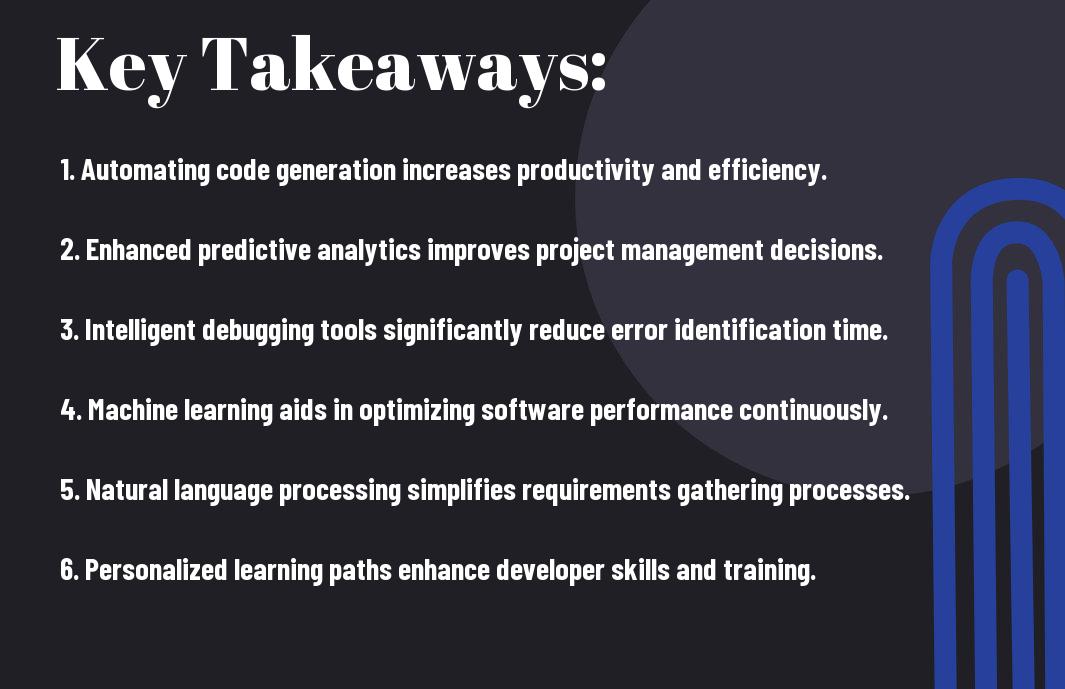
Key Takeaways:
- Automated Testing: Machine learning can enhance software testing by predicting bugs and optimizing test coverage, reducing manual effort and increasing reliability.
- Code Generation: ML algorithms can assist in generating code snippets or even entire functions, speeding up the development process and improving efficiency.
- Predictive Analytics: Using historical data, machine learning can forecast future software performance and user behavior, leading to more informed decision-making.
- Intelligent Code Review: Tools powered by machine learning can analyze code for potential issues and suggest improvements, ensuring higher code quality.
- Enhanced Collaboration: Machine learning can facilitate better collaboration among development teams by providing insights and recommendations based on team performance and project metrics.
The Current State of Software Engineering
While the software engineering landscape is continually evolving, many established practices shape how you approach development today. The integration of methodologies like Waterfall, Agile, and DevOps emphasizes the importance of collaboration, feedback, and delivery. These approaches allow teams to adapt to changing requirements and enhance project responsiveness, ensuring that you remain aligned with client needs. (The adoption of Agile principles can significantly improve your team’s efficiency.)
Traditional Development Practices
Software development methodologies, such as Waterfall, Agile, and DevOps, focus on different aspects of the development lifecycle. Waterfall follows a linear, phased approach, while Agile promotes iterative development with frequent collaboration and feedback. DevOps bridges the gap between development and operations, further enhancing delivery speed and quality. Through these practices, you can foster an environment that prioritizes adaptable solutions and rapid deployment. (Choosing a suitable methodology can impact the success of your projects.)
Challenges Faced by Software Engineers
You often encounter common challenges in software engineering, such as technical debt, resource allocation, and maintaining code quality. These issues can significantly affect your productivity and the overall success of your projects, leading to delays and increased costs. As you navigate these complexities, it is vital to focus on addressing them proactively to enhance project outcomes. (Addressing technical debt early can save time and resources in the long run.)
Challenges Faced by Software Engineers
Across your daily tasks, these challenges can manifest in various ways, sometimes leading to frustrating roadblocks. Technical debt accumulates when quick fixes overshadow long-term solutions, making future changes more complicated. Inadequate resource allocation can lead to team overload, impairing your ability to meet deadlines. Furthermore, maintaining code quality becomes difficult when under pressure, affecting application performance. Addressing these issues will enable you to create a more effective development process. (Prioritizing code reviews and refactoring can help mitigate potential pitfalls.)
Practices
Practices you adopt in software engineering can make a significant difference in your projects. Collaboration among team members is paramount, as it allows for better communication and shared goals. Regular feedback loops ensure that you are aligned with user needs and can make adjustments as necessary. However, neglecting code quality can lead to technical debt and hinder your project’s success. By emphasizing these aspects, you can cultivate a more productive development environment. (Focusing on continuous improvement should be a fundamental part of your development strategy.)
Understanding Machine Learning
You might be curious about how How Machine Learning is changing Software Development. Machine learning (ML) refers to a subset of artificial intelligence in which algorithms analyze data, learn from it, and make predictions or decisions without being explicitly programmed. This paradigm allows software engineers to automate various tasks, optimize processes, and enhance decision-making capabilities, ultimately transforming the landscape of software engineering.
Basic Concepts of Machine Learning
To understand machine learning better, it’s vital to grasp a few key terms: algorithms are the mathematical procedures used to analyze data; training data is the initial data set used to teach the algorithms; models are the representations created based on this data; and predictions are the outcomes or decisions made by the model. There are three main types of machine learning: supervised learning, where models are trained on labeled data; unsupervised learning, which deals with unlabeled data to discover hidden patterns; and reinforcement learning, where models learn by interacting with their environment. (Choosing the correct type of learning is critical for a project’s success.)
The Role of Data in Machine Learning
Before submerging into machine learning, it’s important to understand that data quality and quantity play a significant role in training models. Your models rely on high-quality, well-structured data for accurate predictions, making effective data extraction, cleaning, and preprocessing indispensable steps. The better your data, the more reliable your model will be in performing its functions.
A well-structured data set can lead to impressive model performance, while poor-quality data can lead to devastating errors in predictions. Your preprocessing efforts can significantly amplify the insights gained from data, generating useful information for your projects. However, be aware that too much reliance on incomplete or biased data can induce serious risks. Prioritize data accuracy and quality to ensure your machine learning models yield positive outcomes in your software engineering efforts.

Machine Learning Applications in Software Engineering
Now, machine learning is revolutionizing software engineering by automating complex tasks and enhancing overall efficiency. From enhancing code quality to streamlining testing processes, ML applications are becoming indispensable in modern software development. The integration of ML into various aspects of engineering not only improves productivity but also leads to more robust and maintainable software systems.
Code Quality Improvement
Now, machine learning can significantly enhance code quality through advanced static analysis tools and predictive modeling for bug detection. These tools utilize ML algorithms to analyze code patterns and predict potential issues, allowing developers to address them proactively. Examples like SonarQube and CodeScene employ ML techniques to maintain code standards and improve maintainability. (Investing in these tools can lead to a noticeable reduction in future debugging efforts.)
Automated Testing and Continuous Integration
Machine learning is transforming testing frameworks and continuous integration pipelines by optimizing test case generation and identifying critical scenarios. ML algorithms analyze past testing data to suggest efficient test strategies, thereby improving test suite effectiveness and reducing manual effort. By learning from previous outcomes, these systems can prioritize tests that yield the highest value, allowing you to focus your resources effectively.
In addition, leveraging machine learning in your automated testing and continuous integration processes can lead to more significant efficiencies and cost savings. ML can dynamically adapt to changes in your codebase, ensuring your test cases remain relevant and comprehensive. Moreover, these systems can help spotlight vulnerable areas, reducing the risk of potential failures. Optimizing your testing strategy not only increases your development speed but also enhances the quality of your software, ultimately leading to a better user experience.
Enhancing Developer Productivity
After embracing machine learning, you can expect significant enhancements in your productivity as a software engineer. By automating repetitive tasks and streamlining workflows, machine learning can free up your time to focus on more complex problems, ultimately leading to faster project completion and improved code quality.
Intelligent Code Compilation and Suggestions
Above all, machine learning empowers you with real-time code suggestions and error detection during development, making the coding process smoother. Tools like Visual Studio IntelliCode, GitHub Copilot, and JetBrains IDEs use intelligent algorithms to analyze your code context, offering relevant syntax recommendations and identifying potential issues before they escalate.
Personalized Learning and Skill Development
Across the landscape of software engineering, machine learning creates personalized learning pathways that adapt to your unique skillset and learning style. Platforms like Pluralsight and Codecademy harness machine learning to recommend tailored resources for your growth, enabling you to enhance your abilities effectively. (Choosing the right platform can significantly influence your learning trajectory.)
Across different learning experiences, you may find that machine learning applications help identify your strengths and weaknesses, guiding you through targeted exercises and modules. This adaptive approach makes skill development more efficient and keeps you engaged as you progress in your career. (Investing time in such personalized platforms is vital for long-term success in the tech industry.)
Compilation of your work is optimized through these intelligent systems, providing immediate feedback on your code. This way, you can quickly address potential errors and improve your code quality without the hassle of manual debugging, leading to a more efficient development process.

Ethical Considerations and Challenges
Once again, as machine learning reshapes software engineering, it brings a host of ethical challenges that require careful navigation. Issues such as algorithmic bias and data privacy need to be addressed to foster trust and responsibility within the industry. Exploring the 4 Ways AI Is Transforming Software Development reveals the pressing need for ethical guidelines and oversight in this rapidly evolving landscape.
Bias in Machine Learning Algorithms
On the journey to incorporate machine learning into your software projects, you must be aware of the risks associated with algorithmic bias, which can lead to unfair outcomes and reinforce social inequalities. This underscores the importance of integrating fairness and transparency into your ML applications, ensuring that your algorithms are systematically evaluated and adjusted to mitigate bias.
Data Privacy and Security Issues
Challenges arise within machine learning regarding data privacy, especially when handling sensitive information. Navigating regulations such as GDPR becomes crucial, as adherence to these laws protects both your users and your organization from legal repercussions. (Understanding these regulations can significantly influence your project’s direction.)
Challenges in data privacy and security persist as you design and implement machine learning systems. With more personal information being processed, you face diverse threats including data breaches and misuse, making it crucial to adopt best practices in data handling. (Deciding to implement robust security measures can protect your project’s integrity.)
Bias in your algorithms can manifest in multiple ways, reflecting societal norms and discriminatory practices if left unchecked. You should prioritize diverse datasets and regular auditing to minimize these risks. The implications of biased algorithms stretch beyond performance; they can damage your credibility and lead to public backlash, highlighting the need for ethical vigilance in ML implementation.
The Future of Software Engineering with Machine Learning
All aspects of software engineering will evolve as machine learning becomes integral to development processes. By harnessing AI, you can streamline workflows, enhance coding accuracy, and improve software maintenance. This shift will lead developers to embrace collaboration with intelligent systems, as detailed in Unleashing the Future: How AI is Transforming Software …. The need for innovative adaptation will be paramount as your projects leverage these technologies.
Evolving Roles of Software Engineers
Engineers will find their roles shifting from traditional coding to facilitating and optimizing machine learning solutions. Your focus will evolve towards collaboration with ML systems, allowing you to leverage AI for enhanced efficiency and productivity. Creativity and problem-solving will become key attributes as you sync human intelligence with machine capabilities, ultimately leading to more intelligent and robust software solutions.
Advanced Predictive Analytics and Decision Making
Among the most significant impacts of machine learning in software engineering is its ability to provide advanced predictive analytics for improved decision-making. With powerful data insights, you can anticipate project needs and allocate resources more efficiently. (An important objective would be prioritizing data-driven decisions to meet deadlines effectively.)
| Improved project timelines | Anticipate potential bottlenecks |
| Enhanced resource allocation | Optimize team capacities |
| Risk mitigation | Proactively address challenges |
But machine learning’s role in decision-making extends beyond mere predictions. As you analyze data trends, your team can make informed choices, enabling you to innovate and respond swiftly to market demands. (Being able to adapt project strategies based on real-time insights can transform your approach to development.)
| Data quality management | Ensure reliable inputs for ML systems |
| Integration issues | Compatibility with existing frameworks |
| Ethical concerns | Address transparency in algorithms |
As you navigate this paradigm shift, contemplative analysis of the positives and dangers of machine learning integration will be paramount. Pay attention to evolving practices that not only enrich your projects but also redefine your role as a software engineer.
Summing up
The integration of machine learning into software engineering is set to significantly enhance your workflow, enabling you to automate repetitive tasks, improve code quality, and facilitate advanced predictive analytics. By leveraging these intelligent systems, you can increase your productivity and enhance the user experience through more personalized software solutions. As the landscape evolves, embracing machine learning will empower you to stay competitive, innovate faster, and adapt to changing demands in technology.
FAQ
Q: How can machine learning enhance software testing processes?
A: Machine learning can significantly improve software testing by automating test case generation, identifying potential bugs, and predicting areas of the code that are most likely to fail. By analyzing historical bug data and user behavior, ML algorithms can prioritize test cases based on risk, enabling teams to focus on the most critical components first. Additionally, machine learning models can continuously learn from previous testing cycles, refining their approach to identify vulnerabilities more effectively over time.
Q: In what ways can machine learning influence software design?
A: Machine learning can provide intelligent insights for software design by analyzing user data and feedback to inform design decisions. This approach allows developers to create more intuitive user experiences by predicting user needs and preferences, based on patterns in data. Furthermore, machine learning can guide architecture decisions by simulating performance scenarios and suggesting the most effective design patterns, ultimately resulting in more efficient and user-focused software products.
Q: How might machine learning impact software maintenance and support?
A: Machine learning can streamline software maintenance and support by automating the detection of issues and suggesting resolutions based on historical support data. By utilizing predictive maintenance techniques, ML algorithms can anticipate when parts of the software might fail and prompt developers before issues escalate. Moreover, machine learning chatbots can assist in providing immediate responses to customer queries, improving the overall support experience while freeing up human resources for more complex problems.
Q: What role does machine learning play in enhancing software security?
A: Machine learning enhances software security by enabling proactive threat detection and response mechanisms. Through anomaly detection algorithms, ML systems can distinguish between typical and atypical behavior within a software application, identifying potential security breaches in real-time. Additionally, machine learning can be utilized to analyze code for vulnerabilities, aiding developers in implementing best practices for secure coding, thus reducing the likelihood of security flaws in the software deployment process.
Q: Can machine learning improve collaboration within software engineering teams?
A: Yes, machine learning can enhance collaboration among software engineering teams by providing data-driven insights into team dynamics and productivity patterns. ML algorithms can analyze communication channels, project management tools, and version control systems to identify bottlenecks and recommend strategies for effective collaboration. By leveraging these insights, teams can optimize workflows, improve resource allocation, and ensure that all members are aligned toward common goals, thereby fostering a more cohesive and productive working environment.
Comments