

It’s crucial to understand how autonomous coding will reshape your role as a developer in the coming years. As AI continues to advance, the way you approach programming may shift dramatically, offering enhancements in efficiency and the potential for lower barriers to entry in software development. However, this evolution also poses risks of job displacement and challenges in maintaining the creative and innovative aspects of coding. By grasping these implications, you can better navigate your career in an increasingly automated landscape.

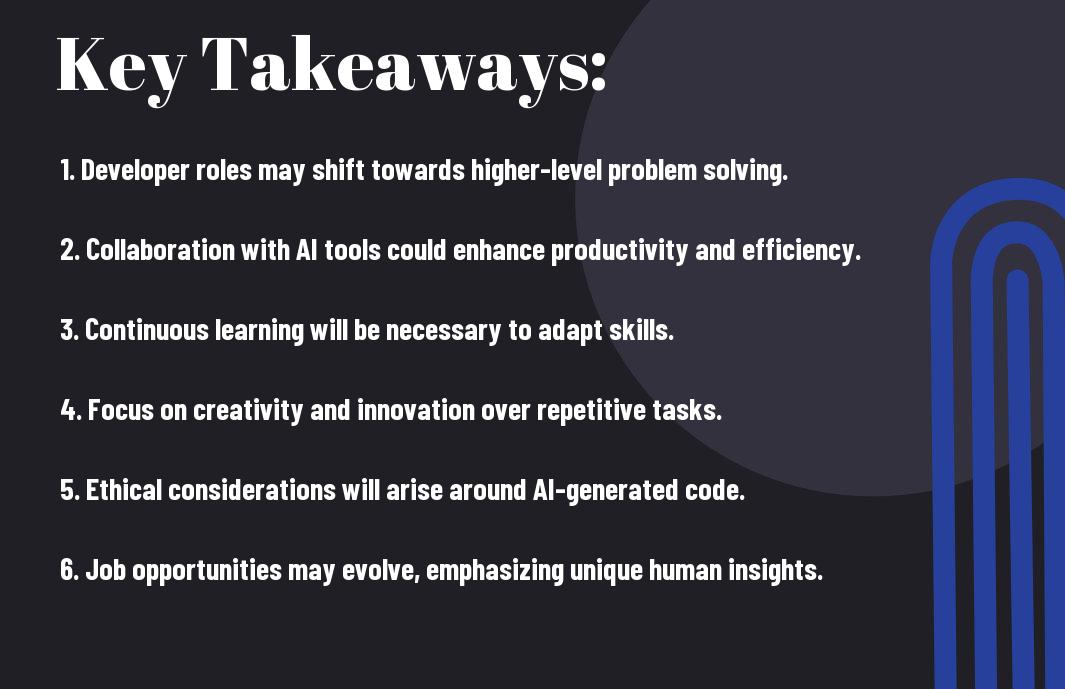
Key Takeaways:
- Shift in Skillsets: Developers may need to focus on higher-level problem-solving and architectural skills rather than routine coding tasks.
- Enhanced Productivity: Autonomous coding tools can significantly increase productivity by automating repetitive coding tasks.
- Continuous Learning: Developers will need to continually adapt and learn new technologies as autonomous tools evolve and integrate into workflows.
- Collaboration Dynamics: The role of developers may shift towards more collaborative efforts with AI, requiring a blend of technical and interpersonal skills.
- Ethical Considerations: Developers will need to navigate ethical implications surrounding AI-generated code, such as authorship, accountability, and bias in algorithms.
Understanding Autonomous Coding
For developers, the concept of autonomous coding represents a transformative shift in how software is created. This approach involves leveraging advanced technologies, primarily artificial intelligence and machine learning, to automate the coding process. Unlike traditional coding, where every line of code is manually written, autonomous coding enables systems to generate code snippets, debug, and even optimize code autonomously. (The adoption of autonomous coding may redefine your role in software development.)
Definition and Scope
Understanding autonomous coding requires you to consider both its definition and its scope. This term generally refers to technologies that allow software to be created with minimal human intervention, primarily through the use of AI algorithms. It expands the possibilities beyond what traditional coding practices offer by enabling faster development cycles and potentially error-free coding capabilities through automated processes.
Current Technologies and Examples
An exploration of autonomous coding would not be complete without examining existing tools and platforms. Tools like GitHub Copilot and OpenAI Codex illustrate how these technologies are already being integrated into your coding workflow. GitHub Copilot auto-suggests code snippets as you write, while OpenAI Codex allows you to convert natural language instructions into code, simplifying complex projects.
Plus, these advancements bring both exciting opportunities and challenges to your development process. For instance, with tools like GitHub Copilot, you can significantly enhance your coding efficiency, but they also raise questions about dependency on AI and the potential for misguided code generation. While automation can reduce human error, there’s a risk that important coding principles may become overlooked. Balancing these benefits with the potential risks is vital for your continued growth as a developer.
The Role of Developers in an Automated World
While technology advances, the role of developers will evolve significantly. As Are Coders’ Jobs At Risk? AI’s Impact On The Future Of coding becomes more autonomous, your role will focus more on oversight and integration rather than traditional coding tasks. You will need to embrace this shift to stay relevant in a rapidly changing landscape.
Shifting Skill Requirements
Before fully adapting to autonomous coding, you must develop new skills that prioritize soft skills such as collaboration and communication. As the dynamics change, technical knowledge alone will not suffice; your ability to work with teams, understand user needs, and convey ideas clearly will become equally important. (Investing in these skills will be key to your success.)
The Evolving Job Landscape
Around this transition, job roles will adapt, with new positions emerging that focus on maintaining, supervising, or integrating autonomous coding systems. You might find yourself taking on roles that require a blend of technology and management, ensuring that these systems align with business goals and quality standards.
In addition, the rise of automation will likely lead you toward roles that focus on system maintenance and quality assurance, where your expertise in integrating human and machine efforts becomes invaluable. While this shift could pose challenges, it also presents an opportunity for you to leverage innovative thinking and enhance your career by stepping into emerging fields that prioritize tech oversight and collaboration.

Implications for Software Quality and Innovation
To understand the implications of autonomous coding, you must consider its capacity to enhance both software quality and foster innovation. By integrating intelligent tools, you’re not only likely to decrease the chances of human error but also prompt a shift in your approach to problem-solving. As software evolves, the focus will shift towards innovative ideas, allowing you to concentrate on complex designs and user experience enhancements rather than mundane coding tasks.
Efficiency and Speed of Development
Above all, autonomous coding systems can lead to significantly faster development cycles and a reduction in time required for code reviews. You’ll experience enhanced productivity as repetitive coding tasks are automated, allowing you to divert attention towards more strategic activities. (This could lead to a more agile approach in your projects.)
Creative Limitations vs. Enhanced Creativity
Before you dismiss the role of autonomous coding, consider how it might either stifle or enhance your creativity. While some may argue that these tools provide less room for innovative thinking, others find that they can be leveraged to achieve unprecedented solutions. With the right balance, you can utilize autonomous coding to propel your projects while maintaining your unique creative input.
Development practices face a shift as you navigate the two sides of the creativity debate. On one side, over-reliance on automated tools can lead to creative stagnation, limiting your capacity to think outside the box. On the other hand, when utilized wisely, these tools can provide a foundation for innovative solutions that you might not have explored otherwise. Balancing automation with personal creativity is key to fostering meaningful advancements in your development workflow.
Ethical and Social Considerations
Once again, the rise of autonomous coding raises significant ethical and social questions. Developers and stakeholders must grapple with the implications of AI in software creation, particularly as we consider its impact on labor markets and job stability. Is There a Future for Software Engineers? The Impact of AI … underscores the necessity for critical discussions around these issues to shape responsible adoption in the tech landscape.
Trust and Reliability
Between the allure of AI-generated code lies concern over its reliability, as automated systems can introduce potential vulnerabilities and bugs. These implications raise serious questions about data security and overall trust in such technology. (As a developer, you must prioritize thorough testing of AI-generated outputs before deployment.)
The Equality of Access to Technology
Before diving deeper, consider the potential divide between developers who can access advanced autonomous coding tools and those who cannot. This disparity may create significant challenges in the industry, with some developers gaining a competitive edge while others lag behind.
Plus, this divide could lead to a more pronounced inequality in skills and job opportunities, ultimately affecting innovation and diversity within tech teams. As access becomes defined by resource availability, it’s vital that you advocate for equitable access to these valuable tools, ensuring that the advantages of automation are available to all developers, not just a select few.
Future Trends in Autonomous Coding
Despite the rapid advancements in technology, the future of autonomous coding promises to reshape the software development landscape significantly. Innovations will likely lead to enhanced tools that streamline your coding process, enabling you to move from assembly to architecture seamlessly. You can read more about these developments in The Future of Coding: Harnessing the Power of AI in …. As these tools evolve, your role may also shift in exciting ways.
Integration with Development Environments
Besides the potential for more sophisticated autonomous coding tools, their integration within various Integrated Development Environments (IDEs) is expected to improve drastically. Enhanced plugins and features will allow seamless collaboration between your coding efforts and AI-driven suggestions, significantly boosting productivity (choosing the right IDE may become vital for your workflow).
The Long-Term Vision for Developers
Any changes in autonomous coding will reshape your role as a developer, emphasizing the need for strategic oversight rather than just execution. Job descriptions may evolve, focusing on design, strategy, and ethical considerations in coding, as you leverage AI tools to enhance your productivity.
But as AI takes a more prominent role in coding, the landscape will become a mix of exciting opportunities and distinct challenges. While you may find that repetitive tasks are automated, the demand for human expertise in understanding the nuances of software engineering will persist. The need for human oversight ensures that developers like you will play a vital role in maintaining ethical standards and addressing complex problem-solving that machines cannot handle. Balancing between automation and creative input will define your future in the tech industry.
Final Words
Taking this into account, the rise of autonomous coding presents both challenges and opportunities for your future as a developer. While it may reshape certain aspects of software development, emphasizing efficiency and automation, it also encourages you to enhance your skills in systems thinking, collaboration, and creative problem-solving. By adapting to these changes, you will position yourself to leverage advancements in technology effectively, ensuring your relevance and success in an evolving job landscape.
FAQ
Q: What is autonomous coding and how does it work?
A: Autonomous coding refers to the use of advanced artificial intelligence and machine learning algorithms to automate the process of writing code. These systems can analyze requirements, generate code snippets, and even optimize existing code, effectively reducing the need for manual programming. The underlying technology can learn from vast repositories of code, improving its capabilities over time. This automation can enhance productivity and reduce human error in the coding process.
Q: What are the potential benefits of autonomous coding for developers?
A: Autonomous coding offers several benefits for developers, including increased efficiency and speed in developing software. By automating repetitive tasks, developers can focus on higher-level responsibilities such as architecture and design decisions. Additionally, the reduction of manual coding can lead to fewer bugs and improved overall software quality, as AI systems can leverage best practices and patterns learned from existing codebases.
Q: How might autonomous coding impact the job market for developers?
A: The advent of autonomous coding could lead to shifts in the job market for developers. While some lower-skill positions focused on repetitive coding tasks may diminish, demand for more skilled roles that involve overseeing AI systems, integrating their outputs, and engaging in problem-solving will likely grow. Developers may need to adapt by focusing on domain expertise, collaboration, and creativity in their work to complement the capabilities of AI-driven tools.
Q: What skills will developers need to thrive in an era of autonomous coding?
A: To succeed in an environment influenced by autonomous coding, developers should cultivate strong analytical and problem-solving skills. Familiarity with AI and machine learning concepts will be increasingly valuable, as well as understanding the limitations and ethical considerations of using such technologies. Additionally, skills in supervising and refining AI-generated outputs, along with an ability to communicate effectively with cross-functional teams, will be imperative.
Q: Are there any concerns related to reliance on autonomous coding?
A: There are several concerns associated with the reliance on autonomous coding, including the potential for loss of coding skills among developers and over-dependence on AI systems. Issues related to intellectual property, security vulnerabilities, and the transparency of AI decision-making processes may also arise. It is important for developers and organizations to balance the use of autonomous coding tools with human oversight and ethical practices to ensure safe and effective software development.
Comments