
Just as technology is rapidly evolving, so too must your SEO strategies to stay competitive. In this guide, you’ll discover how to effectively implement AI into your search engine optimization efforts, enhancing your site’s visibility and improving user engagement. You’ll learn to harness powerful AI tools, analyze data more efficiently, and optimize content creation, all while avoiding common pitfalls. By the end of this guide, you’ll be equipped with the knowledge to integrate AI smoothly and elevate your SEO game.
Key Takeaways:
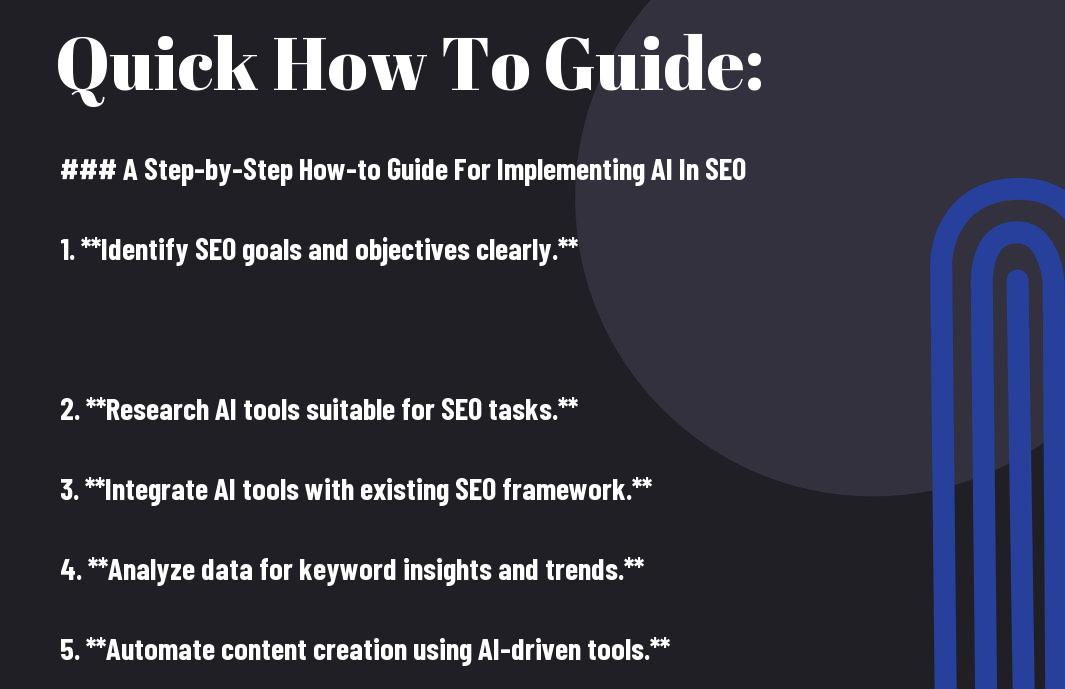
- Understanding AI Tools: Familiarize yourself with various AI tools and platforms that can enhance SEO strategies, such as content generation and keyword research tools.
- Data Analysis: Leverage AI for data analysis to identify trends and patterns in user behavior, which can inform SEO decisions.
- Content Optimization: Use AI-driven insights to improve content quality and relevance, ensuring it meets user intent and search engine requirements.
- Automation of Tasks: Automate repetitive SEO tasks with AI tools to save time and increase efficiency, allowing more focus on strategy development.
- Continuous Learning: Stay updated with the latest AI advancements in SEO, as the field is constantly evolving, and adaptability is key for success.
Understanding AI and SEO
The world of digital marketing is constantly evolving, and two of the most significant forces shaping this landscape are Artificial Intelligence (AI) and Search Engine Optimization (SEO). Understanding how these two disciplines intersect can be a game-changer for your online presence. As you investigate the possibilities of integrating AI into your SEO strategy, it’s crucial to grasp the fundamentals of both aspects.
What is Artificial Intelligence?
Understanding Artificial Intelligence begins with recognizing that it encompasses a collection of technologies designed to mimic human cognitive functions. This includes tasks such as learning, reasoning, and problem-solving. AI systems utilize vast amounts of data to analyze patterns and make predictions, which allows them to improve their performance over time. In the context of digital marketing, AI can automate mundane tasks, analyze user behavior, and even help generate content that resonates with your target audience.
As you integrate AI into your SEO strategy, you’ll discover its capability to enhance keyword research, optimize content for better ranking, and provide deeper insights into your audience’s preferences. The future of SEO is heavily dictated by how effectively you can harness AI tools to not only boost rankings but also tailor your marketing efforts more specifically to user intents.
The Importance of SEO in Digital Marketing
The importance of SEO in your digital marketing strategy cannot be overstated. SEO is the process of optimizing your website to achieve higher rankings in search engine results pages (SERPs), ultimately driving organic traffic to your site. In a world where consumers heavily rely on online searches to make informed decisions, not investing in SEO means missing out on a crucial opportunity to reach potential customers.
Specifically, effective SEO leads to increased visibility, credibility, and ultimately, conversions. As you build your online presence, leveraging SEO best practices will allow you to compete in a crowded marketplace and connect more meaningfully with your audience.
It is not simply about getting traffic; it’s about getting the right kind of traffic. Tailoring your SEO efforts provides your audience with relevant content that meets their specific needs, making your business a go-to resource.
How AI is Transforming SEO
One of the most exciting developments in the SEO landscape is how AI is transforming traditional practices. AI-driven tools can analyze your website and competitive landscape swiftly and accurately. They can uncover opportunities that would typically require exhaustive manual analysis. This capability enables you to make data-driven decisions about content creation, site structure, and user experience design, ultimately improving your rankings.
Additionally, AI plays a significant role in visitor segmentation and personalization. Using machine learning algorithms, AI can identify patterns in user behavior, allowing you to tailor content and recommendations uniquely based on individual preferences. This level of personalization not only enhances user experience but also encourages higher engagement rates and conversions.
Plus, AI can help you predict future trends and shifts in user behavior, giving you a competitive edge in your SEO strategy. By keeping one step ahead, you can adapt your content and marketing strategies proactively, rather than reactively, which is important in today’s rapidly changing market.

Preparing for AI Implementation
Now that you’ve decided to implement AI in your SEO strategy, the next step is to prepare adequately for this transition. Taking the time to assess your current SEO practices and identify clear objectives will ensure that you have a successful integration. This preparation can significantly enhance your website’s visibility, organic traffic, and ultimately, your conversion rates.
Assessing Your Current SEO Strategy
While you may have a set SEO strategy in place, it’s crucial to conduct a thorough assessment of its effectiveness before submerging into AI. Evaluate your current keyword rankings, backlinks, content quality, and user engagement metrics. By identifying areas that are performing well, as well as those that need improvement, you can pinpoint where AI can add the most value. This assessment will provide a clear baseline that can be used to measure success post-implementation.
While performing this assessment, also keep an eye on your competition. Use tools to evaluate their SEO strategies and the keywords they are targeting. Understanding where you stand in relation to your competitors can help you outline specific areas where AI can improve your overall strategy, whether that be through automation, content optimization, or predictive analytics.
Identifying Clear Objectives
Even with a solid SEO foundation, vague objectives can hinder your AI implementation. Ensure that you are clear about what you want to achieve with AI—be it increasing website traffic, improving content quality, or enhancing user experience. By setting specific, measurable goals, you’ll make it easier to assess the effectiveness of the AI tools you choose to implement.
Understanding how AI can cater to your unique objectives will allow you to select the right tools and methods tailored to your needs. For example, if your goal is to increase user engagement, you might look into AI-driven content personalization or chatbots for customer interaction. Conversely, if you aim to enhance your keyword strategy, AI can assist in identifying trending topics and high-traffic keywords that align with your objectives.
Gathering Necessary Tools and Resources
For your AI implementation to be successful, you must gather the necessary tools and resources. Research various AI tools that can directly benefit your SEO efforts, such as analytics software, content creation tools, and predictive modeling. Having the right technology in place will empower you to leverage AI effectively while aligning with your previously established objectives.
For instance, tools like SEMrush or Ahrefs can provide valuable insights into your keyword strategy, while AI-driven content creation platforms can enhance your content marketing efforts. Moreover, don’t forget to allocate sufficient budget and training resources for your team to adapt to these innovative technologies, as improper training could lead to underutilization and wasted investment.
Choosing the Right AI Tools for SEO
Once again, it’s important to approach the selection of AI tools for SEO with thoughtfulness and precision. The right tools can drastically improve your efficiency and effectiveness in optimizing your website. However, navigating the plethora of options available in the marketplace requires careful consideration of various factors, including features, benefits, cost, and compatibility with your existing systems. Choosing the wrong tool could lead to wasted resources and ineffective strategies, so it’s crucial to make an informed decision.
Overview of Popular AI SEO Tools
Any digital marketer will tell you that there is no shortage of AI SEO tools available today. Some of the most popular ones include SEMrush, Ahrefs, and Moz, each boasting unique functionalities designed to address different aspects of SEO. SEMrush, for example, offers extensive keyword research and competitive analysis features, while Ahrefs is known for its robust backlink analysis capabilities. On the other hand, Moz provides comprehensive on-page SEO recommendations and monitoring tools, making it a favorite among beginners.
Another noteworthy mention is Surfer SEO, which focuses on content optimization by analyzing top-performing pages for specific keywords and suggesting improvements. Similarly, tools like Frase utilize AI to help you create relevant content by providing topic research and questions people are asking online. With so many options at your disposal, it’s vital to evaluate these tools based on your specific needs and objectives.
Evaluating Features and Benefits
The evaluation of features and benefits of AI SEO tools is crucial for making an informed choice. Different tools offer distinct features, such as keyword tracking, competitor analysis, and on-page SEO audits. By assessing these functionalities, you can determine which tool aligns best with your SEO goals. Furthermore, consider the benefits each tool brings, such as improving your content strategy, enhancing your understanding of keyword opportunities, or simplifying your workflow through automation.
Evaluating the features also involves looking closely at how user-friendly the tools are. A tool that’s complicated to navigate could lead to inefficiencies, even if it has robust capabilities. Understand the customer support available and whether it offers tutorials, documentation, and community support. This comprehensive assessment will provide clarity on which tools can offer you the most return on your investment.
Selecting Tools Based on Your Needs
To select the right tools, start by identifying your specific SEO needs and goals. Do you want to optimize existing content, conduct keyword research, or keep tabs on your competition’s strategies? By determining your priorities, you can narrow down the list of AI SEO tools that will effectively meet those needs. Some tools may excel in certain areas—like content generation—while others may be more suited for technical SEO or backlinking strategies.
Features that focus on task automation can save you a great deal of time and effort as you work on improving your website’s performance. Additionally, look for tools that offer scalability, especially if you plan to grow your business or expand your SEO efforts. Choosing a tool that can adapt with you will ensure that you’re not left scrambling for new solutions as your requirements change.
Implementing AI in Your SEO Strategy
Despite the challenges SEO professionals face in an ever-changing digital landscape, implementing AI can significantly enhance your SEO strategy. AI brings advanced analytical capabilities that can help you stay ahead of competitors by making informed decisions based on real-time data and trends. In particular, understanding how to effectively leverage AI’s insights can not only streamline your processes but also result in improved search rankings and user engagement.
Data Analysis and Insights Generation
Any successful SEO strategy starts with a robust analysis of your website’s performance and audience behavior. By utilizing AI-driven tools, you can gather extensive data from multiple sources, including website analytics, social media engagement, and market trends. These tools analyze vast amounts of data far quicker than traditional methods, providing you with actionable insights into what works and what doesn’t for your audience. This enables you to refine your SEO efforts and tailor them to meet your users’ needs effectively.
Furthermore, AI can pinpoint seasonal trends or sudden changes in user behavior which might go unnoticed through manual analytics. By monitoring this data regularly, you can make proactive adjustments to your strategy, thus enhancing your website’s performance while keeping audience interest alive. The ability to make data-driven decisions is crucial; it allows you to understand which keywords resonate with your audience and which strategies yield the best outcomes.
Automating Keyword Research
With the right AI tools, keyword research no longer has to be a tedious, time-consuming task. Instead, you can automate the process, empowering you to focus on higher-level strategy and execution. AI algorithms can analyze search patterns, competitor keywords, and user intent almost instantaneously. By using these insights, you can quickly identify high-potential keywords that can drive organic traffic to your site.
Implementing automated keyword research tools not only accelerates the analysis but also increases accuracy. These tools leverage historical data alongside real-time trends, providing you with a comprehensive keyword list that reflects current market demands. With automated suggestions, you’re more likely to discover long-tail keywords that can result in higher conversion rates when compared to generic terms.
Optimizing Content Creation with AI
On the content creation front, AI can significantly enhance your website’s relevance and authority. Advanced algorithms can assist you in generating high-quality content tailored to your audience’s preferences. You can feed AI tools with your target keywords, and they will suggest content outlines, topics, or even draft full articles that resonate with your target audience while adhering to SEO best practices.
The benefits of using AI in content creation extend beyond just generating text. AI tools can analyze which types of content perform best in your niche, helping you to craft engaging and optimized material. Furthermore, they can suggest relevant multimedia options, enriching your written content to make it more impactful for readers. By focusing on creating quality content optimized through AI, you stand a better chance of increasing engagement and driving traffic to your site.
Keyword extraction tools powered by AI further streamline the content optimization process. They analyze your existing articles to identify gaps in keyword usage and offer suggestions to enhance search visibility, broadening your audience reach.
Monitoring and Measuring Success
Many businesses underestimate the importance of monitoring and measuring success after implementing AI in their SEO processes. To ensure that your AI strategies are effective, it’s crucial to establish a robust monitoring framework that allows you to track relevant metrics consistently. This ongoing evaluation will empower you to make decisions based on real data, ultimately guiding your efforts toward maximizing ROI. By keeping a close eye on performance indicators, you can gain a clear understanding of how well your AI initiatives are impacting your SEO strategies.
Key Metrics to Track Post-Implementation
Some of the key metrics you should track post-implementation include organic traffic, search engine rankings, and conversion rates. These metrics provide insight into how well your SEO is performing since the integration of AI technologies. You should also monitor user engagement metrics like bounce rates and time on page, as they indicate how well your content resonates with visitors. By analyzing these figures regularly, you can identify trends and make data-driven adjustments to optimize your AI applications further.
Using AI for Real-time Analytics
There’s a significant advantage in utilizing AI for real-time analytics in your SEO strategy. By employing AI-powered tools, you can gather and analyze data instantaneously, allowing you to respond to fluctuations in traffic, keyword rankings, and user behavior as they happen. This ability to assess real-time data puts you in a strong position to pivot your strategies or focus your efforts where they are needed most. Moreover, real-time insights can help identify opportunities or threats that may not become apparent until much later through traditional methods of measurement.
Another key benefit of relying on AI for real-time analytics is your ability to automate reporting processes. This frees up valuable time, allowing you and your team to focus more on strategy development and less on sifting through spreadsheets. With AI continuously monitoring your SEO performance, you receive timely notifications about significant changes or trends, enabling proactive measures that can further enhance your search visibility and audience engagement.
Adjusting Strategies Based on Performance Data
Analytics serves as the backbone of your SEO strategy, particularly when it comes to adjusting your approaches based on performance data. As you gather and process insights from your AI tools, you’ll notice areas of underperformance that require immediate attention. Making informed adjustments to your content, keyword strategies, or link-building efforts based on these findings can make all the difference in maintaining your search rankings and driving traffic to your site.
Plus, this iterative process of assessment and adjustment fosters a culture of continuous improvement within your organization. Instead of relying on static strategies that may become outdated quickly, you’ll have an adaptive SEO approach that evolves alongside search engine algorithms and user behaviors. This responsiveness is increasingly important in the fast-paced digital landscape, enabling you to stay ahead of your competitors and secure your position in search engine results.
Best Practices and Tips for AI in SEO
All digital marketers and SEO specialists must embrace the integration of AI tools into their strategies. Here are some best practices and tips for implementing AI in SEO:
- Utilize AI-powered tools for keyword research to uncover hidden opportunities.
- Leverage AI analytics for in-depth performance reviews and insights.
- Optimize content creation by employing AI-generated suggestions that align with user intent.
- Monitor and adjust your SEO strategies in real-time using AI-driven data processing.
- Prioritize natural language processing techniques to improve content relevance.
Assume that you consistently apply these practices, your SEO strategy will become more agile and data-driven, enhancing your overall effectiveness in reaching your target audience.
Staying Updated with AI Trends
Staying informed about the latest trends in AI is necessary for maintaining a competitive edge in SEO. The landscape is constantly evolving, and being aware of these changes allows you to optimize your strategies accordingly. Regularly check reputable SEO blogs, attend webinars, and participate in online forums to gain insights into how AI is being utilized for search engine optimization.
Additionally, consider following industry leaders on social media who share valuable updates and case studies about AI applications in SEO. By keeping your finger on the pulse of technological advancements, you can harness new tools and techniques that could significantly benefit your SEO efforts.
Continuous Learning and Adaptation
You must embrace a mindset of continuous learning and adaptation when integrating AI into your SEO strategy. As algorithms and technologies change, your methods must evolve as well. Invest time in understanding how AI systems analyze data and predict trends, as this knowledge will empower you to make informed decisions that align with the shifting dynamics of SEO.
Moreover, actively seek opportunities for training, whether through online courses, workshops, or mentorship from experts in AI and SEO. Engaging with a community of learners can provide fresh perspectives and innovative strategies that enhance your knowledge and skills.
Learning how to effectively apply AI in SEO requires a commitment to staying ahead of the curve. Regularly assess the outcomes of your AI-driven decisions to understand what works best for your unique scenario, making adjustments as necessary to optimize performance.
Ensuring Ethical AI Use in SEO
With the growing use of AI in SEO, it is imperative that you consider the ethical implications of your techniques. The use of AI should aim to enhance users’ experience rather than manipulate search engine results unethically. Ensure transparency and responsibility in your approach, particularly when automating processes that could impact users.
Moreover, AI should be used to augment human decision-making, not replace it. This balance is critical for fostering trust with your audience and maintaining the integrity of your brand in the long run.
For instance, always disclose if you are using AI to personalize content or gather data about user preferences. This openness not only reinforces your commitment to ethical practices but also builds confidence and loyalty among your audience, resulting in more sustainable and trustworthy relationships.
Summing up
So, as you commence on your journey to implement AI in your SEO strategy, remember that the process is both systematic and iterative. By starting with a clear understanding of your goals and collecting relevant data, you set the foundation for effective deployment. Embrace tools that harness AI capabilities, but do not overlook the importance of human insight. These elements combined will empower you to optimize your content better, improve user engagement, and ultimately enhance your website’s search engine visibility.
As you move forward, continuously monitor the results of your AI-driven strategies and be prepared to make adjustments. The digital landscape is constantly evolving, and so too should your approach to SEO. By keeping your finger on the pulse of the latest trends and technologies, you ensure that your SEO efforts remain relevant and effective. The integration of AI into your SEO practices can seem daunting, but with each step, you will find yourself better equipped to navigate this exciting frontier.
Comments