

Most businesses today face fierce competition in the online landscape, making it vital for you to stay ahead in SEO. Leveraging the power of AI for competitive analysis can provide you with invaluable insights into your competitors’ strategies, helping you identify opportunities and pitfalls. In this post, you will discover effective techniques to harness AI tools, refine your SEO strategies, and ultimately boost your visibility and rankings. Equip yourself with the knowledge to not only keep pace but also to dominate your niche.
Key Takeaways:
- Utilize AI tools for in-depth data analysis: Leverage AI-powered platforms to gather and analyze vast amounts of SEO data quickly, allowing for more informed decision-making.
- Perform competitor analysis effectively: Use AI to identify competitors’ strategies, keyword targeting, and content performance, giving you insights to adjust your own approach.
- Optimize content strategy: AI can help in generating content ideas based on trending topics and competitors’ successes, ensuring your content remains relevant and engaging.
- Monitor SERP changes: AI tools can track search engine result page (SERP) shifts in real-time, helping you adapt your SEO tactics to maintain your rankings.
- Automate routine tasks: Streamline repetitive SEO tasks with AI automation, allowing your team to focus on strategic planning and creative efforts.
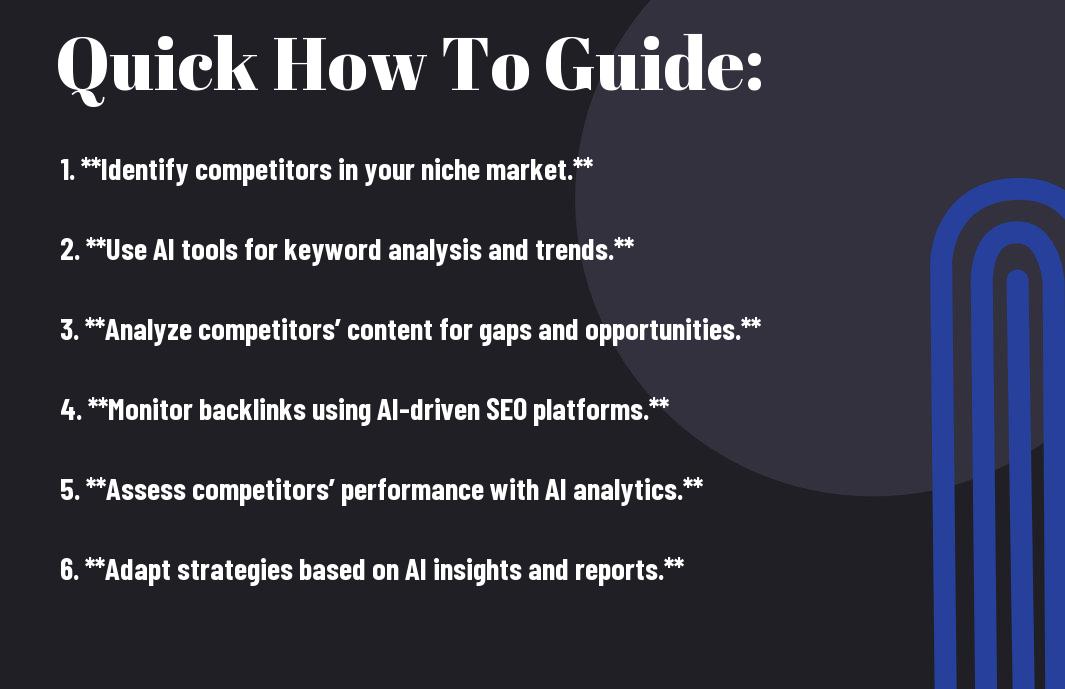
Understanding SEO
Before exploring into how you can leverage AI for competitive analysis in SEO, it’s crucial to understand what SEO is and why it matters in the digital realm. SEO, or Search Engine Optimization, is a systematic approach aimed at improving the visibility of your website on search engines. It revolves around various strategies and techniques designed to earn high rankings in search results. Ignoring SEO is akin to setting up a beautiful shop in a deserted street; without traffic, your products or services won’t reach the audience you want.
What is SEO?
Assuming you’re new to the concept, SEO involves a range of practices to enhance your website, making it easier for search engines to understand and rank your content. You might be asking yourself why this matters. In essence, the better your website is optimized, the higher it will rank in the search engines when users look for products or services like yours. This higher visibility can lead to increased website traffic, generating more potential customers.
Importance of SEO in Digital Marketing
What makes SEO so vital in digital marketing is its ability to drive organic traffic to your site, cutting expensive marketing costs while engaging users who are actively searching for what you offer. Unlike paid ads, organic search is a long-term investment; once you generate quality content and rank on the first page, your website can continue to attract visitors without the need for ongoing expenditure. Moreover, effective SEO enhances credibility, as consumers trust businesses appearing on the first page over those buried further down the search results.
To fully appreciate the significance of SEO, consider that more than 90% of online experiences begin with a search engine. If you want to ensure your business is discovered and chosen over competitors, a solid SEO strategy becomes non-negotiable. With potential customers already searching for your services, the importance of your site’s visibility and how well it ranks cannot be overstated.
Key Components of SEO
Any SEO strategy should consist of several key components that work together to ensure that your website performs at its best. These components include keyword research, which helps identify what terms your target audience is using, on-page SEO for optimizing individual web pages, and off-page SEO, involving strategies that drive traffic from outside sources. Additionally, the site’s technical SEO ensures that your website’s architecture is properly configured for search engines.
It’s imperative to regularly assess these components and stay updated with search engine algorithms to maintain or improve your rankings. As you develop and refine your SEO strategy, consider how these components interlink; ignoring one aspect may adversely affect the others, potentially diminishing your online visibility.
Components of SEO create a robust framework for your digital marketing strategy. When done correctly, they can lead to a significant increase in traffic, a better user experience, and ultimately, an uptick in conversions. By mastering these components, you position yourself to outpace competitors and establish a strong online presence.

The Role of AI in SEO
While search engine optimization (SEO) continues to evolve, integrating artificial intelligence (AI) into your strategy can significantly enhance your capabilities. AI technologies enable you to analyze vast amounts of data, identify trends, and predict user behavior in ways that traditional methods cannot match. By leveraging AI, you can optimize your website to not only improve ranking but also to enhance user experience, which is necessary for long-term success in the competitive landscape of digital marketing.
Overview of AI Technologies in SEO
You may find that AI technologies range from machine learning algorithms that assess website performance to natural language processing systems that enable more sophisticated content creation. Techniques like predictive analysis can offer insights into what content topics will resonate with your audience, while AI-driven tools can help automate and optimize tasks such as keyword research and backlink assessment. By embedding these technologies into your SEO strategy, you can implement a more data-driven approach for better decision-making.
Benefits of Using AI for SEO
To stay ahead in the world of SEO, using AI tools can provide you with **data-driven insights** that inform your strategy. These insights help identify gaps in your content, track your competitors’ movements, and forecast changes in search trends. Additionally, AI can assist in tailoring your content to meet user intent more closely, ensuring that your material is relevant and appealing to your audience. With AI, you’re not just reacting to data; you’re proactively shaping your SEO strategy to adapt to future changes effectively.
Using AI for SEO not only streamlines your processes but also enhances your effectiveness. With its ability to analyze large datasets quickly, AI helps you **discover actionable insights** that would be nearly impossible to gather manually. This means you can focus more on creative tasks and strategy formulation while your AI tools handle the time-consuming data analysis, keeping you ahead of competitors who might still rely on outdated methods.
Common AI Tools for SEO
Using common AI tools can greatly enhance your SEO capabilities. Tools like SEMrush and Ahrefs have integrated AI features that allow you to scrutinize your competitors, analyze backlinks, and optimize your keyword strategy with ease. These tools provide you with real-time data, enabling you to make quick and informed decisions regarding your SEO tactics. Furthermore, other platforms like Clearscope and MarketMuse use AI to help you create content that aligns more closely with SEO best practices by providing keyword suggestions and content optimization tips.
The key to utilizing AI tools effectively lies in understanding their features and capabilities. For instance, tools like Surfer SEO can analyze existing top-ranking content and suggest improvements based on data extracted from hundreds of articles. This can give you a significant edge in creating better, more relevant content that stands out to both users and search engines alike, ensuring a greater chance of ranking higher.
Competitive Analysis in SEO
After you have established your SEO goals, the next step is to conduct a thorough competitive analysis. This process helps you understand where your website stands in relation to your competitors and identifies opportunities for improvement. Competitive analysis involves researching your competitors’ online presence, keyword strategies, content performance, and backlink profiles. By delving into these areas, you can develop tactics to outperform them in search engine rankings.
What is Competitive Analysis?
While many marketers might focus solely on their own strategies, competitive analysis is about diving deep into the landscape of your industry. You’ll analyze competitors to uncover their strengths and weaknesses, which can directly influence your own SEO tactics. This comprehensive examination goes beyond merely gathering data; it involves interpreting that data to make informed decisions aimed at gaining a competitive edge.
Importance of Competitive Analysis for SEO
One of the key reasons competitive analysis is necessary for SEO is that it helps you identify opportunities that you might not have considered otherwise. By observing what works for your competitors, you can replicate and enhance those strategies within your own framework. This approach not only boosts your visibility but also allows you to align your content and marketing efforts with industry trends.
Understanding your competitors’ performance can also shed light on gaps in the market that you can exploit. For instance, if you notice that a competitor is struggling to rank for specific keywords, you can develop content that targets those areas, thus positioning your website as the authority on that topic. This proactive mindset is critical for developing a robust SEO strategy.
Key Factors in Competitive Analysis
To effectively conduct competitive analysis for SEO, you should focus on several key factors. Consider the following elements that can provide insight into your competitors’ strategies:
- Keyword performance: Identify the keywords that bring traffic to your competitors’ sites.
- Content strategy: Analyze the types and quality of content they produce.
- Backlink profile: Evaluate their link-building strategies and sources.
- User engagement: Examine social signals and audience interaction with their content.
- On-page SEO: Assess technical aspects that enhance their visibility.
Any detailed assessment of these factors will give you a clearer picture of your competitive landscape.
Understanding these key factors allows you to develop a strategic approach tailored to your specific needs. Keeping track of your competitors’ activities ensures you remain agile and responsive to changes in the market. This level of awareness is crucial as it informs your own SEO strategies and helps you avoid pitfalls your competitors may have encountered.
- Current trends: Stay informed on the latest industry trends to anticipate shifts.
- Tracking performance: Use tools to monitor your competitors’ ranking and traffic.
- Content gaps: Look for subjects that are underrepresented in their strategy.
- Technical SEO: Understand the technical aspects influencing their success.
Any adjustments you make will ensure that your competitive analysis remains up-to-date and relevant.
Competitive analysis is, indeed, an ongoing task that requires vigilance and flexibility. By continuously monitoring and evaluating your competitors, you can take proactive steps to enhance your own SEO strategies and solidify your position in the market.
How to Use AI for Competitive Analysis
Many digital marketers and business owners are leveraging the power of artificial intelligence (AI) to enhance their competitive analysis efforts. By adopting AI tools and methodologies, you can gain valuable insights into your competitors’ strategies, identify gaps in your own approach, and ultimately position yourself to outperform them in SEO. The ability to analyze data at scale allows you to make informed decisions about your content, keywords, and overall digital marketing strategy.
Setting Up Your Competitive Analysis
While establishing your competitive analysis framework, it’s crucial to determine the scope of your research. Start by defining the parameters of your analysis, including the key performance indicators (KPIs) you want to track, such as organic traffic, backlink profiles, and keyword rankings. AI tools can help automate data gathering, letting you focus on interpretation rather than number crunching. Leveraging advanced algorithms will not only provide you with comprehensive data but also allow for real-time tracking and updates on your competitors’ performance.
Additionally, ensure that you have access to **robust AI platforms** that can handle large volumes of data. This setup will equip you to analyze multiple competitors simultaneously and capture a broader market perspective. Bear in mind, the goal is to uncover actionable insights and develop strategies that lead to sustained success in your SEO efforts.
Identifying Your Competitors
If you want to perform effective competitive analysis, identifying your core competitors is the first step. Start by listing both direct and indirect competitors within your niche. AI-driven tools can assist you in discovering not just well-known rivals but also emerging players that might be gaining traction and could challenge your market position. These insights will help to refine your strategies and focus on the right targets for comparison.
Competitive intelligence also involves assessing competitors across various dimensions, such as their audience engagement and marketing tactics. By embracing a 360-degree view of your competition, you can better understand their strengths and weaknesses, guiding your optimization initiatives.
Competitive analysis goes beyond merely ranking organizations; it involves understanding the underlying factors that contribute to their success and identifying opportunities for your business to capitalize on. By utilizing AI to highlight these areas, you can craft a more targeted and effective strategy.
Analyzing Competitor Websites
Analysis of competitor websites is important for uncovering insights into their SEO strategies. Start by examining their site architecture, content quality, and optimization techniques. AI tools can analyze elements such as page speed, mobile responsiveness, and on-page SEO factors in just a few clicks, allowing you to benchmark your performance against theirs. Additionally, look at user experience (UX) aspects and how they engage their visitors.
Furthermore, focus on the keywords that competitors are targeting on their websites. Analyzing competitor keyword strategies will enable you to identify potential gaps and opportunities in your own approach. This analysis not only helps you to understand what works but also offers direction towards developing unique content that can outshine theirs.
Plus, consider utilizing AI tools for sentiment analysis of user reviews and feedback on competitor sites. Understanding customer sentiment can provide you with insights into what customers value most, allowing you to position your offerings effectively. By keeping a close eye on competitor websites, you’ll ensure that your SEO strategy remains relevant and competitive in an ever-evolving digital landscape.
Tips for Staying Ahead with AI-Driven Insights
For those looking to maintain a competitive edge in the ever-evolving landscape of SEO, leveraging AI-driven insights can be a game changer. With the right strategies, you can implement data-driven decisions to take your SEO efforts to the next level. Here are some tips to guide you in using AI effectively:
- Utilize AI tools for keyword research to uncover high-value opportunities.
- Analyze audience data to inform your content strategy.
- Monitor competitors’ SEO strategies to stay competitive.
- Adopt machine learning algorithms for refining ranking factors.
- Use automated reporting systems to keep your SEO performance in check.
Assume that by adopting AI into your SEO practices, you’re positioning yourself strongly to stay ahead of the competition.
Leveraging AI for Keyword Research
Tips for conducting effective keyword research are pivotal to your SEO success. By leveraging AI tools designed for keyword analysis, you can uncover valuable insights that traditional research methods may overlook. These tools analyze search trends and user intent to identify not just the most popular keywords, but also long-tail keywords that can attract more targeted traffic to your site.
Moreover, AI can help you discover related keywords and variations, allowing you to create optimized content that answers your audience’s questions. As a result, you can drive more organic traffic, improve your content relevance, and enhance your site’s visibility in search results.
Utilizing Data to Optimize Content Strategy
Research shows that utilizing data effectively can dramatically enhance your content strategy. By analyzing performance metrics, you can ascertain which types of content resonate most with your audience. AI tools can provide insights into reader engagement and content consumption patterns, guiding you to create relevant and impactful content while capitalizing on trending topics.
Additionally, consider employing sentiment analysis to gauge audience feelings towards your existing content. This feedback can help you refine your approach and adapt your messaging to cater to what your audience finds most valuable.
Utilizing these insights allows you to adjust your content focus dynamically, ensuring that you stay relevant and ahead of the curve.
Monitoring Competitor SEO Strategies
Assuming a proactive stance in monitoring your competitors’ SEO strategies, you can gain critical insights that inform your own strategies. Utilizing AI tools that track competitor performance can reveal ranking changes, keyword targets, and content strategies that yield results. By identifying gaps or weaknesses in their approach, you can tailor your strategies to capitalize on their oversights.
Moreover, effective monitoring can help you benchmark your performance against competitors, allowing you to set realistic goals based on real-time data. This not only improves your SEO visibility but also aids in strategic planning.
Understanding the specific tactics your competitors employ can provide additional layers of insight into shifts in industry standards and emerging trends. Hence, maintaining an agile response can position you as a leader in your niche.
Factors to Consider for Effective SEO
Not all SEO strategies yield the same results. To maximize your visibility and ranking potential on search engines, you need to factor in several pivotal components. Understanding the interplay of different elements and optimizing them will make a difference in your website’s performance. Here are some critical factors you should consider:
- Technical SEO factors that enhance site performance
- On-Page SEO elements to optimize content
- Off-Page SEO factors to build authority
Recognizing how these factors influence each other will lead to a more comprehensive approach to your SEO strategy.
Technical SEO Factors
While diving deep into technical SEO, you’ll find that it covers a broad spectrum of elements that can significantly affect your site’s visibility. Key components such as site speed, mobile-friendliness, secure connection (HTTPS), and XML sitemaps are necessary for maintaining user experience and adherence to search engine algorithms.
- Site speed to ensure fast loading times
- Mobile-friendliness for accessibility across devices
- HTTPS for security and trustworthiness
- XML sitemaps for better site indexing
Any lapse in these areas could lead to higher bounce rates and consequently diminish your site’s ranking on search engines.
On-Page SEO Factors
Assuming you have technical factors under control, focusing on on-page SEO is your next step. On-page SEO involves optimizing individual pages to rank higher and earn more relevant traffic. This includes using relevant keywords, crafting engaging meta descriptions, and ensuring proper header tags are implemented effectively throughout your content.
- Relevant keywords in titles and content
- Engaging meta descriptions to attract clicks
- Header tags for structured content
- Alt text for images to improve accessibility
This holistic approach will boost your rankings and help you build a more engaging website for your audience.
Consider diving deeper into the specifics of on-page SEO, encompassing not just your content strategy but also user experience elements like internal linking and content hierarchy. Here are some vital aspects to pay attention to:
- Internal linking to boost page authority
- Content hierarchy to improve navigation
- User engagement metrics as ranking signals
This comprehensive approach enriches user experience, thus leading to longer site visits and lower bounce rates.
Off-Page SEO Factors
If you want to enhance your website’s authority, off-page SEO is where it’s at. This relates to external factors influencing your site’s rankings, such as backlinks, social media engagement, and your brand’s overall online presence. High-quality backlinks from reputable sources can use your authority, while social signals also contribute to your site’s relevance.
- Backlinks built from authoritative sites
- Social media engagement to expand reach
- Brand mentions to bolster authority
Perceiving how important these factors are can steer your marketing efforts in the right direction, leading to a more robust online presence.
Moreover, diving further into off-page SEO can help establish a more extensive link-building strategy, ensuring that your website garners the exposure it needs. Consider the following:
- Guest blogging to earn backlinks
- Influencer partnerships for wider reach
- Online community engagement to foster trust
Perceiving these components allows you to develop a solid and well-rounded SEO strategy that will ultimately enhance your site’s performance.
To wrap up
Summing up, staying ahead in SEO requires not only consistent effort but also the ability to leverage cutting-edge tools and technologies, particularly AI for competitive analysis. By integrating AI-driven insights into your strategy, you can efficiently analyze your competitors’ strengths and weaknesses, identify trending keywords, and optimize your content to fill gaps in the market. The data generated can help you make informed decisions about where to focus your resources, ensuring that you maintain a competitive edge in the ever-evolving landscape of search engine optimization.
Ultimately, employing AI in your competitive analysis empowers you to move beyond basic knowledge and react swiftly to changes in your niche. You can enhance your ability to predict shifts in consumer behavior and SEO trends, allowing you to adapt and optimize your strategies proactively. Keep refining your approach by continuously learning from the AI tools at your disposal, and you’ll position yourself favorably against your competitors, ensuring that your website attracts and retains your target audience more effectively.
Comments