
This guide will empower you to maximize your content strategy by integrating AI tools effectively. As digital landscapes evolve, it’s crucial that you harness the power of artificial intelligence to enhance your messaging, reach the right audience, and improve SEO rankings. You’ll learn vital practices that not only streamline your workflow but also elevate the quality of your content creation. Embrace these strategies to avoid common pitfalls and stay ahead of competitors in this increasingly tech-driven environment.
Key Takeaways:
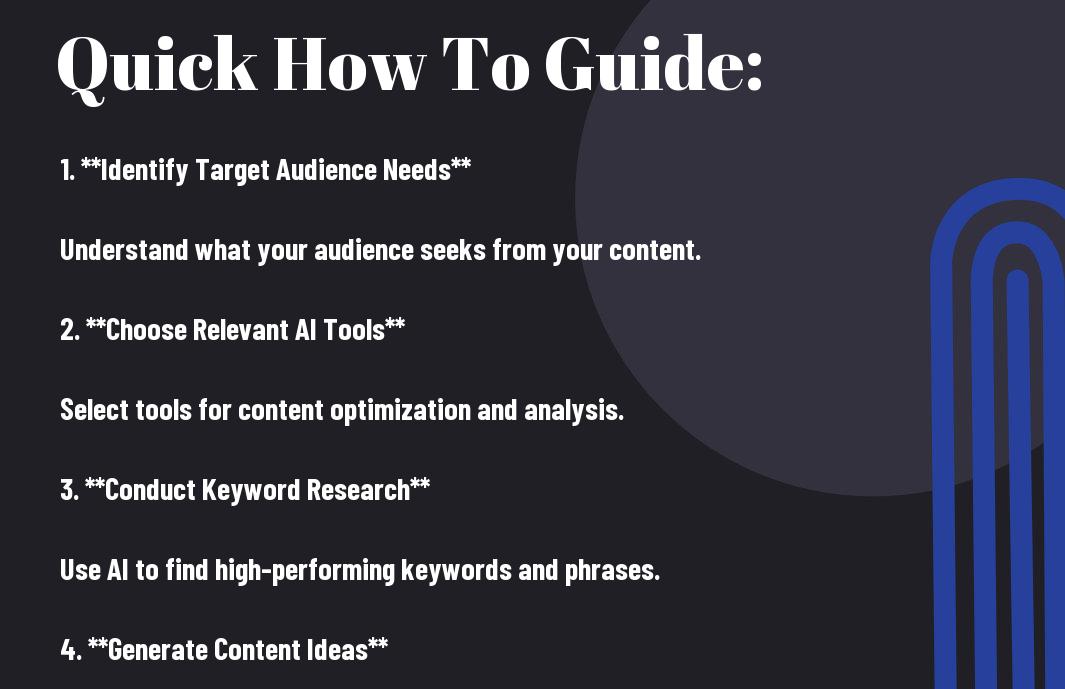
- Utilize AI Tools: Leverage advanced AI tools to analyze your content’s performance and identify areas for improvement.
- Keyword Optimization: Implement AI-driven keyword research to enhance SEO and increase your content’s visibility.
- Content Personalization: Use AI algorithms to create personalized content that resonates with specific audience segments.
- Data Analysis: Regularly analyze user engagement data to refine your content strategy based on real-time insights.
- Continuous Learning: Stay updated on AI advancements and incorporate best practices into your content optimization processes.
Understanding AI in Content Optimization
While many marketers and content creators may feel overwhelmed by the rapid advancement of technology, understanding AI in content optimization can fundamentally transform the way you produce and distribute information. AI content optimization refers to the use of artificial intelligence tools and algorithms to enhance your content quality, making it more relevant and engaging for your audience. By analyzing vast amounts of data, AI can provide insights that help you tailor your content strategies to better meet the needs and preferences of your target audience, ultimately driving more traffic and conversions.
What is AI Content Optimization?
While traditional content creation methods rely heavily on human intuition and experience, AI content optimization employs machine learning and natural language processing to enhance the effectiveness of your content. These technologies analyze user behavior, search trends, and other data points to suggest improvements in your content strategy. With AI, you can identify which keywords are trending, how to structure your articles for maximum engagement, and even discern what type of content resonates most with your audience.
Key Benefits of Using AI for Content
Content optimization powered by AI can catalyze your overall content strategy, bringing about numerous advantages. First and foremost, AI tools can help you generate content ideas and recommend improvements based on extensive data analysis, which ensures your content remains relevant and timely. Additionally, AI-driven analytics can significantly speed up your research process, allowing you to focus on creation rather than data gathering, ultimately conserving your valuable time.
What’s more, integrating AI into your content strategy not only streamlines your workflow but also enhances audience engagement and increases your chances of achieving high search engine rankings. The data-driven insights provided by AI help you tailor your content to meet the specific needs of your audience, which builds trust and credibility over time. By leveraging these critical benefits, you can optimize your content and ensure it delivers value, relevance, and impact, leading to long-term success in your content marketing efforts.
How to Leverage AI for Content Creation
There’s no doubt that AI can be a game-changer in content creation, helping you streamline your process and enhance the quality of your outputs. The key to successfully leveraging AI lies in understanding how to use these advanced tools to your advantage while maintaining a personal touch that resonates with your audience. By combining AI capabilities with your unique insights, you can create content that stands out and serves your target audience effectively.
Selecting the Right AI Tools
Clearly, the landscape of AI tools available for content creation is vast and varied, making it important to choose the right ones for your specific needs. Start by evaluating your content type—whether it’s blog articles, social media posts, or even video scripts—and search for AI solutions that specialize in these formats. Consider features such as language processing, readability, and tone adjustments to ensure the tools align with your voice and brand identity.
Additionally, take into account the integration capabilities of these AI tools with your existing workflow. You want to choose solutions that can seamlessly integrate with your content management systems or collaboration platforms, allowing you to maintain efficiency in your content strategy. Remember that the goal is to enhance your creativity, not to hinder it with complex tools that require extensive learning curves.
Tips for Generating Engaging Content
Content that captures your audience’s attention must be both informative and engaging. Use AI to analyze trending topics and popular keywords within your niche, ensuring your content resonates with what your audience is actively searching for. By tapping into these analytics, you can craft headlines and articles that not only inform but also pique interest.
- Utilize analytics to find trending topics.
- Incorporate keywords naturally in your writing.
- Utilize storytelling techniques for relatability.
Perceiving your audience’s preferences will enable you to deliver content that captivates and retains their attention, fostering a loyal readership.
Content creation can significantly benefit from a keen understanding of your audience’s needs and interests. Use AI tools to help you generate ideas, conduct sentiment analysis, and identify gaps that you can fill in your content strategy. This proactive approach allows for a steady flow of engaging topics that keep your readers coming back for more.
- Use sentiment analysis to gauge audience emotions.
- Identify content gaps that you can address.
- Leverage personalization tools for tailored content.
Perceiving the nuances of your audience’s behavior can be pivotal in crafting content that is not only engaging but also meaningful.
Balancing Creativity and Automation
Balancing creativity and automation is crucial in the era of AI-assisted content creation. While AI can generate text and suggest ideas, the human touch you bring to the writing process is irreplaceable. Aim to use AI tools for data-driven insights and initial drafts, but be sure to infuse your voice, creativity, and personal anecdotes into the final piece. This fusion of technology and personal expression will help you resonate with your readers.
Furthermore, set boundaries on how much you rely on AI to prevent content from becoming too generic or mechanical. Your authentic perspective is what differentiates your content from others, and using AI merely as a supplement, rather than a replacement, will uphold your unique style and message.
Engaging content requires a thoughtful blend of personal creativity and AI efficiency. It’s important to view AI as a collaborative partner in your content creation process rather than a replacement for human insight. With careful consideration of both elements, you can harness the power of AI while maintaining the authenticity and engagement that your audience craves. In doing so, you position yourself not just to meet their expectations, but to exceed them, crafting experiences that are enriching and memorable.
Best Practices for Keyword Optimization
Unlike the traditional methods of keyword usage that often led to keyword stuffing, today’s SEO landscape emphasizes the importance of strategically integrating keywords within your content to enhance visibility and relevance. The focus has shifted towards creating high-quality content that serves the user’s intent, ensuring you appeal to both your audience and search engine algorithms. This recalibration necessitates a nuanced understanding of how keywords function in your content, making it necessary for you to grasp their significance thoroughly.
Importance of Keywords in Content
Clearly, keywords play a crucial role in ensuring your content is discoverable. They act as the bridge that connects your content to the queries your audience is searching for online. When you incorporate relevant keywords effectively, you enhance your chances of appearing in search engine results, which not only boosts your website traffic but also increases your brand visibility and authority in your niche. As such, the choice and placement of keywords can significantly impact your content’s overall performance.
Furthermore, keywords are not just about bringing traffic; they help convey intent and context to your messages. Understanding the context behind your target keywords allows you to tailor your content to further match the needs and preferences of your audience, leading to increased engagement and, ultimately, conversion rates. Crafting your content with a keyword strategy in place ensures that you are directly addressing your audience’s search behavior.
AI Tools for Keyword Research
With the advent of AI technologies, you now have access to powerful keyword research tools that can streamline your optimization process. These tools not only help you discover relevant keywords that resonate with your target audience but also provide insights into keyword trends, search volume, and competition. Utilizing these AI-driven resources allows you to make data-informed decisions, thus optimizing your content more effectively.
Optimization of your keyword strategy using AI tools means you can easily access and analyze large datasets, allowing for a more refined approach to content creation. These tools can generate a comprehensive list of related keywords, suggest long-tail variations, and even forecast trending topics, empowering you to stay ahead of the competition and align your content with audience interests.
Using Long-Tail Keywords Effectively
Practices aimed at incorporating long-tail keywords can significantly enhance your content’s relevance and reach. Long-tail keywords, which typically consist of three or more words, tend to have lower competition and higher conversion rates. By focusing on these specific phrases, you can target a more niche audience, ensuring that your content resonates with users seeking precisely what you offer.
Moreover, long-tail keywords often represent more specific search intent, allowing you to create content that caters directly to users’ needs. This not only increases the likelihood of conversions but also positions you as an authority in your area of expertise. Crafting your content around long-tail keywords requires you to understand your audience’s pain points and tailor your messaging to effectively address them.
Best practices indicate that when using long-tail keywords effectively, you should aim for natural integration within your content. This ensures a seamless reading experience while still satisfying search engine algorithms. Remember to place your long-tail keywords in key areas such as titles, headings, and throughout your text, but avoid over-optimization. By doing so, you create valuable content that both your audience and search engines will appreciate.
Enhancing Readability with AI
Keep in mind that content readability plays a pivotal role in engaging your audience and driving them to take action. Even the best-structured content can fall flat if your readers struggle to understand it. Content that is easy to read not only keeps your audience’s attention but also enhances their comprehension, fostering a robust connection between you and your readers. By prioritizing readability, you’re more likely to increase the time spent on a page, reduce bounce rates, and encourage social sharing, laying the groundwork for a loyal following.
Importance of Readability in Content
Even a well-researched article packed with valuable information can fail to make an impact if it’s not easy to digest. Your readers may quickly lose interest or misinterpret your message when faced with complex language or convoluted sentences. Moreover, high readability is crucial for accessibility; not all of your audience may possess the same level of literacy or domain expertise. By ensuring that your content is easily readable, you are broadening your reach and enhancing user experience.
AI Techniques for Improving Readability
Importance of incorporating AI techniques into your writing process cannot be understated. AI-powered tools can assist you in breaking down complex phrases into simpler alternatives, suggest sentence structures that flow better, and even recommend vocabulary changes that enhance clarity. Utilizing AI can help you achieve a more consistent tone and style throughout your content, making it not only more enjoyable to read but also more engaging and user-friendly.
With the integration of AI tools, you can revolutionize the way you approach your content. These technologies analyze your writing in real time, providing suggestions that can help eliminate jargon, trim excess wordiness, and improve sentence variety. By leveraging AI-driven insights, you’ll ensure that your content caters to a wider audience, encouraging deeper interaction and understanding.
Tools to Analyze Readability Scores
Little do many know, there are various tools available that provide readability scores which can give you critical insights into how your content is being perceived. These scores take into account factors such as sentence length, word choice, and overall tone, offering you a quantifiable measure of your content’s accessibility. With these insights, you can make informed decisions on how to adjust your writing for optimal engagement.
A readability score is a quick way to gauge if your writing matches the intended audience. Tools like the Flesch-Kincaid readability test, Gunning Fog Index, or more sophisticated AI-driven platforms offer comprehensive insights that can help you enhance your content quality. By understanding how your score correlates with audience engagement, you can make necessary changes that resonate more effectively with your readers, ensuring your content not only reaches them but also impacts them positively.
Personalization Strategies Using AI
All successful content strategies today rely heavily on the ability to connect with audiences on a personal level. With the advent of advanced technologies, particularly Artificial Intelligence (AI), you can now tailor your content to meet individual user preferences, enhancing user engagement and loyalty. Incorporating AI-driven personalization strategies can optimize your content and significantly improve overall performance, ensuring you stay ahead in a highly competitive landscape.
Understanding Audience Segmentation
Some of the best personalization strategies start with a deep understanding of audience segmentation. By categorizing your audience based on various characteristics such as demographics, behavior, interests, and preferences, you can create a more targeted approach to content delivery. This segmentation allows you to speak directly to the needs of your audience, ensuring that the content you provide is both relevant and valuable, leading to an enhanced user experience.
Incorporating AI tools in this process can take your audience segmentation to the next level. With its powerful data analysis capabilities, AI can identify patterns and trends within your audience that may not be immediately apparent. This means you can refine your content strategy over time, adapting to the evolving preferences of your audience while maintaining a strong connection with different segments.
AI Approaches to Personalized Content
On the pathway to personalized content, leveraging AI approaches is crucial. This technology can help you deliver tailored recommendations and personalized experiences, transforming how your audience interacts with your brand. AI algorithms analyze user behavior, predicting what content your audience will find engaging and serving it to them at opportune moments. This targeted approach fosters a sense of connection and belonging among your audience, encouraging them to remain active and engaged with your content.
Understanding the potential of AI in this context means recognizing how machine learning, natural language processing, and data mining can all contribute to more effective content personalization. By harnessing these technologies, you can automate the personalization process, ensuring that your audience receives the right message at the right time, ultimately leading to increased conversions and customer satisfaction.
Measuring the Impact of Personalization
One of the critical factors in assessing your personalization strategies is measuring their impact effectively. By utilizing various metrics such as engagement rates, conversion rates, and retention rates, you can gain insights into how well your personalized content is resonating with your audience. Identifying and analyzing these metrics allows you to refine your strategies and ensure that your content is achieving the desired outcomes.
The key to successful measurement lies in establishing clear benchmarks and goals for your personalization efforts. By consistently monitoring the impact of your strategies, you can determine what is working and what needs adjustment. This practice not only supports continuous improvement but also enables you to share success stories and insights with your stakeholders, showcasing the effectiveness of AI-driven content personalization.
Impact of personalization is not just a fleeting trend; it is a fundamental shift in how businesses interact with their audience. By effectively measuring the impact of your personalization strategies, you underscore your commitment to delivering value to your audience. This will not only help you stay relevant but also foster long-term relationships built on trust and appreciation.

Performance Analysis and Adjustment
Once again, understanding the nuances of your content performance is critical to the optimization process. Without a thorough analysis, your efforts to enhance the visibility and impact of your content may be in vain. Regularly assessing your content’s effectiveness allows you to adjust your strategies in real-time, ensuring that your target audience is consistently engaged and your objectives are met. Leveraging AI technology in this phase not only saves you time but also provides more accurate insights into how your content is resonating with users.
Key Performance Indicators (KPIs) to Track
For any effective content strategy, discerning which Key Performance Indicators (KPIs) to track is imperative. KPIs such as traffic, engagement rates, bounce rates, and conversion rates give you a clear picture of your content’s performance. By focusing on these metrics, you can pinpoint which pieces of content are performing well and which might need adjustment. Often, user feedback can also serve as a valuable KPI, offering insights into user sentiment and areas for improvement.
Utilizing AI for Data Analysis
Assuming you are equipped with advanced AI tools, the process of analyzing your content’s performance becomes increasingly sophisticated. These tools can sift through data at an unprecedented speed and gather relevant insights that indicate how your audience is interacting with your content. AI technologies enable predictive analytics, allowing you to anticipate future trends rather than merely reacting to past data.
The key to maximizing the efficiency of your content lies in the implementation of AI-driven analytics. By leveraging sophisticated algorithms, you can derive actionable insights not only on content performance but also on audience behavior. This process helps you identify opportunities for enhancement, enabling you to tailor your content strategy based on solid data rather than assumptions.
Tips for Continuous Improvement
Some valuable tips for continuous improvement in your content strategy include regularly reviewing your data analytics, staying updated on relevant trends, and experimenting with new content formats. By being flexible in your approach and making adjustments based on KPIs, you can significantly enhance your content’s efficacy. Additionally, engaging with your audience through surveys or feedback forms can provide valuable insights into their preferences and needs. Any adjustments made should be executed with a focus on meeting your audience’s expectations.
Remember to keep a finger on the pulse of your performance metrics and don’t hesitate to pivot when necessary. Continuously monitor what works and what doesn’t, ensuring that your content aligns with the evolving demands of your audience. Maintaining a proactive mindset will pave the way for continual growth.
- Data tracking is paramount in discerning performance.
- Always be prepared to adapt your strategy for better engagement.
- Any serious content creator must prioritize continuous improvement.
Analysis is a continual journey rather than a single destination. By embedding an iterative process into your content strategy, you can cultivate a more engaged audience and a more dynamic approach to content creation. Engage with performance data constantly and use it as a foundation for ongoing improvements in your content. Any strategies that do not resonate with your audience should be evaluated and refined to ensure you maximize your content’s potential.
- Iterative process leads to continuous improvement.
- Audience feedback can guide your strategy adjustments.
- Any plan that lacks responsive measures will likely fall short.
Final Words
Presently, optimizing your content with AI is not just a trend but a necessity in today’s digital landscape. By harnessing the power of artificial intelligence, you can enhance your content strategy, streamline your workflow, and ultimately improve your audience engagement. To effectively implement these best practices, start by identifying the right AI tools that align with your content goals. Regularly analyze the performance of your content and make adjustments based on data-driven insights to ensure that your audience remains captivated and informed.
Furthermore, remember that while AI can significantly enhance your content creation and optimization processes, the human touch remains irreplaceable. Balance the efficiency of AI-generated recommendations with your unique voice and creativity to ensure that your content remains authentic and resonates with your audience. By integrating these approaches into your content strategy, you will not only elevate the quality of your output but also position yourself as a leading authority in your niche.
Comments