

SEO requires a deep understanding of your audience and their behaviors, which is where AI-powered analytics come into play. By leveraging these advanced tools, you can make data-driven decisions that enhance your website’s visibility and performance. This guide will walk you through the necessary steps to integrate AI technology into your SEO strategy, helping you uncover actionable insights, optimize your content, and ultimately achieve better search rankings. Get ready to elevate your SEO game with the power of artificial intelligence!
Key Takeaways:
- Data-Driven Insights: Use AI-powered analytics to gain deeper insights into user behavior, enabling smarter SEO decisions.
- Automated Reporting: Leverage AI tools for automated SEO reporting, saving time and providing real-time updates on keyword performance.
- Content Optimization: Utilize AI to analyze content performance and suggest optimized keywords that resonate with target audiences.
- Predictive Analytics: Implement predictive analytics to foresee trends in search behavior, which can help you stay ahead in your SEO strategy.
- Improved Competitor Analysis: Employ AI tools for a more comprehensive competitor analysis, helping you identify gaps and opportunities in the market.
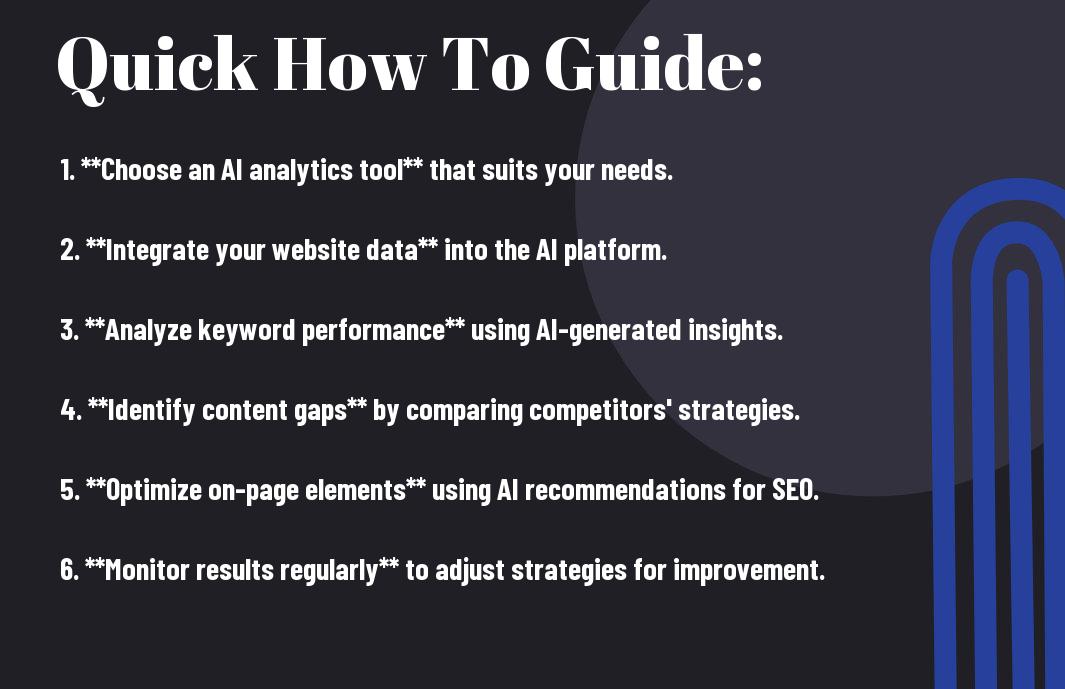
Understanding AI-Powered Analytics
Before plunging into the specifics of utilizing AI-powered analytics for superior SEO decisions, it’s important to comprehend what this technology entails and how it can transform your SEO strategies.
What is AI-Powered Analytics?
To put it simply, AI-powered analytics combines the computational skills of artificial intelligence with advanced data analytics techniques to derive insights from vast amounts of data. This leads to enhanced performance metrics, predictive modeling, and actionable insights that are crucial for making informed SEO decisions. Such analytics can analyze user behavior, search engine trends, and content effectiveness, filling in the gaps that traditional analytics may overlook.
To better utilize AI-powered analytics, you may find it helpful to understand the various tools and platforms that leverage this technology. These tools automate data collection, providing you with comprehensive reports that highlight critical areas for growth, opportunities, and shortcomings in your current SEO strategy.
The Importance of AI in SEO
Analytics have evolved dramatically with the introduction of artificial intelligence, fundamentally changing how we approach SEO. By harnessing the power of AI, you can efficiently analyze large datasets to better understand user behavior, search engine algorithms, and market trends. This enables you to make targeted adjustments to your SEO strategy, ensuring it is optimized for relevant keywords and user intent.
AIPowered technologies provide real-time insights and predictive analytics, which are vital for staying ahead of your competition. Rather than relying solely on historical data, AI can analyze current trends and suggest proactive strategies, ultimately elevating your SEO game and attracting more organic traffic.
Key Factors Influencing AI Analytics for SEO
Any effective AI-powered analytics system relies on several critical factors, including:
- Data Quality: The accuracy and relevance of your data can significantly influence AI outcomes.
- Algorithm Selection: Different algorithms are suited for various SEO analyses and decisions.
- User Behavior Analysis: Understanding how your audience interacts with your content helps inform strategy adjustments.
- Content Relevance: AI can evaluate how well your content aligns with user queries and intent.
The integration of these factors will allow you to leverage AI’s full potential for optimizing your SEO strategy.
Plus, ensuring that you focus on these vital factors can enhance your understanding and application of AI in SEO, leading to better rankings and more website traffic. By maintaining an awareness of how these elements interact, you can tailor your approach for maximum effectiveness, ultimately paving the way for long-term success.

Setting Up AI Analytics Tools
Even with all the advancements in technology, the true power of AI can only be unlocked when you set up your analytics tools correctly. Implementing AI-powered analytics can provide a wealth of data to guide your SEO strategies, ultimately leading to better decision-making. However, it is important to ensure that you have the right tools tailored to your unique SEO needs. In this section, we’ll go over how to select the best tools, integrate them with your existing systems, and configure your dashboard for maximum effectiveness.
Choosing the Right AI Tools for SEO
On your journey to enhance your SEO efforts, selecting the right AI tools is crucial. There are numerous options available, each with varying features and capabilities. It’s imperative to evaluate tools based on factors such as user-friendliness, data accuracy, and integration capabilities. A tool that provides actionable insights tailored to your specific goals will enable you to focus your efforts on strategies that yield results.
Additionally, consider whether the tool provides real-time data and predictive analytics. These features can help you stay ahead of your competition and adapt your strategies based on current trends. Note, you want a tool that can not only analyze past performance but also foresee potential opportunities for optimization in your SEO campaigns.
Integrating AI Analytics with Existing Tools
Tools can often provide more value when they’re integrated with your existing systems. Integration allows you to pull data from various sources, offering a holistic view of your SEO performance. Many AI analytics tools offer plug-ins and APIs that make it seamless to incorporate them into your current tech stack, whether you’re using content management systems, social media platforms, or email marketing tools.
Another important aspect to keep in mind is the compatibility of your chosen AI analytics tools with your current software. Proper integration not only saves time but can also enhance your data accuracy, allowing you to make more informed decisions based on comprehensive insights. Before finalizing your choice of tools, check for established connections with current software and assess any necessary setup procedures.
Configuring Your AI Analytics Dashboard
If you have successfully chosen and integrated your AI analytics tools, the next step is to configure your analytics dashboard to reflect the metrics that matter most to you. A well-organized dashboard can serve as a central hub for tracking key performance indicators (KPIs) and performance trends over time. It’s beneficial to customize the display to highlight the data points that affect your SEO strategy, such as keyword rankings, organic traffic, and backlink performance.
Choosing the right data visualizations—whether it be line graphs for tracking historical trends or pie charts for comparing traffic sources—can greatly enhance your understanding of the data. Additionally, consider setting up alerts for significant changes in your metrics, which can prompt you to take immediate action when necessary.
Interpreting Data for SEO Decisions
All digital marketers know that data is a goldmine for making informed SEO decisions. However, the challenge lies in interpreting that data effectively. Utilizing AI-powered analytics can greatly enhance your ability to sift through mountains of information, helping you derive actionable insights that can lead to better decision-making. By leveraging these insights, you can streamline your SEO strategies and improve overall performance.
Analyzing Traffic Sources
An effective way to start interpreting your data is by analyzing your traffic sources. Understanding where your visitors are coming from—be it organic search, social media, or paid ads—is crucial. If you notice a decline in organic traffic, for example, you can investigate deeper to identify the root cause, such as changes to Google’s algorithms or on-page optimization issues. AI tools can help automate this analysis, providing you with regular reports that identify trends and anomalies in your traffic sources.
Additionally, identifying high-performing traffic channels can guide your SEO strategy. By examining which sources bring in the most engaged visitors, you can allocate resources** more effectively. For example, if organic search is yielding high-quality leads, investing time and effort into optimizing your content for SEO would be a wise decision.
Measuring User Engagement Metrics
Assuming that traffic numbers alone dictate your success can be misleading; it’s equally vital to measure user engagement metrics. Metrics such as bounce rate, average session duration, and pages per session can provide you with insights into how well your site is performing in terms of retaining visitors. A high bounce rate may indicate that your landing pages aren’t addressing user needs or that there are issues with site speed, which is where AI can assist by providing real-time analysis and actionable insights.
When looking at these metrics, beware that not all traffic is created equal. Engaged users who interact with your content are worth far more than visitors who leave immediately. Understanding the nuances of user engagement will allow you to refine your content strategy significantly.
To further enhance your understanding of engagement, consider segmenting your audience based on their interaction levels. By doing so, you can tailor content, marketing options, and call-to-action strategies to different user segments, thereby increasing the likelihood of engagement and conversions.
Understanding Keyword Performance
User engagement metrics are complemented by a robust understanding of your keyword performance. By tracking which keywords are driving traffic to your site, you can gauge their effectiveness in bringing in engaged visitors. Leveraging AI analytics tools can uncover hidden patterns in user behavior associated with specific keywords, allowing you to optimize accordingly.
Persistently monitoring your keyword performance can help you identify opportunities for improvement. If certain keywords are ranking well but generating low engagement, it may indicate that the content linked to those keywords needs refinement. This analytical approach will ultimately bolster your SEO strategy by aligning your content more closely with user intent.
Keyword variations and long-tail keywords should not be overlooked, as they can often attract niche audiences that are highly engaged. Keep a close eye on how these keywords fair over time and be prepared to adjust your strategy as necessary.

Leveraging AI for Content Optimization
Once again, AI is transforming the way you approach content optimization. By integrating AI-powered analytics into your SEO strategy, you can make informed decisions that bolster your content’s performance. Utilizing tools that analyze user behavior and preferences, you can tailor your content to address the specific needs and interests of your audience. This not only enhances user engagement but also significantly improves your chances of ranking higher in search results.
Identifying Content Gaps with AI
Optimization is crucial when it comes to maintaining a competitive edge in the digital landscape. AI tools are adept at analyzing your existing content alongside competitor offerings, highlighting areas where content is lacking or outdated. By understanding these gaps, you can create targeted content that not only fills these voids but also resonates with your audience, leading to improved traffic and better engagement metrics.
Generating Topic Ideas Using AI
Content ideation can be a daunting task, but AI simplifies the process by analyzing trending topics, user searches, and social media discussions. By leveraging natural language processing and machine learning algorithms, AI can provide you with a plethora of relevant topic ideas that are tailored to your niche. This empowers you to stay ahead of the curve and anticipate what your audience craves, ultimately driving more traffic to your site.
Topic generation using AI not only streamlines your content creation process but also ensures that your articles are aligned with current industry trends. With AI-generated insights, you can create content that is timely and relevant, allowing you to connect with your target audience in meaningful ways. This proactive approach will set your site apart, driving engagement and solidifying your role as a thought leader in your field.
Best Practices for AI-Driven Content Creation
Content created with AI should not only be optimized for search engines but also tailored for human readers. While AI can generate compelling headlines and assist in structuring articles, ensuring your unique voice and perspective are prevalent is vital. Incorporating your insights and experiences into AI-generated content lends authenticity, creating a connection with your audience. Additionally, regularly refining and updating your content based on AI-driven analytics can yield significant benefits.
With the rise of AI in content creation, understanding best practices is fundamental for success. Always use AI as a tool to complement your skills rather than a complete replacement. Encourage collaboration between AI-generated suggestions and your personal touch to maintain originality and flair in your writing. As you balance technology with creativity, you will increasingly find yourself delivering top-tier content that resonates well with your audience.
Utilizing Predictive Analytics in SEO
What is Predictive Analytics?
Your understanding of predictive analytics can significantly enhance your SEO strategies. At its core, predictive analytics refers to the use of statistical techniques and machine learning algorithms to analyze historical data and forecast future outcomes. By leveraging this approach, you can identify potential trends, consumer behavior patterns, and areas for improvement in your SEO campaigns. Essentially, predictive analytics allows you to dive deep into the data and extract valuable insights that will guide your decision-making process.
Little do many know that implementing predictive analytics into your SEO strategy doesn’t have to be daunting. Various tools and platforms are available to help you gather and analyze data, making it easier for you to capitalize on these insights. By understanding how predictive analytics works, you can develop a highly focused and effective SEO strategy that adapts to changing consumer preferences and market conditions.
Forecasting Trends and Consumer Behavior
Analytics tools that incorporate predictive analytics enable you to accurately forecast trends and understand consumer behavior. By examining historical data patterns, you can anticipate changes in search behavior, emerging keywords, and content preferences. This proactive approach not only allows you to stay one step ahead but also helps you create content that genuinely resonates with your target audience. Such insights can lead to more effective keyword targeting and improved user engagement on your website.
Predictive analytics empowers you to identify shifts in consumer behavior before they fully materialize. You can adapt your SEO campaigns accordingly, ensuring that you are not merely reacting to trends but anticipating them. This foresight is crucial in today’s fast-paced digital landscape, where preferences can change overnight. By committing to this strategic approach, you can enhance your website’s visibility and maintain a competitive edge in your industry.
Making Data-Driven Decisions for Future SEO Strategies
Clearly, utilizing predictive analytics in your SEO strategy allows you to make data-driven decisions that directly impact your future campaigns. Instead of relying solely on gut instinct, you can base your strategy on relevant data that has been carefully analyzed. This method ensures that your content aligns with consumer demand and enhances your website’s performance. Predictive analytics also helps in identifying potential risks and obstacles that may lie ahead, allowing you to navigate your SEO strategies with precision.
As your understanding of predictive analytics matures, you will find yourself establishing a well-informed, long-term SEO strategy that adapts fluidly to new information. Employing this approach fosters a culture of continuous improvement, empowering you to capitalize on both opportunities and challenges. What you once thought was risky becomes manageable, as you rely on proven data insights to steer your SEO efforts effectively.
Continuous Improvement through AI Insights
Now that you’ve integrated AI-powered analytics into your SEO strategy, it’s vital to focus on continuous improvement. This approach not only keeps your tactics up-to-date but also maximizes your chances of success in a competitive digital landscape. Utilizing AI-powered insights allows you to make informed decisions and adjust accordingly as you track your performance over time.
Tracking Performance Over Time
Little by little, tracking your SEO performance becomes easier with the help of AI solutions. These tools enable you to analyze vast amounts of data efficiently, pinpointing which keywords, content, and strategies are delivering results. With AI, you can create comprehensive dashboards that visualize your progress, making it simple to see how your SEO rankings fluctuate and identify patterns over time.
As you assess your performance, you’ll want to keep a close eye on key metrics such as organic traffic, bounce rates, and conversion rates. By continuously monitoring these indicators, you can gather valuable insights that inform your SEO decisions and guide your content creation efforts more effectively.
Adjusting Strategies Based on AI Feedback
You have the power to transform your SEO strategy by using the feedback provided by your AI analytics tools. When those tools highlight underperforming keywords or suggest emerging opportunities, you can take proactive steps to fine-tune your approach. Adaptive strategies allow you to pivot quickly, ensuring that you stay relevant amidst constant changes in search engine algorithms and consumer behavior.
This agility is critical in today’s fast-paced digital landscape. Monitoring your SEO results through AI gives you real-time feedback, aiding your decision-making process. By embracing this data-driven approach, you will not only enhance your current rankings but also create content that resonates with your target audience and addresses their evolving needs.
Keeping Up with SEO Trends Using AI
Time is of the essence in SEO, and keeping up with ever-evolving trends is vital if you want your website to thrive. AI tools can help you stay abreast of the latest developments in search engine optimization by analyzing data trends and providing recommendations that align with contemporary practices. With these insights, you can adapt your content strategies to align with current consumer interests and search behaviors.
By leveraging AI, you will be able to anticipate changes in SEO trends and adjust your strategies accordingly. This proactive approach not only positions you as a leader in your industry but also improves your chances of ranking higher on search engines, thanks to your ability to predict and adapt quickly.
With the rapid evolution of technology, the knowledge acquired from AI can give you an edge in staying current with SEO trends. Utilizing AI-powered solutions enables you to maintain a competitive advantage by consistently adjusting your tactics based on real-time data and consumer insights. This commitment to adaptation and continuous learning will lead to better overall SEO performance and results.
Summing up
Taking this into account, leveraging AI-powered analytics for your SEO strategy can significantly enhance your decision-making process. By utilizing advanced algorithms and data analysis, you can gain deeper insights into user behavior, keyword performance, and content effectiveness. This will allow you to refine your strategies and prioritize actions that yield the highest return on investment. Moreover, AI tools enable you to anticipate trends and adapt your approach. Thus, staying ahead of the competition becomes a more attainable goal when you incorporate these technologies into your SEO efforts.
Ultimately, integrating AI into your SEO strategy not only helps you make data-driven decisions but also elevates your overall digital marketing game. As you harness the power of AI analytics, remember to continuously evaluate and adjust your techniques based on the insights you gather. This iterative process will help you create more relevant content, optimize your website more effectively, and ultimately enhance your site’s visibility in search engine results. By embracing these technologies, you can ensure that your SEO efforts are not just reactive but proactive, setting the stage for long-term success in the digital landscape.
Comments