

Uncover the fascinating journey of AI development, from Turing’s theories to the modern genius of deep learning technology. Dive in!

Table of Contents
Artificial intelligence, or AI, has become an integral part of our daily lives, from virtual assistants like Siri and Alexa to recommendation algorithms on streaming platforms. However, the concept of AI has been around for decades, with roots dating back to the 1950s. In this blog post, we will delve into the fascinating history of AI, exploring its evolution from its early beginnings to the cutting-edge advancements in deep learning.
Introduction to AI
Artificial intelligence refers to the ability of machines to perform tasks that typically require human intelligence, such as problem-solving, decision-making, and speech recognition. The goal of AI is to develop computer systems that can simulate human cognitive functions and learn from experience.
Historical Context
The history of AI can be traced back to the pioneering work of mathematician Alan Turing, who proposed the concept of a “universal machine” capable of performing any computation. Turing’s theoretical framework laid the foundation for the development of early AI systems, such as the Logic Theorist created in the 1950s by Allen Newell, Herbert A. Simon, and J.C. Shaw.
Over the years, AI research flourished, leading to the creation of expert systems, neural networks, and machine learning algorithms. Major milestones in AI history include the development of IBM’s Deep Blue chess-playing computer, which defeated world chess champion Garry Kasparov in 1997, and the rise of natural language processing technologies like IBM Watson.
Current Applications
Today, AI is being used in a wide range of applications across various industries, including healthcare, finance, and transportation. Chatbots powered by AI are revolutionizing customer service, while autonomous vehicles are redefining the future of transportation.

Image courtesy of digitalwellbeing.org via Google Images
Other common examples of AI in action include recommendation engines, which use machine learning algorithms to personalize content for users, and predictive analytics tools that help businesses make informed decisions based on data insights.
Benefits of AI
The benefits of AI are manifold, with the potential to improve efficiency, enhance productivity, and drive innovation. In the healthcare sector, AI technologies are being used to diagnose diseases, predict patient outcomes, and streamline medical processes.
Furthermore, AI has the ability to automate routine tasks, allowing humans to focus on more strategic and creative endeavors. From automated inventory management systems to intelligent marketing strategies, AI is transforming the way we work and interact with technology.
Challenges and Ethical Concerns
However, the widespread adoption of AI also raises ethical concerns, such as the potential for bias in algorithms, the loss of jobs due to automation, and threats to privacy and security. Issues surrounding data protection, algorithm transparency, and accountability are key areas of debate in the AI ethics discourse.
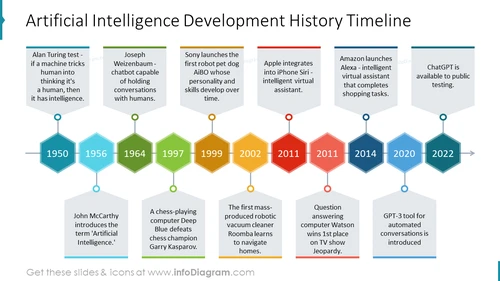
Image courtesy of www.infodiagram.com via Google Images
It is crucial for developers, policymakers, and society at large to address these challenges and ensure that AI is developed and deployed responsibly, with due consideration for its impact on individuals and communities.
Future Direction
Looking ahead, the future of AI holds immense promise, with advancements in deep learning, reinforcement learning, and AI ethics shaping the trajectory of the field. Deep learning techniques, which mimic the neural networks of the human brain, have propelled AI to new heights, enabling breakthroughs in image recognition, natural language processing, and robotics.
As AI technologies continue to evolve, the emphasis on ethical considerations and responsible AI development will be pivotal in shaping a future where AI benefits society as a whole while mitigating potential risks.
Can Skynet Happen?
The concept of Skynet, a self-aware AI system depicted in the Terminator movies, serves as a cautionary tale of the potential dangers of superintelligent AI. While the scenario of a malevolent AI taking control of the world may seem far-fetched, experts warn of the risks associated with unchecked AI development.

Image courtesy of ug.linkedin.com via Google Images
To prevent a Skynet-like scenario from becoming a reality, researchers and policymakers are actively working on ensuring the safety and control of AI systems through measures such as safety protocols, ethical guidelines, and AI regulation.
AI in Popular Culture
AI has long captured the imagination of writers, filmmakers, and artists, who have explored its implications in works of science fiction and popular culture. From the sentient AI Hal 9000 in “2001: A Space Odyssey” to the android hosts in “Westworld,” AI has been portrayed in various forms, reflecting society’s fascination and fear of intelligent machines.
Popular culture plays a key role in shaping public perceptions of AI, influencing how we view the potential benefits and risks of AI technologies. By engaging with AI narratives in media and entertainment, we can gain insights into the societal implications of AI and foster discussions on its ethical and philosophical dimensions.
Interviews with AI Experts
As AI continues to evolve and impact all aspects of our lives, it is essential to hear from experts in the field who are at the forefront of AI research and development. Interviews with leading AI researchers, developers, and ethicists can provide valuable insights into the latest trends, challenges, and ethical considerations in AI.

Image courtesy of sitn.hms.harvard.edu via Google Images
By engaging with diverse perspectives and expertise, we can gain a deeper understanding of AI’s potential and limitations, as well as foster a dialogue on how to harness AI for the greater good of humanity.
Conclusion – Envisioning a Future with AI
In conclusion, the journey of AI from its inception to its current state of rapid advancement has been nothing short of revolutionary. As AI technologies continue to reshape industries and societies, it is imperative that we approach AI development with caution, responsibility, and a commitment to ethical principles.
By staying informed about AI developments, engaging in discussions on AI ethics, and supporting responsible AI innovation, we can pave the way for a future where AI enriches human lives, fosters creativity, and drives progress in ways we have yet to imagine.
Comments