

It’s imperative for any writer to explore innovative tools that can enhance their storytelling skills. With ChatGPT, you have a powerful ally in developing complex plots and unique characters. This guide will show you how to utilize ChatGPT effectively to brainstorm ideas, expand your narratives, and refine your storytelling techniques. By leveraging this AI tool, you can unlock new narrative possibilities and engage your readers like never before.

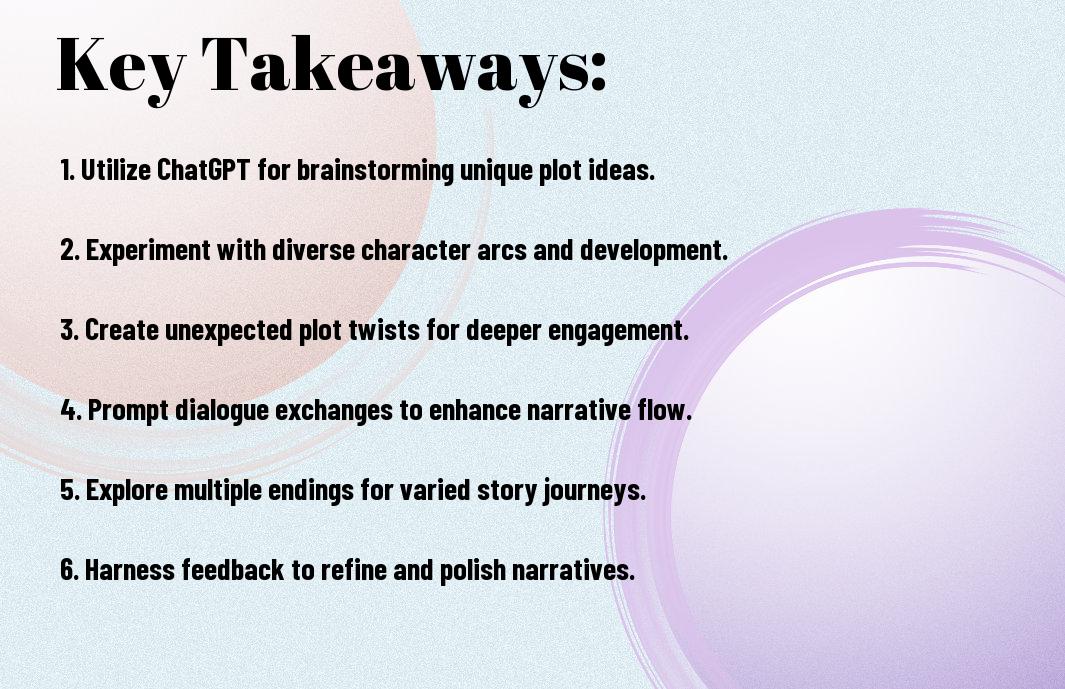
Key Takeaways:
- Character Development: ChatGPT can assist in crafting multi-dimensional characters by generating backstories, motivations, and conflicts that deepen engagement.
- Plot Twists: Leverage ChatGPT to brainstorm unexpected plot twists that can enhance tension and keep the audience guessing.
- World-Building: Utilize ChatGPT for creating detailed settings, including unique cultures, geographies, and histories that enrich the narrative experience.
- Dialogue Generation: Use ChatGPT to formulate dynamic and authentic dialogue that reveals character traits and advances the plot effectively.
- Theme Exploration: ChatGPT can help investigate into complex themes and messages, suggesting ways to weave them throughout the narrative for greater impact.
Understanding Narrative Structures
Before delving into how ChatGPT can aid in developing captivating narratives, it’s necessary to grasp the foundational concepts of narrative structures. Your understanding of these concepts will serve as a guide as you explore the intricate games of storytelling.
Definition and Importance of Narrative Structures
By definition, narrative structures refer to the organized framework that shapes the story’s progression. They determine how events unfold, characters are developed, and themes are conveyed. These frameworks are vital for creating a cohesive tale; without them, your narrative might become disjointed or aimless, making it difficult for readers to engage with your story. Effective narrative structures can evoke emotions, deepen character arcs, and ultimately resonate with your audience on a profound level.
Moreover, understanding narrative structures helps you design your story with intention. A well-structured narrative not only captivates your reader’s attention but also guides them through the story, allowing them to connect with the characters and plot in a meaningful way. Superior storytelling stems from mastery of these structures, enabling you to create rich and immersive experiences for your audience.
Elements of Narrative Design
Importance lies in recognizing the key components that make up narrative design. Every story is built upon fundamental elements such as characters, setting, plot, conflict, and theme. Your confidence in weaving these elements together will significantly impact the overall strength of your story. An imbalance or neglect of any element can result in a narrative that falls flat, leaving readers unengaged.
Understanding these elements allows you to craft an engaging narrative that seamlessly weaves together intricate details, climactic moments, and satisfying resolutions. As you explore these components, consider how each element contributes to the larger picture of your story, enabling you to build tension, develop character arcs, and deliver impactful messages.
Types of Narrative Structures
Structures in storytelling can vary widely, and as a writer, you have the opportunity to experiment with different types. Common narrative structures include linear, non-linear, epistolary, fragmented, and circular narratives. Evaluating these types will help you decide the best approach for your own stories. Here’s a breakdown of the main types of narrative structures:
| Type | Description |
| Linear Narrative | Follows a direct, chronological order of events. |
| Non-linear Narrative | Events are presented out of chronological order. |
| Epistolary Narrative | Story is told through letters, diary entries, or emails. |
| Fragmented Narrative | Comprised of disjointed events and perspectives. |
| Circular Narrative | Story ends where it begins, closing the loop. |
Understanding the nuances of each type will allow you to harness their unique strengths to enhance your storytelling. Experimenting with these structures and tailoring them to fit your narrative will help create dynamic and engaging stories. This exploration can result in unexpected connections and deeper insights for both you and your readers.
Types of Narrative Structures (Continued)
Consequently, developing a profound understanding of various narrative structures can enrich your storytelling arsenal. Each type offers distinctive pathways to develop and unfold your story. As you experiment with them, consider how they influence pacing, character development, and thematic depth. Here’s a summarization of the types you may wish to explore:
| Type | Key Features |
| Linear | Straightforward progression; great for clarity. |
| Non-linear | Engages readers, invites piecing together the narrative. |
| Epistolary | Unique perspectives; fosters intimacy with characters. |
| Fragmented | Captivates through unpredictability and complexity. |
| Circular | Creates thematic resonance; reflects on character growth. |
This understanding aids in selecting the most suitable narrative structures for your stories, further enriching your writing journey. Elevating your narrative techniques can lead to heightened emotional connections and innovative storytelling experiences.
The Role of AI in Creative Writing
If you have ever wondered how technology could redefine storytelling, AI stands as a powerful ally in your creative writing journey. Its potential to generate ideas, assist in narrative development, and enrich character creation is remarkable. By integrating AI tools like ChatGPT, you create an interactive collaboration that enhances your storytelling capabilities, providing fresh perspectives and creative prompts that may not have emerged in isolation.
Historical Overview of AI in Literature
On this fascinating timeline, the inception of artificial intelligence can be traced back to the mid-20th century, where early programs like the ELIZA chatbot experimented with natural language processing. Writers began to explore the idea of machines that could not only understand human language but also produce coherent text. Over the years, more sophisticated algorithms emerged, paving the way for AI’s growing relationship with literature. Important milestones include projects like the “The Policeman’s Beard is Half Constructed,” a book written entirely by an AI. These early endeavors signaled the beginning of a new frontier in the literary landscape.
As technology evolved, so did AI’s role in creative writing. By the early 2000s, advanced neural networks and machine learning techniques enabled AI to analyze vast amounts of literary data, allowing it to generate text that mimicked various writing styles. This evolution has sparked a wave of interest among writers, who are beginning to see AI not just as a tool but as a prospective co-author, inspiring new insights and offering experimentation possibilities.
Current Trends in AI-Assisted Writing
After years of development, current trends illustrate an increased reliance on AI in writing processes. Many authors now utilize AI-powered tools for brainstorming, character development, and plot advancements. You may find that AI can generate specific prompts that align with your desired themes or even suggest complex narrative structures that enhance dramatic tension. Through collaboration with AI, you can fine-tune your work, exploring alternative directions and perspectives that enrich your storytelling.
As AI continues to evolve, advancements in natural language processing are leading to improved interactivity and more varied content. This means that you can expect context-aware responses and suggestions, making AI a more effective partner in your writing endeavors. Moreover, platforms that combine AI assistance with community feedback are emerging, creating spaces for writers to share their experiences and learn from one another. The integration of AI in creative writing allows you to push boundaries and enhance your technique dynamically.
The Impact of AI on Authorial Voice
By engaging with AI in your writing process, you may notice complex changes in your authorial voice. The ability of AI to analyze and produce text in a variety of styles allows you to explore new dimensions of your writing. While your unique voice remains necessary, AI can help you experiment with different tones, styles, and genres, providing a broader canvas to express your creativity. You can leverage AI-generated text as inspiration, reimagining your narrative without losing your distinct identity as an author.
Plus, the dynamic interplay between your voice and AI contributions can result in unanticipated synergies, enabling you to create texts that resonate with readers in fascinating new ways. This interaction can deepen your exploration of themes and enhance the emotional depth of your narratives, allowing you to push your creative boundaries further than you thought possible. Engaging with AI not only fosters innovation; it may also empower your unique writing journey.
Introducing ChatGPT
To initiate on the journey of harnessing the power of artificial intelligence in storytelling, it’s important to first grasp the intricacies of ChatGPT. This remarkable tool leverages a sophisticated language model architecture known as the Generative Pre-trained Transformer (GPT). By training on diverse datasets, it can generate coherent and contextually relevant text, enabling it to assist you in crafting engaging narratives.
Overview of ChatGPT Architecture
Behind the scenes, the GPT architecture employs a neural network which uses transformer mechanisms to understand and generate language. This architecture allows ChatGPT to analyze patterns in data, drawing from its extensive training to anticipate and produce human-like responses. Its proficiency in language generation makes it a valuable asset when you seek to enhance your storytelling techniques.
Capabilities and Limitations of ChatGPT
Overview of what ChatGPT can accomplish underlines its strengths as a narrative collaborator. You will find that the tool can generate diverse narratives, develop characters, and suggest plot twists with relative ease. However, it also has restrictions, such as the inability to understand context fully or provide deep emotional insights, which can occasionally lead to less compelling storytelling results.
Plus, these limitations mean that while ChatGPT can assist in developing content ideas and drafting outlines, you should approach its outputs with a discerning eye. The model relies heavily on the prompts provided, meaning the quality of your interaction greatly influences the effectiveness of the narratives created. Balancing its strengths and weaknesses will empower you to craft captivating stories efficiently.
Comparing ChatGPT to Traditional Writing Tools
| Flexibility | ChatGPT offers more adaptability for narrative generation and instant feedback compared to static writing tools. |
| User Engagement | As an interactive AI, it allows for real-time adjustments and exploration of various plot directions. |
| Creativity Enhancement | ChatGPT can suggest unique ideas that you may not have considered, enriching your creative process. |
| Dependence on Prompts | The model’s output quality is highly dependent on the inputs it receives, which can lead to variability in effectiveness. |
Limitations of ChatGPT compared to traditional writing approaches highlight a key consideration when integrating it into your creative workflow. You might find it efficient in generating fresh content, but the nuanced understanding of human emotions, character development, and thematic depth often requires a more human touch, which traditional writing methods can provide.
| Depth of Emotion | While ChatGPT can create emotionally resonant content, it often lacks the deep understanding of human experiences needed for nuanced storytelling. |
| Consistency in Themes | Maintaining thematic consistency can be a challenge, as the tool may stray from established narrative arcs without careful guidance. |
| Personalization | Your unique voice and style may be diluted if you heavily rely on AI-generated content without adjusting it. |
Traditional writing methods retain their significance, especially in collaborative environments where personal insights and emotional layers are vital. By intertwining your unique perspective with the advantages that ChatGPT offers, you can unlock new dimensions in your storytelling while retaining the essence of your creative voice.
Cultivating Intriguing Narrative Structures with ChatGPT
All writers, no matter their experience level, encounter the challenge of developing original story ideas. With ChatGPT, you can kickstart your creativity by generating some fascinating story ideas and plots that draw from diverse genres and themes. By engaging in a dialogue with the AI, you can quickly explore potential narratives that might have never crossed your mind. The beauty of using ChatGPT lies in its ability to propose unique angles, ensuring that your plots are fresh and captivating.
Generating Story Ideas and Plots
With the practical application of prompts, you can instruct ChatGPT to suggest themes, settings, and character archetypes that align with your interests. By weaving these elements together, the AI can help you conceptualize intriguing plots that capture attention and inspire further development. By asking it to elaborate or offer variations, you can refine your ideas and discover new paths for storytelling that resonate deeply with your audience.
Character Development and Dialogue Creation
Against common misconceptions, crafting compelling characters and authentic dialogue doesn’t need to be an insurmountable task. By utilizing ChatGPT, you can explore various character traits, backgrounds, and motivations that lend depth to your narratives. The AI’s ability to simulate conversations allows you to create dynamic interactions between characters, enhancing their realism and driving the plot forward. This engagement transforms flat characters into multi-dimensional beings that resonate with readers.
Indeed, the assistance you receive from ChatGPT can act as a powerful catalyst for your character development. You can prompt the AI to generate dialogue tailored to specific situations, enabling you to explore different tones, emotions, and reactions. The back-and-forth exchanges it offers can mirror authentic human interactions, allowing you to portray character relationships realistically. This not only enriches the narrative but also invites your audience to connect more intimately with the characters.
Crafting Conflict and Resolution
Behind every compelling narrative lies a strong conflict that propels the characters and plot. ChatGPT can facilitate this by helping you identify potential conflicts—be it interpersonal struggles, moral dilemmas, or environmental challenges. By providing various resolutions, the AI fosters your analytical thinking, guiding you through academic structures that enhance story tension and pacing. This ultimately allows you to craft a storyline that captivates and maintains your readers’ interest from beginning to end.
Creation of the perfect conflict and resolution involves understanding the stakes for your characters. By asking ChatGPT to propose outcomes based on your conflict, you can explore different pathways and the implications of each resolution. This guidance helps you achieve a satisfying narrative arc, engaging readers through effective storytelling that leaves a lasting impact. With each exploration, your narrative gains depth and significance, elevating it beyond mere entertainment.

Enhancing Creativity Through Collaborative Writing
After exploring the innovative potential of ChatGPT, it’s imperative to probe deeper into how this technology can be effectively integrated into your writing process. By employing an approach known as *Human-AI collaboration*, you can not only streamline your creative process but also enrich your narrative structures in unexpected ways.
The Concept of Human-AI Collaboration
On one hand, traditional writing often thrives on the solitary experience where your thoughts flow uninterrupted. However, incorporating ChatGPT into your creative endeavors transforms this experience into an interactive dialogue. This transition allows you to bounce ideas off the AI, leverage its expansive data processing capabilities, and explore narrative directions that you might not have considered otherwise.
On the other hand, this collaborative writing journey is about merging your unique voice with AI’s vast knowledge base. While you remain the principal architect of your narrative, ChatGPT serves as a dynamic co-writer, offering alternative perspectives, proposing plot twists, or even enriching character development. This experience ultimately fosters an innovative atmosphere where your creativity can flourish in new dimensions.
Co-Authoring with ChatGPT: Best Practices
Around the collaborative writing landscape, best practices emerge to guide you in making the most of your partnership with ChatGPT. First, ensure that you establish clear objectives before you engage with the AI. Identify what elements of your narrative you wish to enhance, whether it’s dialogue, pacing, or world-building. By doing so, you will be able to utilize ChatGPT more effectively as a resource tailored to your specific needs.
Collaborative writing also involves maintaining a feedback loop between you and ChatGPT. After generating content, scrutinize the output critically, modifying or expanding upon it as needed. This step not only helps to maintain your unique voice but also allows you to refine the AI’s contributions into something cohesive and engaging.
Collaborative writing with ChatGPT becomes a symbiotic relationship when you actively engage with its outputs. Consider committing to a routine where you review sections of generated text, adapt them, and then provide new prompts or revisions. This iterative process enables you to shape the narrative continuously, creating a more seamless blend of human creativity and AI efficiency.
Case Studies of Successful Collaborations
Around the world of literature and content creation, numerous case studies highlight the success of collaborations between authors and ChatGPT. Observing different scenarios can give you practical insights into how this partnership manifests in various genres and projects.
- Novel Development: A well-known author collaborated with ChatGPT to draft their fantasy novel, resulting in a 30% increase in writing speed and a unique plot twist that was generated by AI.
- Screenwriting: A screenwriter used ChatGPT to brainstorm dialogue, leading to a final script that was shortlisted at a prominent film festival. ChatGPT provided over 50 unique dialogues that were integrated into the final product.
- Blog Creation: A marketing team utilized ChatGPT to create a series of engaging blog posts, improving readership by 40% and decreasing content development time by 50%.
- Poetry and Prose: A group of poets collaborated with ChatGPT to weave poems that became part of a joint anthology, illustrating how AI can help in expressing abstract thoughts. The anthology sold over 2,000 copies within the first month of release.
Collaboration extends beyond just final products; it also includes the opportunities for learning and growth for both you and ChatGPT. Each collaboration presents a unique chance to discover new approaches in writing, enhancing your skills as a storyteller. By embracing the strengths of AI, you allow yourself to tackle more complex narratives, ultimately leading to storytelling that resonates deeply with your audience.
Utilizing Prompts for Effective Output
To create engaging narratives using ChatGPT, the first step is to carefully design your prompts. The nature of the prompts you use can significantly influence the quality and creativity of the output generated. By understanding different types of prompts, you can establish a framework for intriguing storytelling. Below is a breakdown of various prompt types that can be employed.
Types of Prompts to Engage ChatGPT
With different prompts, you can evoke a variety of responses from ChatGPT, leading to captivating narratives. Here’s a table that outlines different prompt types and their characteristics:
| Prompt Type | Description |
|---|---|
| Open-ended | Encourages broad and creative responses, allowing narrative expansion. |
| Guided | Provides context or specific elements to ensure structured storytelling. |
| Scenario-based | Presents hypothetical situations that challenge the model creatively. |
| Character-driven | Emphasizes character development and interactions to enrich the plot. |
| Dialogue-focused | Encourages crafting engaging conversations, enhancing narrative dynamics. |
After experimenting with these prompts, you’ll find that each type can open avenues for distinctive storytelling approaches.
Constructing Tailored Prompts for Specific Narratives
Beside utilizing generic prompts, customizing your prompts to align with your narrative vision can yield even more compelling results. When you create tailored prompts, you can include specific themes, tones, or plot elements that resonate with the story you wish to convey. For instance, if you want a suspenseful tale, you might instruct the model to focus on building tension and introducing unexpected twists.
Understanding the intricacies of effective prompts can also lead to more refined outputs. Concentrating on specific genres, settings, or character traits helps you steer the narrative in a desired direction. Personalizing your prompts ensures that the generated content aligns closely with your objectives, ultimately enhancing the storytelling experience.
Analyzing Output and Providing Feedback
Engage with the responses generated by ChatGPT to refine your narrative further. Analyze the output for coherence, creativity, and alignment with your initial vision. Providing constructive feedback encourages the model to correct or improve aspects that may not meet your expectations. Delving into the subtleties of the generated narratives will allow you to gain deeper insights into character development, plot structure, and thematic elements, which are vital for your storytelling process.
Indeed, your feedback is imperative for fine-tuning the narratives produced by ChatGPT. By highlighting things you liked or aspects that require changes, you can foster a more collaborative relationship with the model, yielding increasingly compelling results. This iterative process enhances both your skills and the effectiveness of the tool, ultimately leading to a more satisfying storytelling experience.
Avoiding Common Pitfalls in AI-Assisted Writing
Once again, as you examine into using ChatGPT for your writing projects, it is necessary to navigate through potential pitfalls that may arise during the process. While AI can be a powerful tool for generating narrative structures, you must also be aware of the limitations and challenges that accompany AI-assisted writing. By understanding these pitfalls and actively working to avoid them, you can enhance the quality of your storytelling and ensure that your unique voice shines through.
Recognizing Bias in AI Responses
Across various applications, AI systems, including ChatGPT, can exhibit unintended biases that stem from the data on which they were trained. This means that the generated narratives may reflect cultural stereotypes or biased viewpoints that do not align with your storytelling intentions. You should always approach AI-generated content with a critical eye, asking yourself whether the narrative structure or character portrayals uphold the values and themes you wish to convey.
Moreover, being aware of biases in AI responses enables you to make more informed decisions about the content you choose to use. When you identify biased language or viewpoints embedded in the generated text, you can consciously alter them to better reflect diverse perspectives, ensuring your work remains inclusive and relevant.
Mitigating Over-Reliance on AI
Along with recognizing bias, you should also be cautious about developing an over-reliance on AI tools like ChatGPT. While these systems can produce creative suggestions and narrative ideas, relying entirely on them can lead to a lack of originality in your writing. It’s necessary to strike a balanced approach where you use AI as a source of inspiration rather than a crutch.
Developing your own writing style and voice is integral to becoming a successful storyteller. While AI can assist you in brainstorming or structuring your narrative, it is your creative insights that will ultimately shape the story you want to tell. Use AI-generated ideas as a starting point to stimulate your imagination, then let your unique perspective guide the final piece.
Bias can also creep in when you start to depend too heavily on AI-generated content. By using ChatGPT solely as your creative engine, you risk losing touch with your original ideas and personal artistry. This is why it is vital to self-reflect and ensure that your creative input remains at the forefront of your writing process.
Editing and Reworking AI-Generated Content
Among the critical steps in ensuring quality storytelling, thorough editing and reworking of AI-generated content cannot be overlooked. While AI can provide a wealth of ideas and structure, the raw generated content is rarely ready for publication. You will need to sift through the output, refining language, enhancing character development, and ensuring that the plot flows seamlessly. Failure to invest time in this process can result in narratives that may seem disjointed or lack depth.
Additionally, viewing AI-generated content as a draft rather than a finished product is a mindset that will serve you well. It gives you the freedom to experiment and mold the narrative until it aligns with your vision. With careful editing, you can turn AI-generated suggestions into gripping tales that truly resonate.
Over-reliance on AI-generated content without proper editing can lead to inconsistencies and a lack of coherence in your storytelling. By taking the time to revise and enhance the material, you ensure that your narrative emerges as cohesive and polished, ultimately making the story more engaging for your readers.
Integrating ChatGPT in Different Genres
Unlike traditional writing methods, incorporating ChatGPT into your creative process opens doors to innovative narrative structures across various genres. By utilizing this advanced AI, you can enhance your storytelling capacity, pushing boundaries and exploring new terrains that may have seemed impossible before. This technology serves as an adaptable partner, capable of generating ideas, refining concepts, and offering fresh perspectives tailored to your unique voice.
Fiction: Novels and Short Stories
Beside enabling you to brainstorm character arcs and plot twists, ChatGPT can provide stimulating prompts that can kickstart your fiction writing process. For instance, if you’re stuck at a particular point in your novel, you can prompt the AI to suggest developments that align with your narrative tone. The result is often an unexpected, yet coherent, narrative thread that enhances your overall story.
Moreover, you can use ChatGPT to explore different viewpoints by asking it to generate scenes from various characters’ perspectives. This exploration can add depth and complexity to your stories, making characters more relatable and multidimensional, thus captivating your audience’s attention from start to finish.
Non-Fiction: Articles and Essays
Behind the scenes of every impactful article or essay lies a well-structured narrative supported by clear and compelling arguments. ChatGPT can assist you in shaping your non-fiction work by outlining critical themes, generating ideas for discussion points, and even suggesting potential counterarguments. This process enables you to create richer, more engaging content that resonates with readers.
Articles often require you to synthesize complex information into digestible formats. By leveraging ChatGPT, you can ensure that your arguments are presented clearly, accompanied by examples and counterpoints that invite dialogue. Ultimately, this AI-driven approach can elevate the quality of your writing, allowing you to articulate your thoughts more effectively.
Articles produced with ChatGPT can also be tailored to specific audiences, enhancing their reach. By adjusting the tone and style based on your target demographic, you can create compelling pieces that not only inform but also engage and inspire readers to act or reflect.
Genre-Bending Narratives with ChatGPT
Above all, the beauty of integrating ChatGPT into your writing lies in its ability to help you create genre-bending narratives that challenge conventional storytelling structures. With its capacity to generate diverse ideas, the AI can assist you in blending different genres seamlessly, whether you’re looking to fuse romance with science fiction or horror with comedy. This capability nurtures originality, allowing you to craft stories that stand out in a saturated market.
Additionally, ChatGPT’s versatility empowers you to explore the characteristics of various genres while maintaining a coherent narrative flow. Incorporating elements from multiple genres can captivate your audience by continuously surprising them with unexpected twists and turns, thus keeping their engagement high throughout your narrative.
Considering the intricate dance between characters, themes, and stylistic choices, the potential for genre-bending narratives with ChatGPT is limitless. You can experiment with combining themes and styles, producing unique narratives that blur the lines between genres, ultimately redefining storytelling as you know it.
Exploring Interactive and Multimedia Narratives
Despite the traditional boundaries of storytelling, interactive and multimedia narratives have emerged as powerful avenues for engaging audiences in a more immersive way. By allowing you to take control of the storyline, these formats create a dynamic interplay between narrative structure and player decision-making. This evolution in storytelling not only enhances user experience but also encourages deeper emotional attachment to the characters and plots, making the overall experience more memorable and impactful.
The Rise of Interactive Storytelling
Rise of interactive storytelling has transformed the way narratives are constructed and consumed. No longer are you a passive reader or viewer; instead, you actively participate in the unfolding of the story. This shift has paved the way for innovative formats such as video games, choose-your-own-adventure books, and interactive films, all designed to keep you engaged through your choices and actions. With technology improving rapidly, these narratives have become increasingly intricate, offering multiple pathways and endings that reflect your decisions.
Today, interactivity is not just an added feature but rather a fundamental component of storytelling. By fostering a sense of agency, interactive storytelling creates a profound connection with the narrative that traditional formats often fail to achieve. You find yourself not just a spectator, but a pivotal player in the dramatic arc, which heightens emotional investment and encourages exploration of various narrative possibilities.
Employing ChatGPT in Game Design
On the frontier of game design, ChatGPT can serve as a remarkable asset to enhance interactive storytelling. By leveraging its advanced natural language processing abilities, you can create rich dialogues, diverse character arcs, and respond to player interactions in real-time, providing a level of engagement that was previously only attainable through manual scripting. This flexibility allows for easier updates and expansions of the storyline, ensuring that your game continues to be relevant and exciting as it evolves.
In fact, ChatGPT provides opportunities for tailoring narratives that respond to player feedback instantaneously, creating a sense of a living world. By integrating AI-driven dialogue systems, you can allow players to initiate on uniquely personalized journeys, where their choices and interactions lead to distinctive outcomes. This not only enriches the gameplay experience but also encourages players to explore various facets of your narrative, ultimately leading to prolonged engagement with your game.
Multimedia Enhancements through AI
On another front, multimedia storytelling is quickly gaining momentum, and AI plays an instrumental role in this evolution. The integration of visuals, sounds, and interactive elements can enhance your narrative, making it more impactful and engaging. With tools driven by AI, you can easily incorporate stunning graphics or tailored soundscapes that resonate with the atmosphere you’re trying to create. The accessibility of these technologies allows for a richer experience that can captivate your audience on multiple sensory levels.
Interactive elements enable you to blend various media together seamlessly. By using AI to analyze and adapt elements like audio-visual narratives based on user interactions, you can create unique versions of your story tailored to each individual’s experience. This level of engagement fosters a deeper connection, as audiences are no longer mere observers but actively participating in the weaving of the tale.
Interactive technologies driven by AI pave the way for enriching storytelling experiences, allowing you to blend traditional narrative forms with innovative multimedia features. You can explore a variety of interactive enhancements that not only keep your audience engaged but empower them to shape their own narrative journey.
Feedback Mechanisms
Now, let’s explore how you can leverage effective feedback mechanisms to improve your narrative structures using ChatGPT. Receiving constructive feedback is imperative in the writing process, particularly when striving for innovation and depth in storytelling. It is no longer about simply crafting a story but about refining it through various lenses that offer diverse perspectives. To achieve this, systems for evaluating narrative quality are key in guiding your revisions and enhancing your storytelling skills.
Systems for Evaluating Narrative Quality
For writers seeking to enhance their narrative quality, implementing structured systems that analyze elements like plot cohesion, character development, and thematic resonance is vital. These systems can be integrated with ChatGPT’s capabilities, where you can input your narratives and request an assessment based on specific criteria. Using these automated evaluations not only saves time but also provides consistent insights into how your story can better engage readers or sharpen its focus.
Utilizing Peer Reviews with AI Support
Evaluating your narrative through peer reviews allows you to gain insights from fellow writers and readers who may have different experiences and tastes. By combining traditional peer reviews with ChatGPT’s analytical prowess, you can gather feedback that highlights strengths and weaknesses in your writing. This dual approach enables you to create a more rounded narrative by addressing concerns that may not be visible to you during the editing process.
Due to the ability of AI to analyze large volumes of text quickly, you can streamline the feedback process significantly. By integrating suggestions from both human reviewers and AI-generated insights, you can develop a refined narrative that resonates more with your intended audience. This collaborative effort not only aids in identifying problematic areas but also opens doors to fresh ideas and unexpected narrative directions.
Audience Engagement and Reception
The ability to gauge how your narrative is received by its audience is paramount to crafting compelling stories. Using ChatGPT, you can simulate audience reactions by inputting varying story elements and assessing the likely impact of those changes. This predictive analysis can help you tailor your narrative to increase engagement and reduce the risk of disconnection with your readers.
Support from AI tools in analyzing your targeted audience’s preferences can be invaluable. As you create your narrative, utilizing ChatGPT to understand demographic trends and reading habits empowers you to adjust your tone and content accordingly, ensuring a stronger connection. By remaining attuned to your audience’s reception, your storytelling will not only captivate but also foster a loyal readership eager for your next installment.

Ethical Considerations in AI Writing
After exploring the potential of ChatGPT to enhance narrative structures, it’s necessary to address the underlying ethical considerations that accompany AI-assisted writing. Engaging with AI means navigating various complex issues, including copyright, authenticity, and the future of literary authorship. These factors not only affect your creative output but also have broader implications for the writing community as a whole.
Copyright Issues and Content Ownership
Any discussion about the intersection of AI and writing must acknowledge the complexities surrounding copyright and content ownership. When you utilize an AI system like ChatGPT, the question arises: who owns the content generated? The typical user might assume that since the input and creative direction come from you, the resulting narrative belongs to you. However, legal interpretations may vary, and it remains ambiguous how copyright laws apply to AI-generated content. It’s vital to understand these frameworks to protect your rights and manage your work effectively.
Additionally, there might be instances where the AI draws from existing copyrighted materials, leading to another layer of potential infringement. As you craft your narratives using AI, you must be cautious not to inadvertently incorporate copyrighted elements that could lead to legal challenges. Being aware of these issues empowers you to make informed decisions regarding what content to include and how to use AI responsibly.
Authenticity and Originality Concerns
With the increasing reliance on AI in writing, questions about authenticity and originality come to the forefront. As you generate narratives using AI tools, you may find yourself pondering whether the resulting content genuinely reflects your unique voice and perspective. The blend of machine-generated text and human creativity creates a landscape where distinguishing between original thought and AI assistance becomes challenging.
Indeed, the essence of storytelling lies in its distinctiveness—your individual style, tone, and perspective shape the narrative. While using ChatGPT can enhance the richness of your storytelling, it also raises the issue of whether the final output embodies your authentic voice or simply a regurgitation of patterns recognized from the data it was trained on. This tension between leveraging AI as a creative partner and maintaining your originality calls for thoughtful consideration.
The Future of Literary Authorship
On the horizon, the landscape of literary authorship is evolving, particularly as AI tools gain traction. As a writer utilizing AI, you stand at the crossroads of tradition and innovation. The question of what it means to be an author in the age of AI looms large—will your role be that of a creator directing the AI, or will the AI itself be considered a co-author in its own right? This shift challenges the conventional notions of authorship and the contributions that make a piece of writing truly yours.
Looking ahead, you might ponder how this democratization of storytelling through AI will impact the literary world. The barriers to entry may lower, allowing more voices to be heard, but this might also flood the market with derivative work that lacks uniqueness. Navigating this new terrain will require vigilance and an adaptation of existing norms regarding authorship, creativity, and the very definition of what it means to be a writer. The implications are both exciting and daunting, making it necessary for you to engage in ongoing dialogue about the future of your craft.
Another important aspect to consider is how the rise of AI in literary authorship could lead to a revaluation of credit and recognition for writers. As AI-generated content becomes more widespread, traditional notions of authorship may need to evolve. You might find that, in the future, co-creating with an AI could add another layer of depth to your storytelling, requiring new frameworks to assess contribution and authority in creative works. How you navigate this change could influence not just your career but also the very structure of the literary landscape.
Future Trends in AI and Narrative Development
Keep an eye on how the landscape of storytelling is shifting with the help of AI technologies. The advent of tools like ChatGPT is a game-changer for writers, producers, and content creators, providing fresh avenues for narrative innovation. As you explore the integration of AI into your narrative practices, it’s important to consider the evolving dynamics that will shape future creativity.
Predictions for AI-Assisted Narrative Creation
An increasingly collaborative relationship between humans and AI is anticipated in narrative creation. As algorithms become more sophisticated, they are likely to understand your unique style and preferences, helping you co-create stories that resonate deeply with your audience. Moreover, advancements in natural language processing will enable AI to predict narrative arcs based on successful storytelling patterns, offering you suggestions that are both innovative and aligned with your vision.
Emerging Technologies Influencing Storytelling
The future of storytelling is being reshaped by technologies like augmented reality (AR), virtual reality (VR), and machine learning. These innovations are not just enhancing how you consume stories; they are redefining the narrative itself. By integrating these technologies with AI-assisted writing tools, you can craft immersive experiences that allow your audience to engage with narratives on multiple sensory levels.
Narrative possibilities expand dramatically as you incorporate AR and VR into your work. Imagine interactive environments where your audience can influence plot directions or character outcomes, based on their choices. These technologies provide a platform for you to create stories that are not only linear but also multi-dimensional and reactive, ensuring a deeper and more meaningful connection with your audience.
Vision for AI’s Evolution in Creative Industries
Narrative trends suggest that AI will evolve from mere assistance to becoming a co-creator within the creative industries. This partnership could foster an environment where you are free to explore new ideas and concepts, thus enhancing your creative output. AI’s ability to analyze vast datasets will help you develop a profound understanding of audience preferences, ultimately guiding your narrative choices in real time.
In addition, as AI technology progresses, you may find yourself leaning more on AI not just for support, but also as a vital contributor to the storytelling process itself. This prospect raises fascinating questions about authorship and creativity, leading to new methods of collaboration that could redefine what it means to be a storyteller in the digital age. Engaging in this partnership may also enrich your narratives, allowing for more *dynamic* and *engaging* storytelling experiences.
Workshops and Tools for Writers
For those looking to enhance their storytelling abilities, utilizing ChatGPT can open up innovative avenues for narrative exploration. One of the most effective ways to do this is through engaging in workshops and utilizing specialized tools designed for writers. These experiences can provide you with structured guidance, helping you to understand how to harness and apply AI technology to your creative process.
Training Programs for Using ChatGPT
Training programs focused on using ChatGPT can offer you valuable insights into the potential applications of this powerful tool. Such programs typically include hands-on sessions where participants can engage directly with the AI, experimenting with different prompts and structures that enhance the richness of their storytelling. As you learn how to tailor prompts effectively, you’ll discover how to manipulate narrative elements and develop more complex characters and plots.
Additionally, these training sessions often incorporate feedback loops, allowing you to refine your approach in real-time. With the assistance of experienced instructors, you’ll gain a deeper understanding of how AI can complement your own creative voice, thereby fostering a more dynamic writing process that can lead to surprising, interesting outcomes.
Recommended Software and Platforms
Software solutions play an crucial role in optimizing your engagement with ChatGPT. Various platforms offer unique features that can streamline your creative workflow, making it easier for you to communicate your story ideas effectively. Some popular options include dedicated writing applications coupled with AI integrations, allowing for seamless transitions between brainstorming and drafting phases.
Recommended software tools often provide customizable templates and prompts, enabling you to craft intricate narrative arcs with minimal distraction. By leveraging features such as collaborative writing spaces and built-in revision feedback, you can enhance your productivity and creativity simultaneously. Experimenting with different platforms will help you find the tools that best suit your specific writing needs.
Community Resources for Writers
Along your writing journey, tapping into community resources can significantly enrich your experience. Online forums, local workshops, and social media groups are excellent avenues for connecting with fellow writers who are also exploring the capabilities of ChatGPT. Engaging with these communities allows you to exchange ideas, seek guidance, and share your insights as you navigate the complexities of narrative structure.
Community resources can provide a supportive environment where you can ask questions, gain feedback on your work, and discover new techniques for storytelling. Whether you seek motivation or constructive criticism, these collaborative spaces can amplify your growth as a writer and your overall understanding of how to effectively use AI in your craft.
Summing up
Summing up, employing ChatGPT in cultivating intriguing narrative structures opens up a realm of possibilities for your storytelling endeavors. You can leverage its strengths in generating ideas, crafting dialogues, and exploring unforeseen plot twists. By inputting prompts that outline your story’s core essence, the model can offer various narrative paths and character interactions, enhancing your creative process. Whether you are a seasoned writer or just starting, this tool can help you explore diverse perspectives and deepen your narrative through its interactive capabilities.
Moreover, you can refine your narrative structure by using ChatGPT for brainstorming and editing purposes. As you analyze its suggestions, you may discover unique angles and elements that enrich your story arc. Encouraging iterative feedback from ChatGPT can also enable you to identify pacing issues or character development opportunities, giving you greater control over your narrative flow. In short, your storytelling can reach new heights by integrating ChatGPT into your writing practice, making the process both dynamic and engaging.
FAQ
Q: How can ChatGPT assist in developing unique plot twists?
A: ChatGPT can analyze existing plot structures and suggest unexpected developments that can serve as twists. By generating various scenarios based on character motivations and established story arcs, it can help writers brainstorm ideas that diverge from traditional storytelling paths. This allows for the creation of more engaging narratives that surprise readers.
Q: In what ways can ChatGPT enhance character development within a narrative?
A: By offering insights into psychological profiles and motivations, ChatGPT can help writers build multidimensional characters. Writers can input character backgrounds and personality traits, and ChatGPT can suggest potential growth arcs, conflicts, and relationships, ensuring characters evolve meaningfully throughout the story. This depth enriches the narrative and keeps readers invested.
Q: Can ChatGPT help establish consistent themes throughout a narrative?
A: Yes, ChatGPT can analyze themes present in a narrative and suggest ways to interweave them throughout the text. By providing relevant symbols, motifs, and dialogues that resonate with the core themes, it helps maintain a cohesive feel. This not only strengthens the storyline but also allows readers to engage more deeply with the material.
Q: How can ChatGPT be utilized to create engaging dialogue among characters?
A: ChatGPT is capable of generating dialogues that reflect character personalities and the story context. By inputting details about each character and the scene, writers can receive dialogue suggestions that feel authentic and relevant. This not only enhances character interaction but also adds realism and depth to the narrative.
Q: What role does ChatGPT play in outlining a narrative structure?
A: ChatGPT can assist in creating a structured outline by identifying key elements such as exposition, rising action, climax, and resolution. Writers can collaborate with ChatGPT to organize their ideas logically, ensuring that the narrative flows smoothly. This outlining process aids in maintaining pacing and clarity, which are vital for impactful storytelling.
Comments