

AGI has the potential to reshape the way you perceive and interact with societal norms. As this advanced technology evolves, it introduces new paradigms that challenge traditional values and practices, influencing everything from communication to economic systems. In this blog post, you will explore how AGI can alter your understanding of decision-making, ethics, and community dynamics. Through a closer examination, you will gain insights into the transformative effects AGI may have on the very fabric of society.
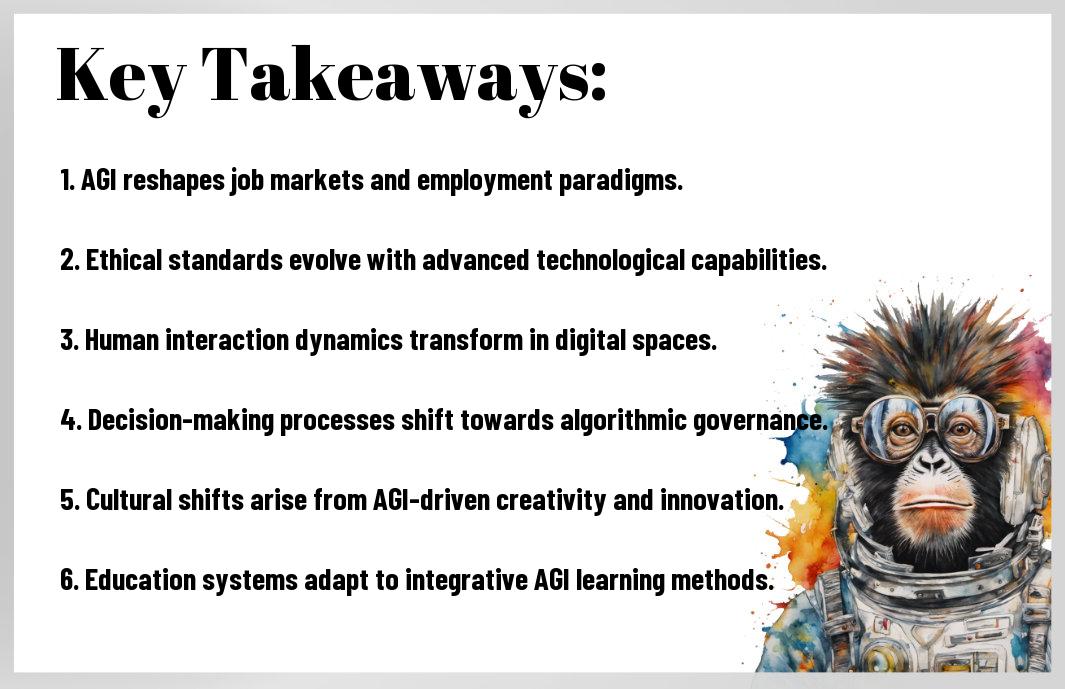
Key Takeaways:
- Redefine Employment: AGI will likely transform job markets, leading to new roles and a shift in skills required, making traditional employment norms less relevant.
- Cultural Dynamics: The integration of AGI into daily life may alter cultural values and social interactions, prompting a reevaluation of human connections and collective behavior.
- Ethical Paradigms: As AGI becomes more prevalent, societal ethical frameworks will need to adapt, challenging existing moral codes and prompting discussions about consent, privacy, and accountability.

The Concept of AGI
Your understanding of Artificial General Intelligence (AGI) is important as we investigate deeper into its societal implications. AGI is often described as a form of artificial intelligence that possesses the ability to understand, learn, and apply knowledge across a diverse range of tasks, similar to the cognitive functions of a human being. Unlike traditional AI, which is designed to perform specific tasks, AGI aims to replicate the versatile, adaptable thinking process found in human intelligence. By harnessing this capability, AGI systems could potentially shift the dynamics of decision-making and problem-solving within various sectors of society.
Definition and Functionality
For you to comprehend the true potential of AGI, it is vital to appreciate its definition and functionality. AGI encompasses a broad set of capabilities, including reasoning, learning, and understanding language. These systems can process vast amounts of information and generate insights that go beyond simple data analysis. The ultimate goal of AGI is to create machines that can autonomously innovate solutions, adapt to new environments, and execute tasks outside their initial programming. This could lead to transformative changes in fields such as healthcare, education, and engineering.
Types of AGI Models
Types of AGI models are varied and can impact how AGI systems are developed and utilized. Generally, these models can be broken down into different categories, depending on their architecture and function. Below is a summary of five widely recognized types of AGI models:
| Type of AGI Model | Description |
|---|---|
| Statistical Models | Utilize mathematical frameworks to understand patterns in data. |
| Symbolic Models | Rely on logical rules and representations to simulate human reasoning. |
| Neural Network Models | Mimic the human brain’s structure to process information and learn. |
| Hybrid Models | Combine different approaches to enhance learning and reasoning. |
| Evolutionary Models | Employ concepts of evolution to improve problem-solving capabilities. |
At this point, it is important to expand your understanding of AGI models as they represent the backbone of AGI functionality. Each type has its own strengths and weaknesses, which can determine how effectively an AGI system can learn and interact with the real world. The diversity of AGI models includes the following:
- Flexibility in applications tailored to specific needs.
- Potential for cross-domain capabilities.
- Innovative problem-solving beyond conventional limits.
- Ability to simulate complex human-like reasoning.
- Recognizing the importance of tapping into various modeling strategies to achieve a well-rounded AGI system.
| Key Features | Benefits |
|---|---|
| Robust data processing | Improves decision-making accuracy. |
| Adaptable learning | Enhances system resilience across tasks. |
| Scalability | Permits growth and evolution of AI solutions. |
| Interoperability | Supports integration with existing technologies. |
| Recognizing the varied approaches in AGI modeling can lead to innovative breakthroughs in its applications. |

Current Societal Normative Structures
While you navigate through the complexities of contemporary society, it becomes increasingly evident that the normative structures shaping your interactions and experiences are deeply entrenched. These structures serve as the underpinnings of social behavior, guiding your actions and expectations within various contexts. From a cultural standpoint, societal norms and values often dictate what is deemed acceptable or unacceptable in your community, influencing everything from interpersonal relationships to broader societal issues such as justice and equality. Understanding these norms is pivotal as they play a significant role in shaping not only individual behavior but also collective societal outcomes.
Social Norms and Values
Before examining the implications of AGI, it is vital to identify the prevailing social norms and values that govern your daily life. These values often stem from historical processes, cultural traditions, and shared experiences among members of your society. You may find that norms around respect, hierarchy, and individualism vary considerably across different regions and communities, each contributing to a unique societal fabric. Engaging with these norms allows you to appreciate the diverse perspectives that exist and the potential challenges that arise when these viewpoints collide.
Institutional Frameworks
An integral facet of your societal experience lies within the institutional frameworks that govern public and private sectors. These frameworks, including laws, educational systems, and governance bodies, establish the rules of engagement that shape your interactions at multiple levels. Such institutions are designed to enforce norms, provide stability, and ensure order within society. You might recognize that these frameworks are continually evolving, often reflecting shifts in public sentiment and technological advancements. As society grapples with its complexities, the robustness of these frameworks is paramount to maintaining a cohesive social structure.
Another aspect to consider when discussing institutional frameworks is the interplay between established systems and emerging technologies. The advent of AGI may create opportunities for reevaluating and redesigning existing institutional practices. For instance, as decision-making processes become increasingly automated, you could witness a shift in how accountability is assigned and how governance evolves. This transformation could lead to more adaptive institutions that are better equipped to handle the challenges of the future, thereby influencing your relationship with both authority and community in unprecedented ways.
Potential Impacts of AGI on Society
Once again, as we explore into the potential impacts of AGI on society, it is crucial to recognize that these transformations are not merely theoretical. You are witnessing the growing integration of AI technologies into various facets of life, signaling a paradigm shift that is set to redefine your social structure, your economy, and even your governance. The emergence of AGI will likely accelerate existing trends while also introducing unforeseen changes that require careful consideration and adaptation on your part. Understanding these impacts can better prepare you for the profound shifts that lie ahead.
Transformations in Economic Structures
At the heart of the transformation brought by AGI are the economic structures that underpin your daily life. You will likely observe a dramatic shift in labor markets as AGI takes on many functions traditionally performed by human workers. This could lead to increased productivity and lower costs, but it also raises questions about job displacement and the need for new roles that leverage human creativity and emotional intelligence. The shift could necessitate a re-evaluation of how value is created and distributed in your economy, promoting new forms of collaboration between human and machine intelligence.
Changes in Governance and Decision-Making
Between the influx of AGI capabilities and the existing frameworks of governance, a redefinition of decision-making processes is inevitable. You may find that traditional governance structures become more agile and data-driven, utilizing AGI to analyze vast datasets and forecast societal needs more accurately. Such advancements could enable more informed and responsive public policies, ultimately active in addressing complex societal challenges more effectively than ever before.
In fact, as AGI becomes increasingly integrated into governance, the potential for automated decision-making could reshape democratic participation. You may see a shift away from representative governance toward systems where algorithms help guide public opinion and policy, blurring the lines of accountability and ethical governance. This could raise necessary discussions about transparency, fairness, and the role of human judgment in a landscape profoundly influenced by intelligent systems.
Ethical Considerations
After contemplating the rapid advancements in artificial general intelligence (AGI), you might find yourself grappling with the ethical ramifications of its adoption within society. As AGI systems become more integrated into your daily life—from personal assistants to critical decision-making processes—the implications surrounding morality necessitate thorough examination. You may ponder questions about the fundamental principles that will guide these intelligent systems. Which values will be prioritized? How will diverse cultural and ethical perspectives be harmonized? These inquiries are vital as AGI challenges traditional ethical paradigms and raises potential conflicts between human values and machine-driven decisions.
Moral Implications of AGI Adoption
Considerations of morality in the context of AGI adoption are complex and far-reaching. In a landscape where machines can make decisions and influence outcomes, the potential consequences on human welfare and autonomy must be carefully assessed. You may have to navigate a shift towards a society where AGI dictates certain norms or expectations, which can lead to profound dilemmas regarding accountability and moral responsibility. As these systems evolve, you might find yourself questioning what moral framework should govern their actions and who ultimately bears responsibility for their decisions.
Public Trust and Accountability Issues
With the integration of AGI into various sectors, issues surrounding public trust and accountability are prominent. As you rely more on artificial systems to make critical decisions, the transparency of these algorithms becomes increasingly important. Concerns may arise regarding how decisions are formulated, especially when they lead to significant socioeconomic outcomes. You might find yourself asking whether adequate safeguards are in place to ensure these systems perform ethically and fairly, ultimately shaping your perception of their reliability.
To foster public trust in AGI, it is imperative for organizations to establish mechanisms for accountability that reassure you of their commitment to ethical standards. You should be able to access information on how decisions are made, and the rationale behind these processes should be clear and comprehensible. By addressing concerns over transparency and accountability, stakeholders can build a sense of security and cooperation with the technology, ensuring a collective approach to navigating the complexities that AGI introduces to societal norms.
Case Studies of AGI Integration
Despite the ongoing debates surrounding the implications of AGI, numerous case studies highlight its integration into various sectors, showcasing both transformative effects and learning experiences. A closer examination of real-world implementations offers valuable insights into how AGI systems have begun to reshape societal norms. Here are some notable examples:
- Healthcare: A leading healthcare institution reported a 20% reduction in diagnosis time for chronic diseases by implementing an AGI system that processes patient data much faster than human counterparts.
- Finance: An international bank utilized AGI to enhance fraud detection capabilities, achieving a 30% increase in efficiency in identifying fraudulent transactions within a year.
- Education: A notable online learning platform introduced AGI for personalized learning experiences, resulting in a 40% increase in student retention rates.
- Manufacturing: A well-established manufacturing company integrated AGI into its supply chain management, leading to a 25% reduction in operational costs and a 15% increase in production efficiency.
- Local Government: A city adopted an AGI-based system to process citizen requests, which streamlined services and reduced response times by 35% over six months.
Successful Implementations
Beside these impressive statistics, the successful integration of AGI demonstrates its capacity to not only enhance productivity but also redefine the standard operating procedures within organizations. In healthcare, for instance, the ability of AGI to analyze vast datasets for predictive analytics has paved the way for more proactive care models. This allows medical professionals to focus on patient-centered care rather than spending excessive time on administrative tasks, fundamentally altering how health services can be delivered.
In the finance sector, establishing AGI systems to navigate complex algorithms and transaction patterns has resulted in minimized risks and heightened security. AGI’s predictive capabilities enable financial institutions to foresee potential market trends, thus allowing you to make informed decisions that align with evolving customer needs. Such operational shifts have led to increased trust from clients, impacting the overall perception of banking efficiency.
Challenges Faced
Challenges persist amid the success stories, with the integration of AGI often facing significant hurdles that require thoughtful consideration. Many organizations encounter resistance from employees uneasy about job security as AGI automates certain tasks, leading to tension in the workplace. Furthermore, establishing regulatory frameworks that ensure ethical usage of AGI has proven to be complex, requiring collaboration across different sectors and governments to mitigate risks.
Plus, some organizations struggle with the technical challenges of effectively training AGI systems to ensure accurate output. Data quality and availability can hinder your ability to fully leverage AGI’s potential. Additionally, balancing technological advancement against the need for human insight remains a vital aspect of integration, requiring ongoing dialogue and strategic planning to create systems that are beneficial to both the workforce and society at large.
Future Scenarios
Optimistic Perspectives
All signs point toward a future where Artificial General Intelligence (AGI) enhances human potential in unforeseen ways. Imagine a society where AGI systems work alongside you, not as mere tools but as collaborative partners that empower your creativity and problem-solving abilities. This partnership could lead to unprecedented advancements in fields like medicine, education, and environmental sustainability, creating a thriving economy that prioritizes human well-being. With AGI optimizing complex tasks, you may find more time to engage in pursuits that promote personal and communal growth, ultimately fostering a more enlightened society.
All of these transformations can encourage a shift in societal norms, where compassion, inclusivity, and knowledge-sharing become foundational pillars. Envision a world where human achievements are no longer gauged solely by economic metrics, but rather by collective advancements in areas such as quality of life, health, and ethical stewardship of technology. Your role within this new societal framework could be one of greater empathy and collaboration, steering both yourself and those around you towards a more prosperous and harmonious future.
Cautionary Predictions
Below the surface of potential optimism, there are significant challenges that AGI may pose to your societal environment. If left unchecked, the rise of AGI could exacerbate existing inequalities, with those who control the technology potentially overriding the needs and voices of the larger population. In this scenario, you may see a widening chasm between the tech-savvy elite and those who lack access to advanced tools, leaving many to grapple with obsolescence in the workforce. Additionally, the ethical dilemmas surrounding privacy and surveillance could resurface, leading to a society that fosters mistrust rather than collaboration.
Considering the rapid pace at which AGI is being developed, the question of governance becomes ever more pressing. You should contemplate whether adequate frameworks will be established to ensure equitable access and ethical usage. The potency of AGI means that it could make decisions that significantly impact your life and those around you without proper oversight. The challenge lies in balancing innovation with safety, necessitating a global dialogue to create ethical standards and regulatory mechanisms that keep human welfare at the forefront of technological advancement.
Final Words
Now that you have explored the potential impact of AGI on societal normative structures, it’s evident that the transformation will be profound and multifaceted. As AGI continues to evolve, your understanding of ethics, governance, and interpersonal relationships will likely shift. You may find that traditional boundaries in areas such as work, education, and even human interaction begin to blur, as AGI systems challenge established paradigms. The implications of this shift could either enhance collective efficiency or raise new ethical dilemmas that you, alongside your contemporaries, will need to navigate thoughtfully.
As you stand on the brink of this transformative era, it’s important to engage actively with the development of AGI and the legislative frameworks surrounding it. Your role, whether as a consumer, a professional, or a citizen, will be significant in shaping how these technologies are integrated into daily life. By advocating for responsible AI practices and remaining informed about developments in AGI, you can contribute to a future where technology serves to elevate societal norms rather than undermine them. The challenge ahead invites you to envision a society where AGI can enhance human potential while reinforcing the values that matter most to you.
FAQ
Q: How might AGI impact traditional job roles and employment structures?
A: AGI has the potential to significantly alter traditional job roles by automating tasks that were once considered uniquely human. As AGI systems become capable of performing complex cognitive functions, industries may witness a shift where routine jobs are automated, leading to a reduction in demand for certain roles. However, this also opens up opportunities for new job categories that focus on managing, programming, and improving AGI systems. The resulting change may compel individuals to develop more advanced skills, prompting educational systems and training programs to evolve in tandem.
Q: In what ways could AGI contribute to changing social norms and ethical standards?
A: The introduction of AGI into society could reshape social norms and ethical standards by challenging existing frameworks. For example, topics like privacy, consent, and accountability may be re-evaluated as AGI systems become integrated into everyday life. As AGI systems operate based on data-driven algorithms, society may place a greater emphasis on transparency and fairness in their design and use. Additionally, the potential for AGI to influence decision-making processes could lead to a more collective approach to ethics, encouraging public discourse on the moral implications of employing artificial intelligence across various sectors.
Q: How could AGI influence cultural beliefs and communal interactions?
A: AGI could influence cultural beliefs and communal interactions by fostering new forms of connectivity and collaboration. As AGI enables individuals to access more diverse perspectives and information, it could challenge prevailing cultural narratives and encourage critical thinking. This increased exposure may lead to the blending of cultural practices and beliefs, supporting a more globalized view of society. Furthermore, AGI can facilitate new platforms for communication, allowing communities to engage in innovative ways, potentially reshaping interpersonal dynamics and promoting a sense of shared understanding across different societal groups.
Comments