

Just as AI technology continues to advance, Retrieval-Augmented Generation (RAG) emerges as a compelling approach that could significantly improve how machines process information. By integrating retrieval mechanisms with generative models, RAG allows AI to leverage vast datasets, enhancing the quality and accuracy of generated content. In this blog post, you’ll discover whether RAG truly serves as the solution you need for enhanced AI thinking and how it can influence various applications in your daily life and work.
Key Takeaways:
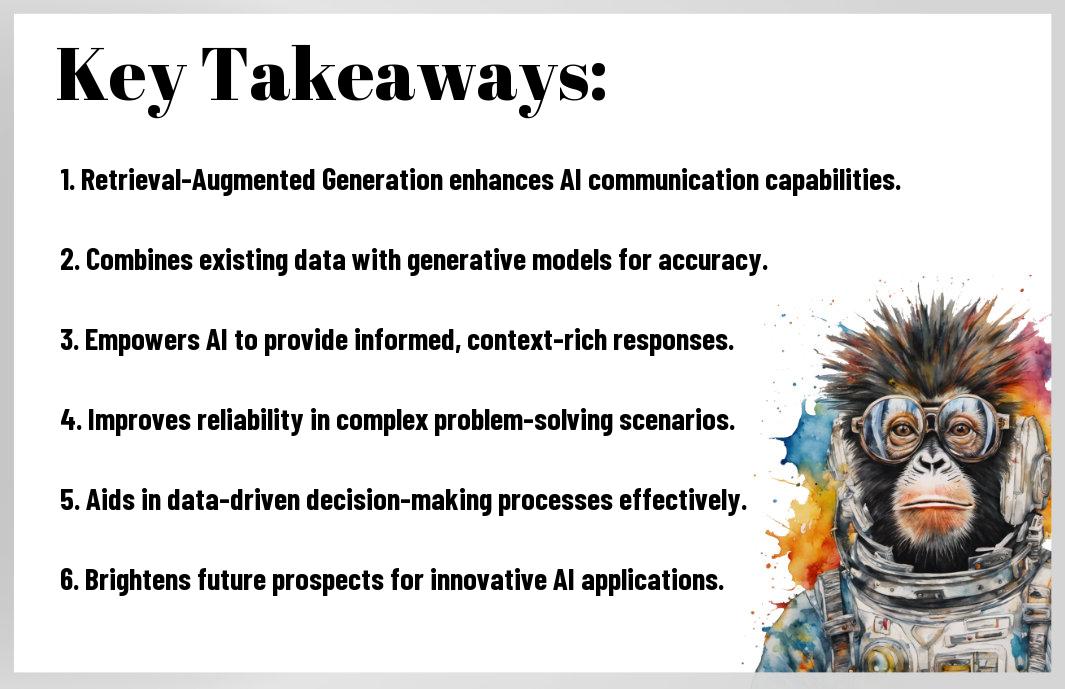
- Retrieval-Augmented Generation (RAG) combines the strengths of retrieval-based and generation-based models, leveraging large external knowledge bases to enhance performance.
- Contextual Relevance is improved as RAG can pull in relevant information dynamically, making responses more accurate and context-aware.
- Efficiency in information processing is achieved; RAG utilizes retrieval techniques to minimize the amount of generated text while maximizing informativeness.
- Versatility allows RAG to be applicable in various domains, such as customer support, educational tools, and content creation, enhancing user experience across applications.
- Enhanced Learning enables models to adapt and learn from updates in external databases, keeping knowledge fresh and reducing the risk of generating outdated information.
- Complex Task Handling showcases the ability of RAG to tackle multifaceted queries by merging both generated content and retrieved data effectively.
- Future Implications indicate potential improvements in AI reasoning capabilities, leading to smarter AI systems that can understand and process information more like humans.
Understanding Retrieval-Augmented Generation
While traditional AI models largely rely on the training data they were exposed to for generating responses, you must appreciate how Retrieval-Augmented Generation (RAG) significantly enhances this process. RAG integrates a retrieval mechanism in concert with generative models, allowing AI systems not just to produce text based on learned patterns, but also to source real-time information dynamically. By employing an external knowledge database to retrieve relevant data, generative models like GPT-3 can provide more accurate, up-to-date, and contextually relevant answers. This capability expands your understanding of how AI can mimic human-like thinking and reasoning, providing insights that are more precise and informative.
Retrieval-Augmented Generation operates on a dual mechanism: retrieval followed by generation. Initially, the system queries a database to identify pertinent documents or pieces of information that relate to your input or question. This retrieved content serves as a foundation or context upon which the generative model builds its response. You can think of it as an AI that not only memorizes facts but also has the ability to search and utilize a library of data to deliver more comprehensive and tailored outputs. This dual-step process allows you to engage with an AI that is increasingly capable of producing high-quality, relevant content grounded in real-world knowledge.
By harnessing RAG, AI systems can enhance their reasoning and overall cognitive capabilities, making them tools for deeper understanding rather than just mere content generation. For instance, when engaging in complex topics or inquiries, RAG enables the AI to ground its outputs in verifiable facts rather than ambiguous predictions based on previous training alone. This becomes especially important for you as a user, as it raises the reliability and utility of AI in applications ranging from research to customer support, thereby transforming the interaction into a more educational and enlightening experience.
Definition and Mechanism
RetrievalAugmented Generation is built on the premise that information retrieval can significantly elevate the functionality of generative models. At the heart of RAG lies the combination of two distinct types of neural networks: one that is responsible for retrieving relevant documents from a pre-defined knowledge database and another that generates text based on that retrieved information. This synergy allows you to invoke the wealth of existing knowledge, while simultaneously generating thoughtful, context-aware responses. It effectively redefines the boundaries of what AI can accomplish by merging the strengths of tradition and *modern information sourcing methods*.
As you examine deeper into its mechanism, you’ll find that RAG typically employs a pipeline approach. Initially, the system takes your query and utilizes a retrieval model, often based on technologies like BM25 or neural search architectures, to pull up relevant data points from its knowledge base. After it has gathered this information, it feeds the retrieved content into a generative model, like a transformer-based architecture, that weaves this information into coherent and contextually aligned output. This two-layer process not only makes your AI interaction richer but also aligns the generated text with real data sources, enhancing credibility and relevance.
The implementation of RAG can be transformative, particularly in instances when you’re facing questions that require precise information or nuanced understanding. Imagine asking an AI for recent research on climate change—where a traditional generative model would likely rely on pre-existing knowledge, RAG would execute a real-time query against a database, pulling in the latest findings, figures, and analyses. This cutting-edge approach encourages a deeper engagement, allowing you to turn to AI not merely for answers but for a dynamic exchange of ideas grounded in up-to-date, verifiable data.
Historical Context and Development
To grasp the significance of Retrieval-Augmented Generation, you should first understand its developmental history—a journey that reflects the evolution of AI itself. The initial stages of AI focused heavily on pattern recognition and static knowledge databases. While these early methods were groundbreaking, their limitations became increasingly apparent as the demands for more interactive, responsive systems grew. In response, researchers began exploring ways to combine traditional database retrieval techniques with advanced natural language processing, leading to the creation of systems that could effectively augment generative models with targeted information retrieval capabilities.
The shift toward integrating RAG into mainstream AI applications marked a pivotal point in the field, particularly with the rise of transformer architectures and neural networks that could process vast amounts of data in real-time. Innovations in this area occurred alongside a growing recognition of the *importance of context and up-to-date knowledge*, prompting researchers to rethink how these two pieces could be stitched together. As a result, you now see various applications—from search engines enhancing their algorithms to AI chatbots providing more informative responses—leveraging RAG to create richer, more meaningful interactions.
Even as AI continues to develop, the balance between generation and retrieval remains a topic of active research, opening doors to new possibilities and scenarios. As users become increasingly aware of the value of accurate and timely information, RAG stands out as a beacon of hope for future advancements in AI, reminding you of the potential for technology to provide *greater depth and understanding* in your engagements while ensuring that the information you receive is not only relevant but also substantiated by real-world data.
The Role of Retrieval in AI Thinking
There’s no denying that retrieval plays a fundamental role in AI thinking. As more organizations leverage artificial intelligence to process vast amounts of data, the retrieval component emerges as a key player in enabling systems to access relevant information efficiently. It is necessary to understand that retrieval-augmented generation (RAG) frameworks facilitate better performance in AI by incorporating external knowledge sources into the generative process. By doing so, your AI systems can respond to queries and generate content that is not only coherent but also grounded in factual data. If you’re curious about the foundational aspects of this methodology, you can examine deeper into what is retrieval-augmented generation (RAG)?.
Enhancing Knowledge Access
Behind the mechanics of retrieval lies the promise of superior knowledge access that boosts your AI’s intellectual capacity significantly. The traditional models that rely solely on pre-existing datasets often fall short when it comes to delivering up-to-date or highly specialized information. With retrieval mechanisms integrated into generative processes, your AI can pull the most relevant knowledge from extensive databases, ensuring that its output reflects the latest findings and trends in real-time. This ability to access a broader spectrum of information not only enhances your AI’s reliability but also enriches the contextual integrity of its responses.
Moreover, the process of enhancing knowledge access via retrieval mechanisms allows your AI to function as more than just a static information repository. When augmented with retrieval capabilities, your AI system becomes a dynamic node of intelligence that continually learns from new data and developments in various fields. This leads to more informed decision-making, as the AI can recognize patterns and insights that would otherwise remain obscured in isolated datasets. Not only does this transform the way you interact with AI, but it also elevates the potential applications of AI across multiple industries, from healthcare to finance.
Improving Contextual Relationships
Improving contextual relationships in AI thinking comes from the sophisticated integration of retrieval mechanisms. As your AI learns to correlate different pieces of information effectively, it can provide responses that resonate with the user’s intent and context. This level of understanding is achieved through well-structured retrieval processes, which help your AI model draw connections between the query and relevant knowledge effectively. When the AI can recognize the nuances of human language and interaction, the answers it provides become far more relevant and insightful, ultimately enhancing user experience.
Thinking about contextual relationships, it’s necessary to consider how retrieval influences the essence of understanding in AI. Through the amalgamation of previous knowledge and real-time information, your AI can tailor responses based on not only what is being asked but also the underlying motivations and expectations of the user. The result is an AI that does more than just spit out facts; it engages in a dialog that’s meaningful and contextually relevant. This capability to bridge disparate data pieces and derive personalized responses embodies the transformative potential of retrieval-augmented generation. As you explore these systems, consider how they might reshape your interactions with AI, making them more intelligent and impactful than ever before.

Use Cases of Retrieval-Augmented Generation
Keep in mind that the implementation of Retrieval-Augmented Generation (RAG) is not limited to a singular domain but spans across various fields, significantly enhancing the capabilities of AI models. You may ask how RAG improves applications, especially in the areas of Natural Language Processing (NLP) and Knowledge Management Systems (KMS). These use cases demonstrate the power of combining retrieval mechanisms with generative models, empowering you to harness the full potential of sophisticated AI technologies. If you seek to investigate deeper into the subject, you can check out How Retrieval Augmented Generation (RAG) Enhances … for comprehensive insights.
Natural Language Processing
Above all, Natural Language Processing has seen remarkable transformation with the integration of RAG techniques. You can employ RAG to assist AI in understanding context better and providing more accurate responses. By retrieving relevant documents and previous interactions, your AI model becomes more resourceful, efficiently synthesizing information to generate coherent and insightful responses. This added step of retrieval not only elevates the models’ performance but also addresses the limitations of traditional NLP systems that might struggle with ambiguity or lack of specific context.
Additionally, RAG provides enhanced capabilities in tasks like sentiment analysis, summarization, and translation. For instance, when translating phrases or sentiments, a RAG-enabled system can access a broader knowledge base to ensure the accuracy of the translation while keeping the contextual integrity intact. This is particularly significant for tasks that involve multiple nuances that require a deep understanding of language variations. You will find that the smarter your systems get, the more seamlessly they can cater to user needs, which can elevate user satisfaction and enhance engagement.
Furthermore, RAG can be particularly beneficial in specialized fields like healthcare, finance, and legal sectors where the accuracy of information is paramount. For instance, in healthcare applications, an AI system powered by RAG can access medical journals, patient histories, and treatment guidelines to provide expert-level assistance. This prevents misinformation or misinterpretation, which can lead to detrimental outcomes. When you embrace RAG in your NLP applications, you position yourself at the cutting edge of AI-driven solutions.
Knowledge Management Systems
An equally impactful use case for RAG lies within Knowledge Management Systems (KMS), where effective management and retrieval of information are necessary for businesses. You will appreciate how RAG enhances KMS by allowing users to access a wealth of knowledge in real-time, significantly improving productivity. By integrating retrieval mechanisms, your KMS can source relevant documents and internal resources instantly, helping users to make informed decisions without the hassle of sifting through extensive databases.
Moreover, organizations can benefit from RAG’s capability to personalize knowledge-based interactions. By utilizing retrieval-augmented techniques, your KMS will allow for tailored responses based on user inquiries or behavior. This means that when someone in your organization seeks information on a particular project or topic, the AI can not only retrieve data from previous reports but also suggest additional resources and insights that may add value to the query. Effectively, this leads to enhanced collaboration and synergy across teams, contributing to a more knowledgeable workforce.
Indeed, adopting RAG in Knowledge Management Systems sets a precedent for how businesses manage their crucial resources. The sophisticated capacity for rapid data retrieval streamlines processes, reduces time spent searching for information, and enhances the reliability of knowledge dissemination. Moreover, with RAG, you empower your staff to operate more effectively by providing access to the right information at the right time. This augmented capability can significantly influence the overall productivity and innovation in your organization.
Benefits of Retrieval-Augmented Generation
Not only does Retrieval-Augmented Generation (RAG) promise to enhance the capabilities of artificial intelligence, but it also introduces a clear array of benefits that can profoundly reshape how you interact with and deploy AI technologies. By leveraging external data and knowledge bases, RAG has the potential to supercharge your AI systems in ways that go beyond traditional generative models. If you’re curious about the core mechanisms underlying RAG and how it can fit into your AI strategies, you might find valuable insights in What is Retrieval Augmented Generation – by Prateek Joshi. Grasping these benefits could place you ahead in the rapidly evolving AI landscape.
Increased Accuracy and Relevance
Relevance is at the heart of why Retrieval-Augmented Generation stands out as a game-changer. Traditional AI models often generate responses based on patterns in the training data alone, which can lead to inaccuracies or a misalignment with current knowledge. With RAG, your AI can augment its generative abilities by drawing on real-time, external information sources. This means that the likelihood of producing responses that are accurate and relevant to your specific queries significantly increases. Essentially, the AI can sift through vast databases of information and pinpoint what is most pertinent to your needs, leading to more meaningful and useful interactions.
Moreover, increased accuracy extends beyond just relevant content; it enhances the overall user experience. When you engage with an AI that provides precise and contextually appropriate answers, it instills confidence in the interactions. Whether you are using an AI for customer support, content generation, or data analysis, knowing that the responses are not only more likely to be correct but also pertinent will encourage you to rely more heavily on these systems. This can result in improved productivity and decision-making capabilities, enabling you to work smarter, not harder.
The implementation of RAG brings about a more integrated approach to knowledge synthesis, where it’s not just about generating coherent text but ensuring that generated information is enriched by the most relevant and accurate data available. You’ll benefit from enhanced insights that are timely and backed by trustworthy sources. This adaptability and improved performance make RAG an indispensable tool in a landscape where knowledge is rapidly evolving and staying up-to-date is key to success.
Cost Efficiency in AI Development
Among the many advantages of Retrieval-Augmented Generation, one of the standout features is its potential for cost efficiency in AI development. Traditional approaches often require developing extensive datasets, which can be resource-intensive, both in terms of time and financial resources. However, with RAG, you can leverage existing knowledge bases and information repositories, diminishing the need for creating expansive training datasets from scratch. This not only accelerates the development cycle but also allows for more efficient allocation of your resources, making it easier to innovate without the typical overhead costs.
Indeed, thinking about cost efficiency in AI development can lead to transformative results. By utilizing a RAG system, you minimize the expenses associated with data collection and processing while maximizing the quality of outputs. You can effectively tap into the wealth of knowledge that exists outside your databases, giving your AI a more robust and informed basis for generating responses. This has the potential to significantly shorten your development timeframes while ensuring improved performance and accuracy.
By integrating Retrieval-Augmented Generation into your AI systems, you are not just opting for enhanced intelligence but also advocating for a more sustainable and economically viable path forward in AI development. This cost-effective approach opens up opportunities for smaller enterprises or startups that may have previously struggled to compete with larger players due to budget constraints. Additionally, it empowers you to allocate resources towards other critical areas of your business, ultimately driving a more innovative and agile organizational culture.
Challenges and Limitations
Now that you’ve explored the potential of Retrieval-Augmented Generation (RAG) in enhancing AI thinking, it’s important to consider the challenges and limitations that accompany this technology. One of the most significant issues is the dependency on data quality and availability. Even the most sophisticated RAG systems rely heavily on the underlying data, meaning that any flaws in the data can lead to less reliable outputs. You might find that if your data sources are outdated or not comprehensive enough, the answers generated by RAG could lack depth or even accuracy. This reliance on data also means that if your sources are biased or lacking in diversity, those biases can propagate through the system’s outputs, shaping the way AI models understand and interact with the world.
Data Dependency and Quality Concerns
Quality control becomes a pivotal issue when you’re dealing with RAG systems. You must ensure that the data you incorporate is not only rich and relevant but also representative of various perspectives. If the data lacks breadth or depth, your results may be skewed or not align with real-world complexities. This can be particularly problematic in areas such as decision-making or content generation, where inaccuracies can lead to poor outcomes or the dissemination of incomplete information. As you curate your data sources, consistently evaluating their quality and applicability will be imperative to achieving reliable outputs.
Additionally, the nature of the data you use directly influences how well your AI system performs its tasks. In some cases, you may encounter challenges linked to the timeliness of the data. If you’re pulling information from static databases that aren’t updated regularly, your RAG system may produce responses that are outdated or irrelevant to current events or trends. This further underlines the importance of selecting high-quality, constantly updated data sources to enhance the reliability of the generated responses.
Ethical Considerations and Misinformation
Above and beyond data quality, you should consider the ethical implications of using Retrieval-Augmented Generation, especially when it comes to the issue of misinformation. As RAG systems generate content based on external information, they can unintentionally perpetuate inaccuracies or biased narratives if the retrieved data is flawed. The risk of disseminating false information can exacerbate issues like public misinformation, especially in sensitive contexts such as health, politics, and science. Therefore, it is crucial that you take a proactive approach in vetting your data sources and evaluating the credibility of the information to minimize the risks associated with misinformation.
Another concern that emerges in this domain is the potential for algorithmic bias, which can manifest when the data fed into an AI system reflects historical inequalities or prejudice. This is particularly dangerous, as it can lead to the reinforcement of stereotypes and discrimination in generated content. You need to be vigilant about the sources you rely upon, ensuring that they help foster responsible AI use. In light of this, ethical frameworks and rigorous oversight become imperative to safeguard against the spread of misleading or harmful information, ultimately aiming to create a more inclusive and informed public discourse.
Future Perspectives
Your exploration of Retrieval-Augmented Generation (RAG) technology leads you to consider its potential role in the future of artificial intelligence. As AI systems evolve, you might find yourself wondering how RAG can enhance the thinking capabilities of machines, making them more capable of handling complex tasks. The integration of large-scale data retrieval with generative models could be a game-changer, allowing for a new level of contextual awareness and problem-solving ability. This evolution will likely pave the way for AI systems that not only generate human-like text but also substantiate their arguments with relevant data, marking a significant shift in how you interact with AI technology.
Innovations on the Horizon
The landscape of artificial intelligence is poised for remarkable advancements, and RAG is at the forefront of this wave of innovation. You can expect to see improved algorithms that better blend retrieval mechanisms with generative processes, enabling AI to access vast repositories of knowledge in real-time. This could transform the way you use AI for tasks like content creation, customer support, and research. Imagine AI that not only qualifies its generated text with reliable references but also tailors its responses to your individual preferences and needs, leading to a more personalized interaction that blurs the line between machine-generated and human-generated content.
Your curiosity about the future of AI will certainly be piqued by the potential for RAG to integrate more sophisticated forms of understanding, such as semantic analysis and contextual reasoning. Upcoming innovations may allow RAG systems to discern the user’s intent with greater accuracy, adapting their responses based on a deeper understanding of the information at hand. This means that your interactions with AI could become even more intuitive and relevant, opening new avenues for practical applications across various industries, from education to healthcare.
Integration with Other AI Technologies
Integration of RAG with other AI technologies will play a pivotal role in shaping your experience with artificial intelligence in the future. By combining RAG with advances in natural language processing and machine learning, you will benefit from a more cohesive and powerful AI ecosystem. As these technologies converge, you may notice that AI systems become increasingly adept at handling multi-faceted queries that require both retrieval of information and generation of meaningful responses. This synergy could make your interactions with AI not only more productive but also more enriching, as they become capable of offering insights and solutions that are tailored to complex scenarios.
Plus, the implications extend beyond mere improvements in efficiency. The integration of RAG with other cutting-edge technologies, such as neural networks and computer vision, could unlock new dimensions of AI capabilities. Imagine a scenario where AI not only generates text responses based on prior knowledge but also combines visual data with textual data, allowing for an even deeper comprehension of context. This multi-modal approach can empower you to leverage AI in innovative ways that were previously unthinkable, shaping your interactions into a seamless experience where technology truly understands and serves your needs. Ultimately, the future of AI, particularly through RAG, suggests a pathway toward more intuitive and intelligent systems that enhance your daily life and decision-making processes.
Conclusion
Summing up, the concept of Retrieval-Augmented Generation (RAG) presents a transformative approach to enhancing AI thinking capabilities. By integrating external knowledge sources into the generative process, RAG allows you to tap into a broader spectrum of information and context than traditional models, which rely solely on pre-existing data. This integration not only empowers AI tools to produce more accurate and relevant responses but also fosters an adaptive learning environment. When you leverage RAG, you unlock the potential for your AI systems to become more versatile, effectively bridging the gap between generalized knowledge and the specific needs of your queries.
Your engagement with RAG signifies a move toward a more interactive relationship with AI. Instead of merely receiving responses based on static training data, you become part of a dynamic knowledge ecosystem where the system can pull real-time information to address your inquiries better. This feature is particularly beneficial in fields that demand current and precise data, such as medicine, technology, or finance, where your ability to access the latest information can support more informed decision-making. Consequently, RAG’s capabilities might enhance not only the efficiency of AI systems but also your experience when interacting with them, making it feel almost like a collaboration between human and machine.
When all is said and done, as you continue to explore the advancements in AI technology, RAG stands out as a significant innovation with the potential to redefine how we interface with intelligent systems. The advancements in AI-dependent tasks, combined with the ability to access and retrieve relevant information contextually, ensure that you can achieve better outcomes in your projects and daily activities. By embracing Retrieval-Augmented Generation, you position yourself at the forefront of AI evolution, prepared to harness its strengths in a way that fosters more profound insights and efficiencies, paving the path for an enhanced future of human-AI collaboration.
FAQ
Q: What is Retrieval-Augmented Generation (RAG)?
A: Retrieval-Augmented Generation (RAG) is a hybrid AI approach that combines traditional generative models with retrieval systems. It allows AI models to generate responses while referencing large datasets or external documents. This method enhances the accuracy and relevance of the generated content by integrating real-time information retrieval into the generation process.
Q: How does RAG enhance AI thinking compared to traditional generation methods?
A: Traditional generation methods rely solely on pre-trained models, which may lack the latest information or context needed for specific queries. RAG, on the other hand, enhances AI thinking by utilizing vast repositories of knowledge, which helps provide up-to-date and contextually appropriate responses. This leads to more informative and relevant interactions, making the AI outputs more aligned with user needs.
Q: In what applications can RAG be particularly beneficial?
A: RAG is particularly beneficial in applications requiring accurate and timely information, such as customer support, content generation, and educational tools. By leveraging external data sources, RAG can improve the relevance of responses in fields like medical advice, legal guidance, or technical support, where precision and context are paramount.
Q: Are there any limitations to using Retrieval-Augmented Generation?
A: While RAG offers many advantages, there are limitations to consider. The quality of the output is heavily dependent on the retrieval system’s capability to fetch the most relevant and high-quality data. Additionally, RAG models can be more complex and resource-intensive to train, requiring careful optimization to function effectively without compromising response speed or accessibility.
Q: How do developers implement Retrieval-Augmented Generation in their projects?
A: Developers can implement RAG by integrating a generative model with a retrieval architecture, typically involving a two-step process: first retrieving relevant documents or data points, and then generating responses based on that information. Popular frameworks and libraries, such as Hugging Face’s Transformers, often provide tools and pre-trained models that streamline this implementation. Collaboration with domain experts can further enhance the retrieval strategies, ensuring more specialized and relevant outputs.
Comments