

Most individuals are unaware of how the innovative combination of Retrieval-Augmented Generation (RAG) and Artificial Intelligence (AI) is poised to transform the landscape of cognitive machines. This partnership enhances the way machines understand and generate information, paving the way for more intuitive and context-aware systems. By exploring this synergy, you may discover its potential to revolutionize your interactions with technology, improving efficiency and creativity in various applications. As these technologies continue to evolve, understanding their implications is imperative for navigating this exciting frontier.
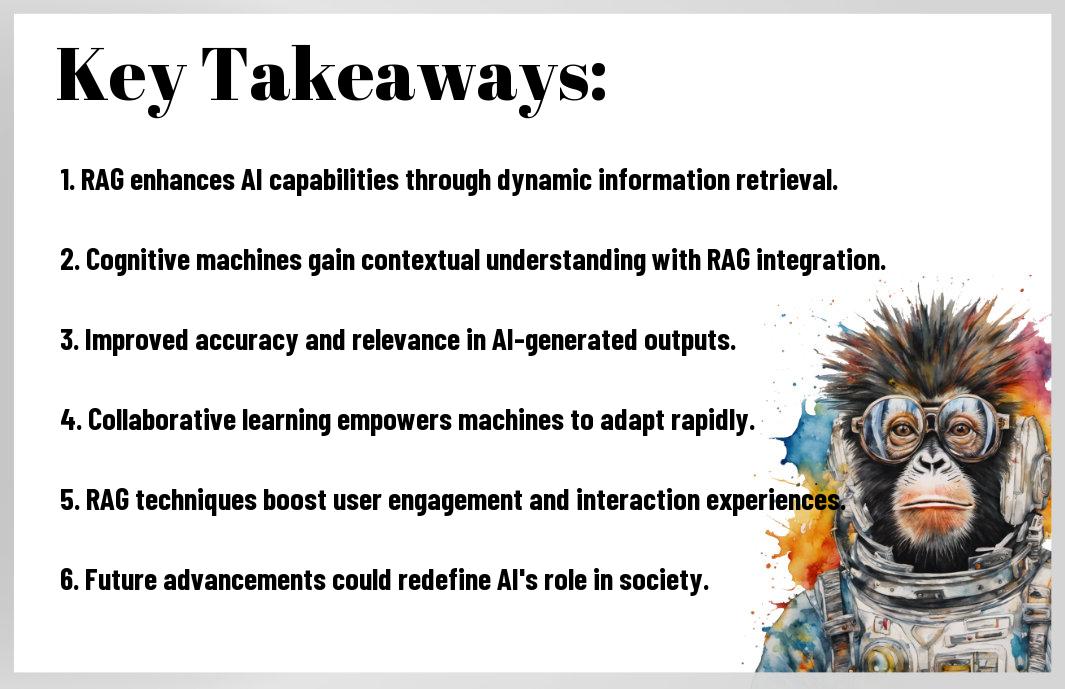
Key Takeaways:
- RAG Integration: The combination of Retrieval-Augmented Generation (RAG) with AI enhances data retrieval and generation capabilities for more accurate responses.
- Cognitive Machines: This synergy is paving the way for advanced cognitive machines that can perform complex reasoning and understanding tasks.
- Contextual Awareness: RAG helps machines better understand context, allowing for more relevant and tailored interactions with users.
- Scalability: The blend of RAG and AI supports scalable solutions, making it easier to handle large volumes of information effectively.
- Real-World Applications: Industries such as healthcare, finance, and education are witnessing transformative impacts through the adoption of RAG-enhanced AI systems.
- User Experience: Improved accuracy and responsiveness in AI applications significantly enhance overall user experience and satisfaction.
- Future Prospects: As technology evolves, the continued development of RAG and AI is likely to spawn even more innovative cognitive solutions.

Understanding RAG: Definition and Mechanisms
To grasp the full potential of RAG, or Retrieval-Augmented Generation, it’s vital to first understand its fundamental definition and mechanisms. RAG represents a synergistic approach that combines traditional generative models with a retrieval system to enhance the content it produces. By utilizing an extensive database of information, RAG improves the accuracy and relevance of the outputs generated. You can think of RAG as a bridge that connects the vast realm of information retrieval to the creative generative processes of AI, thereby enhancing your overall user experience. This combination not only ensures that the content is tailored to your needs but also roots it in factual accuracy, which can significantly aid in decision-making and knowledge acquisition.
What is RAG?
Mechanisms behind RAG revolve around the simultaneous use of retrieval and generation methods. In practice, when a query is posed, RAG first retrieves relevant documents or data points from a pre-defined dataset. This retrieved information is then fed into a generative model, which synthesizes this data into coherent, contextually appropriate responses. By leveraging the latest advancements in natural language processing, RAG can produce nuanced and informed outputs, making it a powerful tool for various applications such as chatbots, content creation, and even academic research. You can see RAG as a sophisticated cooking process: the retrieval acts as the careful selection of high-quality ingredients, while the generative aspect provides the culinary artistry that transforms these ingredients into a gourmet meal.
The integration of retrieval into the generative process introduces a remarkable degree of flexibility. You can customize your queries to look into specialized domains and retrieve targeted knowledge, thereby enriching the AI’s ability to generate specific, relevant responses. Unlike traditional generative models that may hallucinate or generate incorrect facts, the retrieval component serves as a grounding mechanism, enhancing the reliability and trustworthiness of the outputs. This transformative approach offers you a significant advantage, ensuring that the information you receive is not just creative but firmly anchored in data-driven insights.
The Evolution of RAG Technology
Among the many technological advancements in artificial intelligence, RAG represents a notable evolution in how machines can process and generate information. Originally, generative models operated in isolation, relying solely on their training data to craft responses. This often resulted in outputs that lacked specificity or accuracy, limiting their effectiveness across various contexts. The introduction of retrieval systems into this framework marked a paradigm shift. With this integration, the generative models now have access to a vast reservoir of up-to-date information, thus allowing them to remain relevant and informative.
For instance, the emergence of transformer models revolutionized retrieval-augmented generation, bringing forth a multitude of applications across sectors such as education, healthcare, and business intelligence. Enhanced performance metrics become achievable as RAG leverages advancements in deep learning, leading to ever-improving accuracy and contextual understanding in responses. As you explore the cascading benefits of RAG technology, you will discover that it not only boosts your access to information but also empowers AI to better assist you in various tasks. This integration underscores how the continuous evolution of RAG can redefine the landscape of cognitive machines.
The journey of RAG technology is reflective of the broader evolution in artificial intelligence. As RAG associated models grow smarter and more efficient, they are poised to change how you interact with machines fundamentally. Embracing these advancements allows you to harness the powerful combination of accurate information retrieval and advanced generative capabilities, thus ensuring a more streamlined and productive experience in your endeavors. It is this interplay of technology and needs that signals the dawn of a new era in cognitive machines.
The Role of AI in Cognitive Systems
Some of the most innovative developments in cognitive technology today are driven by advancements in AI. As you explore the ways that AI is being integrated into cognitive systems, it’s imperative to understand the underlying mechanisms that shape this technology. Cognitive systems, at their core, aim to emulate human thought processes, allowing machines to learn, reason, and interact with their environments. These systems leverage AI to enhance their capabilities, thereby transforming your experience and the efficiency of various processes. For a deeper understanding of this integration, you may refer to The synergy of humans and cognitive robots – AI for Good.
Types of AI: Narrow vs. General Intelligence
The field of AI can be broadly categorized into two distinct types: Narrow AI and General AI. Narrow AI focuses on specific tasks, allowing it to outperform humans in certain domains. This includes applications such as voice recognition, image analysis, and personal assistants that automate everyday tasks. In contrast, General AI aims to emulate human cognitive functions across a wide range of activities, from problem-solving to emotional understanding. While General AI is largely theoretical at this point, the pursuit of such technology may significantly redefine your interaction with machines.
| Narrow AI | General AI |
| Task-specific capabilities | Ability to learn and apply knowledge broadly |
| Examples: Siri, Google Assistant | Not yet fully realized |
| Highly efficient in defined tasks | Potential for emotional and social intelligence |
| Widely used today | Still a subject of research |
Recognizing the differences between these two types of AI can help you appreciate the advancements being made within cognitive systems. Narrow AI’s prevalence showcases its practical applications, while the exploration of General AI remains a hopeful frontier for the future of cognitive technologies.
Current Applications of AI in Cognitive Technologies
Role of AI in cognitive technologies allows for significant advancements across various industries. To enhance decision-making processes, predictive analytics systems utilize AI to analyze trends and forecast outcomes, enabling more informed choices. In healthcare, AI-driven systems assist in patient diagnosis and customized treatment plans, improving overall health outcomes. Furthermore, AI is at the forefront of intelligent automation, where its capabilities streamline operational efficiency, allowing organizations to allocate resources more effectively.
Hence, as you probe deeper into the landscape of AI, it becomes evident that the potential applications are vast and varied. In the business sector, AI engenders improved customer service through chatbots and data analytics, while in education, it offers personalized learning experiences tailored to individual student needs. Notably, in security, AI algorithms analyze vast quantities of data to detect anomalies and mitigate threats. These developments highlight the dual-edged nature of AI, with both positive and potentially dangerous implications depending on how technology is used and governed. This evolving relationship with AI in cognitive systems ultimately sets the stage for remarkable advancements in machine capabilities, further reinforcing the synergy of RAG and AI. Your responsibility as a user is to approach these technologies critically, understanding their implications for both society and personal experience.
Synergistic Benefits of RAG and AI
Despite the rapid advancements in technology, the integration of Retrieval-Augmented Generation (RAG) and Artificial Intelligence (AI) presents an unparalleled opportunity to revolutionize various sectors. By combining the strengths of RAG, which excels at retrieving and generating contextually relevant information, with the capabilities of AI that allow for intricate data analysis, you can significantly boost your operations. This synergy not only enhances the performance of cognitive machines but also catalyzes efficiency in planning and executing tasks. Thus, as you explore this intersection of technologies, you stand at the forefront of a transformative wave that can redefine how industries operate.
Enhancing Performance and Efficiency
Against the backdrop of conventional AI systems that falter when faced with ambiguous queries or an overload of information, the incorporation of RAG comes as a game-changer. By enabling AI systems to access and utilize vast, up-to-date knowledge bases effectively, you enhance the system’s ability to deliver precise and relevant answers. This improvement leads to increased throughput in data processing tasks that would otherwise consume much time and resources. Consequently, you can reallocate your team’s focus on more complex, value-added activities rather than getting trapped in cycles of information retrieval and processing.
Not only does this synergy lead to enhanced performance, but it also amplifies operational efficiency significantly. The fast-tracking of data retrieval processes ensures that your decision-making cycles are shortened, allowing you to respond to changing market conditions swiftly. Furthermore, the integration of RAG an AI simplifies information access through intuitive interfaces and natural language processing capabilities, making it easier for your teams to interact with the system. Therefore, as you invest in this technology mix, you position your organization to capitalize on agility and responsiveness, rather than being bogged down by inefficiencies.
Improving Decision-Making Processes
Across industries, the stakes of decision-making are often high and complex, requiring a synthesis of data, insights, and projections. When you integrate RAG with AI, you enhance your decision-making framework significantly. For example, RAG’s capacity to pull context-rich, historical, or real-time data enables AI models to generate forecasts or recommendations that are incredibly informative and relevant. This combination not only optimizes the output but also fosters a sense of confidence in the decisions you make, as they are positioned on solid ground built from intelligent data synthesis.
Decision-making can become a formidable task if you lack access to comprehensive insights. However, with RAG and AI together, you can harness the collective power of data and machine learning to enhance your judgments effectively. The RAG system retrieves information that supplements your learning, while AI processes provide analytical reasoning. This interaction allows for a more rounded approach to choices and actions where you can weigh potential risks and benefits accurately. As a result, you are better equipped to navigate uncertainty, seize opportunities, and facilitate more impactful business outcomes.
By focusing on enhancing the synergy of RAG and AI, you not only improve your performance metrics but also fortify your decision-making processes, ultimately leading to greater organizational success. The continuous access to real-time information and the ability to analyze it contextually allows your cognitive machines to operate at peak capacity. Ultimately, this collaborative system becomes a powerful tool in mitigating operational risks and maximizing the benefits your organization can derive from informed, calculated decisions.

Real-World Applications of RAG and AI Integration
Keep in mind that the integration of Retrieval-Augmented Generation (RAG) and Artificial Intelligence (AI) is not just confined to theoretical discussions; numerous industries are currently benefiting from these transformative technologies. This convergence has opened up opportunities for businesses to improve efficiency, enhance decision-making, and create personalized customer experiences. Whether it’s in healthcare, finance, or manufacturing, the real-world applications are abundant and grow as technology evolves. Companies are increasingly leveraging RAG to enrich their AI systems with comprehensive data retrieval capabilities that allow them to provide contextually relevant insights that drive performance improvements.
Case Studies in Industry
Integration in various sectors showcases the profound impact of RAG and AI synergy. Here are some compelling case studies that illustrate this trend:
- Healthcare: A major hospital chain implemented RAG to improve patient education and outcomes, leading to a 25% reduction in readmission rates. By retrieving and generating personalized care plans based on real-time data, patients received tailored information that better informed their decisions.
- Finance: A leading bank utilized AI with RAG capabilities to analyze customer queries, improving response time by 40%. This shift enabled quicker resolutions and an enhanced customer experience, resulting in a 15% increase in customer satisfaction scores.
- Retail: An e-commerce giant adopted RAG-enhanced chatbots that could retrieve relevant product recommendations while answering customer questions. This led to a 20% boost in sales conversion rates and a reduced cart abandonment rate by 30%.
- Manufacturing: A manufacturing firm integrated RAG to optimize supply chain processes. They achieved a 23% reduction in lead time and lowered costs by 17%. The ability to gather and analyze data from suppliers and production efficiently enabled more informed decision-making.
To foster future innovations and projects, it’s important to envision the possibilities that RAG and AI integration can unlock. As industries mature and adapt these technologies, you will witness a variety of novel applications emerge. The potential to automate complex decision-making processes, enhance creativity in content generation, and produce real-time analytics will transform how organizations operate. For instance, in autonomous systems, the combination of RAG and AI can improve the situational awareness of vehicles or drones by providing contextually relevant data and supporting navigational decisions. As these systems become increasingly capable, their potential applications could extend across logistics, agriculture, and even disaster response.
Potential Innovations and Future Projects
A deeper exploration into Potential Innovations and Future Projects indicates that as RAG and AI technology continue to evolve, a future where cognitive machines operate at unprecedented levels of efficiency could soon become a reality. The next wave of innovative tools might involve a seamless blend of natural language processing and machine learning, allowing your AI applications to understand and anticipate user needs dynamically. Consider the implications: customer service agents powered by advanced AI could provide personalized assistance by drawing real-time insights from vast databases, fundamentally altering the user experience.
You might also observe the development of advanced recommendation systems that leverage RAG to analyze your preferences based on past behavior. By accessing vast amounts of data and generating relevant, tailored suggestions, such systems have the potential to exceed current standards of personalization. With AI ethics and responsibility taking center stage in technology conversations, overcoming any potential risks while embracing the benefits of these innovations will be necessary for a responsible advancement toward the future.
Challenges and Limitations
All advancements often come with their share of challenges, and the combination of RAG (Retrieval-Augmented Generation) and AI is no exception. One significant hurdle you might encounter is the need for well-structured and relevant data. For RAG models to perform effectively, they rely heavily on the quality of external data sources. If the data you are working with is outdated, biased, or misleading, the performance of your cognitive machine may suffer, leading to suboptimal results. Moreover, when implementing RAG, you might face issues surrounding information retrieval efficiency and accuracy, which are paramount to achieving meaningful AI interactions. As outlined in research on Interactive AI with Retrieval-Augmented Generation for …, these factors can directly affect the AI’s ability to generate coherent and contextually appropriate outputs.
Ethical considerations also play a central role in your exploration of RAG and AI synergy. Against the backdrop of rapidly advancing technology, you need to be vigilant about the ethical implications of AI-generated content. Bias, misinformation, and privacy concerns are inextricably linked to the data you use for RAG models. If the training data contains any biases, there is a substantial risk that your AI could perpetuate these biases, leading to unfair or discriminative outcomes. Ethical accountability is paramount; you must ensure that your system operates fairly and transparently while safeguarding user data. Societal trust depends on your commitment to addressing these issues head-on.
Technical and practical hurdles are intertwined with the implementation of RAG and AI systems. Practical concerns often manifest as the challenge of integrating sophisticated AI algorithms into existing workflows. You must evaluate the compatibility of these systems with your infrastructure – a task that can be arduous if your organization is not equipped with the appropriate tools or expertise. Additionally, scalability becomes a prominent issue; ensuring that your cognitive machines can handle increasing volumes of data without loss of performance is key to sustaining effective operations. In today’s fast-paced world, the efficacy of your AI solutions hinges on your ability to navigate these obstacles thoughtfully and strategically.
Ethical Considerations
Against the increasing capabilities of AI technology, you face pressing ethical considerations. Questions around integrity and accountability must permeate your approach when constructing RAG models. If the cognitive machine generates content influenced by flawed or biased data, the implications could be regrettable. Ethical dilemmas must be confronted not just at the design stage but throughout the lifecycle of the AI application. Engaging in regular ethical assessments can help you mitigate adverse outcomes while encouraging responsible AI deployment.
Moreover, your commitment to fostering a transparent and user-centric AI environment is important. You must be proactive in disclosing how your AI functions, including how data is sourced and utilized. This transparency positively impacts user acceptance and trust, which are significant factors for the long-term success of any AI solution. To achieve a balance between innovation and ethics, implementing governance structures to oversee the ethical usage of AI can guide you in aligning your technology with societal norms and values.
Additionally, the responsibility of ensuring privacy protection cannot be overlooked. As you integrate RAG into your AI processes, the collection and usage of user data should adhere to stringent privacy laws and ethical standards. By respecting user privacy and providing opt-in mechanisms for data utilization, you not only enhance the user experience but also protect your organization from potential legal entanglements and reputational damage. Thus, addressing these ethical considerations is a vital step that shapes your approach in deploying cognitive machines.
Technical and Practical Hurdles
Practical challenges arise in the form of system integration and operational scaling. The complexity of RAG models demands an adept understanding of AI algorithms, data management, and software ecosystems. You may find that traditional systems are ill-equipped to accommodate the cutting-edge requirements of RAG, necessitating an overhaul of existing infrastructures. This can be both time-consuming and costly. Furthermore, as you integrate these advanced models, the need for ongoing training and adaptability of your staff becomes apparent, as understanding AI intricacies can be daunting for those not versed in modern computational methodologies.
You also face the challenge of managing the vast amount of data these systems require. Technical limitations in data processing capabilities can impede real-time decision-making, potentially leading to delays in generating outputs. You must consider your organization’s technical infrastructure, such as servers and cloud resources, to ensure they can handle the load without significant power or storage constraints. It’s vital to ensure that your solutions are not only effective but also efficient.
Technical concerns extend further into maintaining system accuracy. As a diverse set of models is utilized, ensuring that they communicate seamlessly and reduce the likelihood of errors in information retrieval is paramount. The potential for system failure increases as complexity rises, which can lead to disruptions in operational continuity. You can mitigate many of these risks by conducting rigorous tests, implementing feedback mechanisms, and refining the algorithms used to ensure their continuous alignment with the objectives of your project.

The Future Landscape of Cognitive Machines
Once again, the emergence of cognitive machines signals a revolutionary shift in the technological landscape, where synergy between Retrieval-Augmented Generation (RAG) and Artificial Intelligence (AI) paves the way for unprecedented capabilities. This evolution represents more than just rapid advancements in computation; it creates an ecosystem where machines can effectively participate in complex decision-making processes alongside human intelligence. As a result, you may find yourself interacting with systems that not only generate responses but adapt and learn from the diverse array of information they retrieve, ultimately enhancing their understanding and contextual relevance. This transformation invites you to rethink the boundaries of machine capabilities and human creativity.
As you research deeper into this new frontier, it becomes clear that cognitive machines will continue to evolve, establishing a dynamic alongside human contributors. Expect to witness a proliferation of applications across various sectors, including healthcare, education, and business, where machines assist in strategic planning, enhancing natural human intuition, and informed decision-making. This trend will necessitate your active participation in molding these technologies, ensuring they align with ethical standards, fostering trust, and improving your overall experience. You can explore more about the interplay of technology and human interaction in the insightful article on Human-AI Cognitive Synergy: Rethinking Collaboration in the Age of AI.
Furthermore, as you engage with cognitive machines, anticipate a synchronization of machine learning algorithms with RAG techniques, manifesting in systems capable of reasoning and contextual comprehension. This synergy aims to elevate AI’s role from merely performing tasks to truly understanding and serving your needs. You will likely witness an enhanced focus on user-centered design in developing cognitive systems, making them accessible, interpretable, and responsive to individual preferences and behavior patterns. It is within this landscape that the full potential of cognitive machines will unfold, ultimately transforming human-computer interaction into a more seamless, intuitive experience.
Predictions and Trends
Machines are evolving at an astonishing rate, not only processing data but also becoming smarter in how they analyze and apply that data. As you look towards the future, anticipate an era characterized by enhanced cognitive capabilities in machines infused with RAG technology. This will empower you as users to extract richer insights and foster a more engaging collaboration between machinery and human intellect. The expected emergence of more sophisticated collaborative applications can result in machines aiding you in creative processes, generating innovative solutions to longstanding problems, or even anticipating your needs before you are fully aware of them yourself.
There are also predictions that these cognitive systems will become increasingly specialized, adapting to the unique challenges faced by different industries. For instance, in healthcare, you could see machines assisting in diagnostics by integrating vast sources of data, identifying patterns, and providing recommendations that augment your understanding and decision-making abilities. As these systems become more prevalent, you may also see a shift in the skills demanded in the workforce, necessitating a blend of technical acumen and soft skills to effectively communicate and collaborate with intelligent machines.
In addition, trends may emerge that focus on making cognitive machines more ethical and transparent. As you utilize these advanced systems, the conversation around responsible AI and machine learning will become crucial. The development of ethical guidelines and frameworks will increasingly influence how cognitive machines operate, ensuring they are designed to complement human insight rather than manipulate or obfuscate information. This shift toward transparency will empower you to trust these machines, creating a foundation for a more profound understanding of their roles in our daily lives.
The Role of Interdisciplinary Collaboration
Below the surface of technological advancements lies the importance of interdisciplinary collaboration in shaping cognitive machines into trustworthy, effective tools. As you navigate this complex landscape, you will find yourself engaging with experts from diverse fields such as psychology, ethics, data science, and software engineering. Each discipline brings its perspectives, ensuring that machines are not only intelligent but also empathetic, incorporating human values and experiences into their frameworks. This comprehensive approach is vital, as it will prevent potential misuse and develop robust systems designed with your well-being and societal impact in mind.
Understanding that the future of cognitive machines is not merely about technology but involves a convergence of multiple disciplines, you can appreciate the value of collaborative efforts. Engaging with experts across various fields fosters the sharing of rich, nuanced ideas that can tackle both the opportunities and challenges presented by these advanced systems. This multidisciplinary collaboration empowers you to advocate for innovations that respect privacy, promote inclusivity, and enhance your interaction with technology while ensuring ethical considerations are at the forefront.
\In summarization, the integration of various perspectives is crucial to maximize the benefits of cognitive machines. By embracing interdisciplinary collaboration, you can play a pivotal role in shaping not only the functionality of these machines but also their societal impact, effectively paving the way for a future whose foundation is built on shared understanding and responsibility.
Summing up
Summing up, the convergence of Retrieval-Augmented Generation (RAG) and Artificial Intelligence (AI) presents an exciting frontier in the evolution of cognitive machines. As you explore the intricate designs of these technologies, you will uncover how RAG empowers AI systems to transcend traditional limitations, leveraging vast databases of information to produce more informed and contextually relevant outputs. This fusion not only enhances the capabilities of AI in generating text but also opens up avenues for richer, more nuanced interactions that closely mimic human cognition. Therefore, the potential for cognitive machines to learn, adapt, and respond intelligently is significantly heightened through this synergy.
Moreover, your understanding of this interaction will allow you to appreciate the implications of RAG and AI on various sectors, including education, healthcare, and customer service. The enhanced ability of cognitive machines to sift through large data sets means you can expect unprecedented levels of personalization and efficiency. For example, in education, these technologies could tailor learning experiences precisely to individual needs, while in healthcare, they could assist in diagnosing illnesses by integrating real-time research insights. This transformative potential extends to every aspect of life, empowering you to envision how AI will interact with and support your everyday activities in more meaningful ways.
As you contemplate the future shaped by RAG and AI, it becomes evident that the role of cognitive machines will evolve from mere tools to partners in innovation and problem-solving. You are likely to witness a transition where these technologies not only respond to your queries but anticipate your needs, creating a more intuitive and collaborative environment. The seamless integration of RAG and AI will redefine what it means to interact with technology, encouraging you to maximize the benefits while navigating the ethical and philosophical dimensions of human-machine collaborations. Embracing this new era brings with it a powerful opportunity for growth, creativity, and the reimagining of intelligent systems that are capable of enhancing your capabilities in ways previously thought impossible.
FAQ
Q: What is RAG and how does it relate to AI?
A: RAG stands for Retrieval-Augmented Generation, a technique in artificial intelligence that combines the strengths of retrieving relevant information from a large database and generating coherent text based on that information. By integrating RAG, AI systems can provide more accurate and contextually relevant responses, enhancing their cognitive capabilities dramatically.
Q: How can the synergy of RAG and AI enhance decision-making processes?
A: The combination of RAG and AI can significantly improve decision-making processes by providing comprehensive data retrieval along with intelligent generation of insights. This allows cognitive machines to analyze vast amounts of information rapidly, identify patterns, and generate informed recommendations, thereby aiding users in making better choices in complex scenarios.
Q: What are some practical applications of integrating RAG with AI?
A: The integration of RAG with AI can be applied in various sectors such as healthcare for diagnosing diseases by retrieving relevant medical literature, customer support by providing accurate information in real-time, and education by assisting students in understanding complex topics through tailored responses. These applications showcase the potential for cognitive machines to become more adaptive and resourceful in real-world tasks.
Q: Could the fusion of RAG and AI lead to ethical concerns?
A: Yes, the convergence of RAG and AI raises ethical considerations, particularly regarding data privacy, the potential for bias in retrieved information, and the accountability of autonomous systems. Ensuring fair, unbiased retrieval and generation of information is crucial, as is establishing frameworks to manage the ethical implications of deploying such technology in sensitive areas.
Q: In what ways might this synergy impact future technology development?
A: The synergy between RAG and AI is likely to influence future technology development by steering innovations towards creating more intelligent, robust, and interactive systems. As cognitive machines evolve, we can expect advancements in natural language processing, enhanced user interfaces, and more effective automation of tasks, paving the way for a new generation of AI tools that can interact and collaborate with humans more effectively.
Comments