

Reasoning through the intersection of Retrieval-Augmented Generation (RAG) and AI reasoning unveils exciting transformations in how knowledge is accessed and utilized. As you explore this fascinating interplay, you will discover how RAG enhances your ability to retrieve relevant information, making your AI interactions more efficient and contextually aware. However, with these advancements come potential pitfalls, including the risk of misinformation and ethical concerns. This blog post probes into these dynamics, highlighting what happens when RAG meets AI reasoning and how you can navigate this evolving landscape.
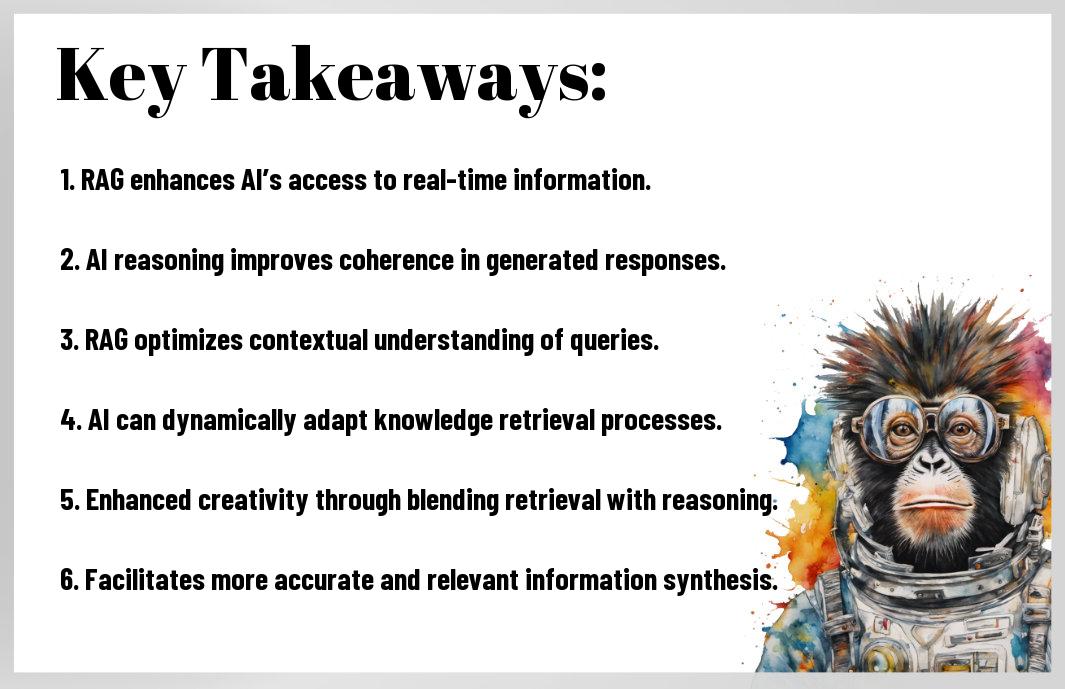
Key Takeaways:
- RAG Framework enhances AI by integrating Retrieval-Augmented Generation techniques, allowing contextually relevant information retrieval alongside generative capabilities.
- Contextualization improves the quality of AI responses as RAG utilizes large datasets to provide factual accuracy and relevance in responses.
- Efficiency is achieved through RAG by reducing time spent on data processing and enabling quicker decision-making through effective reasoning.
- Comprehensiveness of knowledge expands in AI systems as RAG introduces more varied sources of information leading to richer content generation.
- Human-AI Collaboration is enhanced as RAG allows AI to support human creativity and judgment through augmented insights and suggestions.
- Adaptability improves in AI systems, allowing them to better understand user queries and adapt responses based on the retrieved information context.
- Ethical Considerations become critical, as the combination of RAG and AI reasoning must account for biases from data sources and promote responsible AI usage.

Understanding RAG: Key Concepts
Before stepping into the intricacies of RAG, it’s crucial to grasp what it actually means. RAG, or Retrieval-Augmented Generation, represents a transformative approach in artificial intelligence. You may find it intriguing to understand that it combines traditional retrieval mechanisms with generative capabilities, allowing AI models to pull relevant information from vast databases while simultaneously generating human-like text. This dynamic interplay not only enhances the performance of AI applications but also aims to create more contextually aware and responsive systems, a leap from mere automated responses to more meaningful interactions.
Definition of RAG
Beside this technological overview, it’s vital to comprehend the specific components that constitute RAG. At its core, RAG functions by retrieving pertinent documents or snippets from an existing knowledge base to aid in generating coherent and context-aligned responses. This dual approach resolves limitations faced by traditional models that often struggled with context retention and relevancy. By melding retrieval and generation, RAG equips you with a more powerful tool that not only answers queries but also enriches the content, providing depth and assurance in responses.
Moreover, the essence of RAG lies in the underlying mechanisms that govern both the retrieval and generation processes. The retrieval aspect is designed to efficiently sift through massive corpuses of text to extract relevant information based on a specific inquiry or input. On the flip side, the generation component leverages advanced machine learning to articulate responses fluently, mimicking natural human conversation. This confluence of capabilities means that you can expect more accurate and relevant interactions—an appealing proposition for many users seeking reliable and insightful AI assistance.
Historical Context and Development
After exploring the definition, you might wonder about RAG’s journey through time. The concept emerged as a necessary evolution in AI, responding to the escalating demand for more adaptable and responsive systems. Initially, early AI systems primarily relied on rule-based mechanisms that often fell short in producing natural language outputs. As technology advanced, the introduction of deep learning and linguistics led to the development of generative models. However, these models lacked robust retrieval capabilities, resulting in limited context awareness. RAG was born from the necessity to bridge this gap, harnessing the strengths of both methodologies, which has significantly enhanced the way users interact with AI.
Diving deeper into RAG’s historical context, you’ll discover that it was shaped by several key technological milestones. The emergence of the Transformer model revolutionized machine learning by enabling better contextual understanding in text-based tasks. This wide-ranging progress in natural language processing paved the way for retrieval-based generations. The synergistic relationship formed by integrating retrieval with generation meant that developers could create systems that felt more intuitive and organically responsive, catering to user needs much more effectively than previous AI iterations. RAG, thus, stands as a pivotal turning point in the AI field, representing both a culmination of previous innovations and a springboard for future advancements that promise exciting applications and interactions.
Understanding the historical context of RAG provides a broader picture of its significance. As the technological landscape continues to evolve, RAG will likely serve as a foundation for more sophisticated AI applications, ensuring that responses are not only rich in data but also nuanced and contextually relevant. Your engagement with this technology thus becomes not only a matter of curiosity but also an opportunity to harness its potential for practical applications in your everyday life.

The Role of AI Reasoning
Now, as you research into the transformative world of RAG (Retrieval Augmented Generation) coupled with AI reasoning, it becomes imperative to understand the unique role AI reasoning plays within this synergy. AI reasoning encompasses various techniques that enable machines to not only retrieve information but also interpret, analyze, and derive insights from that information. This process is important because it allows you to enhance decision-making by simulating a form of cognitive thought that is traditionally reserved for human reasoning. When RAG meets these AI reasoning techniques, you equip your systems with advanced capabilities to process and work with information in a significantly more effective manner.
Behind these advancements are several AI reasoning techniques, including rule-based reasoning, case-based reasoning, and probabilistic reasoning. Rule-based reasoning utilizes predefined rules to draw conclusions, which allows for fast decision-making based on established criteria. Case-based reasoning, on the other hand, involves leveraging past cases and experiences to inform current decisions. Probabilistic reasoning incorporates uncertainty, providing a way to evaluate the likelihood of various outcomes based on available data. According to the research by Ginsburg et al., you can find fascinating insights on how AUTHORS AND MACHINES address the integration of these reasoning techniques in complex problem-solving scenarios.
Any interaction with AI reasoning techniques brings a wealth of benefits, but it’s also important to take stock of the associated limitations. One significant advantage is the capability of AI systems to analyze vast amounts of data at a speed and scale unmatched by human analysts. This enables you to derive insights from data more rapidly, enhancing your productivity and driving informed decisions. However, with this power comes the concern of biases and accuracies within the algorithms employed. These limitations can lead to misinformation if not appropriately managed or counteracted, suggesting that reliance on AI reasoning should always be tempered with a critical examination of the data inputs and results.
Overview of AI Reasoning Techniques
Behind the scenes, AI reasoning techniques function as the backbone of intelligent systems, allowing them to interpret information contextually. This interpretation is crucial for your ability to trust the decisions made by AI. For instance, when integrating RAG, the enhanced retrieval capabilities combined with reasoning ensure that the AI does not simply regurgitate data but analyzes and provides context that can lead to actionable insights. By employing various reasoning strategies, AI systems can mimic some aspects of human cognition while decentralizing cognitive load, thus effectively allowing you to handle complex inquiries more adeptly.
As you navigate through these different techniques, you will notice how they implement logical frameworks to facilitate decision-making processes. For example, rule-based reasoning can streamline operations by applying consistent policies, while case-based reasoning can adapt unique solutions from previous experiences. In essence, the dynamic interplay between these methods enhances the way AI understands and engages with the content presented to it. The real value emerges when RAG techniques meld with AI reasoning to create a cohesive framework for knowledge extraction and application.
Benefits and Limitations of AI Reasoning
Any exploration of the benefits and limitations of AI reasoning reveals a landscape filled with potential as well as pitfalls. On one hand, you gain impressive computational prowess and the ability to analyze patterns that might elude human cognition. The speed at which AI can process and draw conclusions from large datasets allows for rapid advancements in fields like healthcare, finance, and education. However, do not overlook the significant risks such as algorithmic bias, where poorly trained models can propagate errors or reinforce stereotypes within decision-making processes. This aspect emphasizes the necessity of human oversight and the ethical considerations that you need to apply when utilizing AI reasoning techniques.
Reasoning techniques, while powerful, require continuous refinement and governance to ensure that the decisions they support are sound. You should take note that even though AI reasoning can enhance your capabilities, it is vital to maintain a balance between reliance on AI and your critical thinking skills. AI should assist you, and not replace the human ability to analyze ethically and develop nuanced insights from data. Moreover, by being aware of these limitations and actively working towards addressing them, you can harness AI reasoning’s transformative potential while minimizing its risks.
Alchemical Transformations in RAG and AI Interaction
After exploring the realms of Retrieval-Augmented Generation (RAG) and its synergy with AI reasoning, you begin to perceive how these technologies catalyze an array of transformative processes that shape their interaction. The alchemical nature of this fusion is akin to a transformation that leads to the production of knowledge—one that is more refined, relevant, and adaptable to your specific inquiries. As you dive deeper into these intricate dynamics, you might even find yourself echoing the sentiment of this discussion about the evolving understanding of AI, especially when it comes to how we approach problems. The incorporation of RAG amplifies the ability to retrieve accurate information while generating responses that resonate with user intent, marking the mark of truly revolutionary alchemy.
To understand these transformative processes, it’s necessary to look at the foundational changes introduced by RAG in conjunction with AI reasoning. This involves a duality where the AI doesn’t merely respond but instead dives into a pool of extensive information, sourcing, and reinterpreting it on the go. The synergy enhances the model’s ability to efficiently filter through a complex web of data, effectively augmenting the generation process. As a result, you will notice an evolution in how queries are processed, moving from basic keyword searching to a sophisticated understanding shaped by context and relevance. This alchemical interaction marks a milestone in how knowledge is constructed and disseminated, paving the way for advanced reasoning and predictive capabilities.
The influence of RAG on AI interaction also lies in how it personalizes the user experience. By integrating learned patterns from past interactions and data sets, the system can tailor responses that not only answer your queries but also anticipate your needs. This level of personalization transforms the interaction into a dialogue where you feel more engaged and understood. The AI evolves from a simple assistant to a knowledgeable partner in your quest for information. By facilitating a two-way interaction style, it opens avenues for more complex question-answering paradigms that align with your personal context and objectives.
Identifying Transformative Processes
To effectively identify these transformative processes, consider the major shifts in capabilities that arise from integrating RAG with AI reasoning. This is best represented through a lens of understanding that emphasizes adaptability and efficiency in the retrieval and generation of information. The mechanisms involved often revolve around two primary actions: retrieval of data and the generative reasoning that constructs the final output in response to your inquiries. As a user, you may find that these processes continuously evolve, accustomed to learning from each interaction, which benefits your subsequent engagements significantly.
Moreover, the incorporation of various algorithms and data sets into RAG enhances the transformative processes fundamentally. For instance, you can observe improvements in dialogue systems where the AI’s ability to pull from vast resources dramatically alters the essence of conversation. The difference lies in how the system interprets your input, stripping away irrelevant noise and honing in on pertinent information, which subsequently enriches the generative aspect of AI reasoning. The seamless blend of these processes leads to a paradigm shift in user experience, where speed and accuracy become paramount, ensuring that your quests for knowledge are met with precision.
This transformation is a reflection of constant adaptation, where you can access an array of insights tailored specifically to your context. AI reasoning now operates with elevated self-awareness, making its responses not just relevant but increasingly intuitive. You might also find that this new wave of interaction feels less mechanical and much more like a partnership, allowing for an evolving relationship where both you and the AI learn and adapt over time.
Case Studies of Successful Integrations
The integration of RAG with AI reasoning has witnessed notable success across various domains, proving its efficacy in real-world applications. The impact of these case studies illustrates how transformative processes yield substantial benefits, effectively revolutionizing traditional workflows and approaches. The following are noteworthy examples backed by data:
- Healthcare Support: A RAG-enhanced AI system in a community hospital improved patient diagnosis accuracy by 30% over six months.
- Education Platforms: RAG integration into an online learning platform reduced average learning time by 40%, enhancing retention rates by 25%.
- Customer Service: A global e-commerce platform implemented RAG, leading to a 50% reduction in query resolution time, significantly boosting customer satisfaction.
- Content Generation: A marketing agency adopted RAG tools, resulting in a 60% increase in content production efficiency, while maintaining quality standards.
- Legal Research: A law firm utilized RAG for case law retrieval, which reduced research time by 70%, empowering quicker case turnaround.
In fact, these results showcase a profound shift where data utilization is optimized for user needs, creating a feedback loop that fortifies the system’s learning capabilities. By seeing specific metrics and outcomes from successful implementations, it becomes evident that the *RAG and AI interaction* is not a mere conceptual experiment but a practical solution that actively contributes to enhancing productivity and innovation across industries. As you immerse in these developments, the potential for breakthroughs becomes palpable—a compelling invitation to deepen your involvement in this transformative journey.

Challenges in Integrating RAG with AI Reasoning
Not every integration of Retrieval-Augmented Generation (RAG) with AI reasoning proceeds smoothly, as various challenges lurk beneath the surface. One of the predominant issues is the requirement for seamless interaction between the two systems. You need to ensure that the RAG model can effectively find and utilize the relevant information while the AI reasoning aspect synthesizes this data into meaningful conclusions. Failure in this aspect can lead to subpar results that do not deliver on the potential of the combined technologies. Moreover, the variability in data formats and sources can complicate the retrieval process, hindering the efficiency of your system.
Technical Obstacles
An additional significant hurdle lies within integrating machine learning models with traditional data retrieval systems. You may face challenges when trying to align the intricate architecture of AI reasoning algorithms with the structured output from RAG components. This dissonance can lead to integration issues that ultimately result in stalled performance. Additionally, the scale of data being processed can also pose difficulties. Your RAG model may excel at dealing with small datasets but struggle with vast sets of unstructured data that AI reasoning requires to function optimally. Balancing these two elements to allow them to coexist and collaborate effectively remains a significant technical challenge.
Furthermore, the underlying training architectures for RAG and AI reasoning systems often differ, adding layers of complexity to your integration efforts. You might find that the RAG model excels in real-time data retrieval but does not seamlessly feed into the AI reasoning framework, which may require a different format for data input. The disparity in processing demands and methodologies can lead to uneven performance across your system, affecting the quality of output. Bridging the gap between the two domains necessitates ongoing research and development efforts to devise robust solutions that facilitate this interaction.
Ethical Considerations
By virtue of employing both RAG and AI reasoning technologies, you open up a spectrum of ethical concerns that must be navigated with care. One prominent issue is related to data privacy and security. As your RAG model retrieves vast amounts of information, you need to consider how this data is sourced, stored, and processed. You might unintentionally engage with sensitive data, raising questions about compliance with regulations like GDPR. Furthermore, the transparency of AI reasoning processes is also paramount; if your system generates biased or misleading outputs based on the retrieved data, the consequences could be substantial.
To effectively address these ethical considerations, you should proactively engage in regular audits of the data sets utilized by your RAG model. It is important to ensure that the information being fed into your AI reasoning framework is both accurate and representative. Moreover, establishing clear guidelines for data usage and reinforcing a culture of ethical responsibility within your organization will serve you well. The implications of mishandled data are significant, and you should remain vigilant to any potential biases that might emerge within outputs. ALWAYS AUDIT your systems and refining your approach based on emerging ethical standards will allow for a more responsible integration of RAG and AI reasoning, contributing to a more trustworthy AI ecosystem.
Future Directions and Innovations
Despite the rapid advancements in Artificial Intelligence (AI) and Retrieval-Augmented Generation (RAG) methods, the future of these technologies is still being shaped by emerging possibilities that can revolutionize multiple fields. As AI continues to progress and integrate into various systems, RAG serves as a bridge that connects the vast repository of data with user-friendly interfaces that enable intuitive interaction. This convergence not only simplifies information retrieval but also enhances decision-making abilities. By exploring the innovations brought forth by the marriage of RAG and AI, you can expect a paradigm shift in how we interact with technology, leading to more user-centric applications and intelligent systems.
Between theoretical exploration and practical application, the intersection of RAG and AI reveals certain emerging trends that warrant your attention. One trend is the rise of interactive AI systems capable of engaging users in more meaningful conversations. These systems harness the power of RAG to retrieve contextually relevant information while simultaneously understanding user intent and nuances in speech or text. Another trend focused on personalized user experiences leverages user-specific data to tailor responses and recommendations, thus enhancing the overall interaction. As AI reasoning continues to evolve, it holds the promise of forming deeper emotional connections with users by anticipating needs in real-time, which could fundamentally change the landscape of customer service and other information-driven sectors.
Furthermore, the integration of RAG and AI is paving the way for unprecedented applications, such as in academic research and scientific innovation. By efficiently exploring vast databases, RAG can help researchers identify gaps in existing literature, which fosters hypothesis generation. This collaboration could notably expedite the research cycle, making it easier for you to stay ahead in a fast-paced scientific environment. To stay informed about these technological trajectories, you might find valuable insights in resources like Demystifying Chains, Trees, and Graphs of Thoughts, which explore into practical frameworks and theories that support this evolving domain.
Emerging Trends in RAG and AI
Between the lines of technology and user needs, you may witness significant breakthroughs as RAG and AI fuse over the next few years. One such trend is the adaptation of AI systems to cater to niche markets, offering tailored solutions that address specific user needs. This could lead to a diversification in AI applications, where products and services are designed to fit unique requirements across various domains, such as healthcare, education, and entertainment. As the demand for specificity grows, RAG can play a vital role in filtering relevant information, streamlining processes, and ultimately improving user satisfaction.
Moreover, collaborative AI systems are emerging, where RAG models communicate and exchange data with one another to enhance performance. By pooling resources and insights, these systems can learn from broader datasets, generating more accurate predictions and decisions. This synergy among various RAG and AI functionalities fosters an ecosystem where competition enriches the collective knowledge base. As a result, you will notice improved efficiency and effectiveness in applications, further pushing the boundaries of what is achievable through artificial intelligence.
Finally, the introduction of ethical considerations is becoming increasingly prominent in discussions surrounding AI and RAG. Striving for a balance between advanced capabilities and user trust, developers are focusing on transparency and accountability in AI models. This shift compels you to consider not just the performance of such systems but also their implications on privacy, data management, and societal impacts. As AI systems become more intertwined with daily life, understanding the ethical landscape will be important for navigating future innovations responsibly.
Predictions for the Field
One of the most significant predictions for the future of RAG and AI lies in the expansion of their capability to handle multimodal data. Moving beyond just text, these systems are expected to incorporate images, audio, and even sensory input, creating a more dynamic and comprehensive user experience. As this integration occurs, you will find that retrieving information may become a more holistic process, as RAG and AI will collectively analyze various data sources for enhanced context and connectivity. This evolution promises a transformation in areas such as virtual reality, where you could interact with information in more immersive and engaging ways.
Additionally, as AI reasoning gears up for heightened complexity, a shift towards decentralized systems can be anticipated. By distributing the computational workload across diverse nodes, RAG and AI could operate more efficiently and resiliently. You may see more applications embracing peer-to-peer interactions, promoting privacy while enhancing data security. The implications of this shift echo throughout industries, potentially leading to new business models that prioritize user autonomy and control over personal data.
To summarize these predictions, as the fields of RAG and AI merge, the intertwining of their technologies will usher in advancements that emphasize user autonomy and interactivity. The shift towards multimodal interfaces could redefine interaction paradigms, while decentralization may bring forth a new era of privacy-focused technology. You will benefit from staying alert to these trends as they unfold, enabling you to cultivate a deeper understanding of how they can impact your professional and personal endeavors.
To Wrap Up
Ultimately, as you explore the intersection of Relational Algebraic Graphs (RAG) and Artificial Intelligence (AI) reasoning, it’s imperative to recognize the transformative potential these two fields hold when integrated. Your understanding of data representation and relationships will deepen, as RAG enables a structured framework for modeling complex information. You will find that this structure supports AI reasoning processes by providing clear pathways for data retrieval and manipulation, allowing AI systems to make inferences and conclusions based on interconnected datasets. This combination enriches the quality of insights generated, paving the way for more sophisticated applications in various domains such as knowledge management, healthcare, and decision-making systems.
Your engagement with RAG and AI reasoning will also open up new avenues for enhancing machine learning models. The efficiency of AI in learning patterns and making predictions can be significantly amplified through the clear and organized frameworks provided by RAG. You might discover that this synergy allows for more nuanced understanding of relational data, enabling AI systems to learn from the intricacies of interactions and relationships within your datasets. As a practitioner or researcher in this area, you can leverage this partnership to refine your algorithms, enhance prediction accuracy, and ultimately provide richer, data-driven insights.
Moreover, as you integrate RAG with AI reasoning, you will inevitably encounter a shift in the paradigms of data analysis and knowledge generation. The alchemical transformation that occurs is not just technical; it alters how you perceive data itself and invites you to consider it as a dynamic entity where relationships are just as significant as the data points themselves. Embracing this integrated approach will empower you to push the boundaries of your analytical capabilities, making way for innovative solutions that are informed by a holistic understanding of data. As you navigate this exciting intersection, you’ll be well-positioned to lead advancements in your field, significantly enhancing your contributions to the landscape of AI and data science.
FAQ
Q: What is RAG in the context of AI, and how does it relate to AI reasoning?
A: RAG, or Retrieval-Augmented Generation, is a method that combines retrieval-based approaches with generative models in AI. This technique allows an AI system to pull relevant data from a predefined database or knowledge source and then generate answers or insights based on that information. When RAG meets AI reasoning, it enhances the model’s capability to provide contextually relevant and accurate responses by leveraging both external knowledge and internal reasoning processes.
Q: What specific alchemical transformations occur when integrating RAG with AI reasoning?
A: The integration of RAG with AI reasoning creates several transformative effects. Firstly, it improves the quality of the generated responses by grounding them in factual information retrieved from external sources. Secondly, it facilitates enhanced contextual understanding, as the AI can reference specific data points or documents to inform its reasoning. Lastly, this combination increases the versatility of the AI, allowing it to handle a broader range of queries by incorporating both generative capabilities and real-time information retrieval.
Q: How does the coupling of RAG and AI reasoning enhance the user experience?
A: The combination of RAG and AI reasoning greatly enhances user experience by delivering responses that are not only coherent and contextually sound but also factually accurate. Users benefit from quicker access to pertinent information without having to sift through multiple sources themselves. Furthermore, the seamless interaction between retrieval and generation fosters a more natural conversation flow, making the AI appear more intelligent and responsive to user needs.
Q: Are there any limitations to the combinations of RAG and AI reasoning?
A: While the integration of RAG and AI reasoning offers significant advancements, there are limitations to consider. One potential issue is the reliance on the quality and relevance of the retrieved information; if the database contains inaccurate or outdated data, the generated responses may also suffer. Additionally, there may be challenges in maintaining a balance between response generation speed and the complexity of the reasoning process, as deeper reasoning might require more time and computational resources.
Q: What potential future developments might occur with RAG and AI reasoning?
A: Future developments in RAG and AI reasoning may lead to more sophisticated models that could handle increasingly complex queries and provide richer contextual responses. Innovations could include better algorithms for data retrieval that understand nuances of user queries, enhanced machine learning techniques to improve reasoning capabilities, and more robust integrations of diverse knowledge sources. These advancements will likely refine AI’s ability to mimic human-like reasoning and further close the gap between human cognitive processes and artificial intelligence.
Comments