

RealEstate marketing is undergoing a transformative shift, and harnessing the power of AI can elevate your strategies to new heights. As you explore innovative techniques, you can take advantage of AI tools to enhance customer engagement, improve property listings, and streamline communications. In this guide, you’ll discover actionable insights and effective methods to seamlessly integrate AI into your marketing efforts, enabling you to stay ahead in a competitive market and make data-driven decisions that will optimize your outreach.

Understanding AI in Real Estate Marketing
While the real estate sector has long been driven by personal interactions and traditional marketing methods, the rise of artificial intelligence (AI) is reshaping how you engage with clients and market properties. AI is a powerful tool that can analyze vast amounts of data, automate repetitive tasks, and deliver personalized marketing strategies tailored to your audience. You can leverage AI technology to make more informed decisions, ultimately enhancing your efficiency and effectiveness in the competitive real estate landscape.
How AI is Transforming the Real Estate Landscape
Some of the most significant advancements in real estate marketing can be directly attributed to AI innovations. With machine learning algorithms, you can predict market trends, identify ideal target demographics, and optimize your advertising campaigns for improved performance. Tools like chatbots and virtual home tours are streamlining the buying process and providing potential buyers with instant access to information, resulting in a more engaging and efficient experience.
Key Benefits of AI Integration
Integration of AI in your marketing strategies not only saves you time but also enhances the quality of your outreach efforts. By automating lead generation and nurturing processes, you can focus your energies where they are most needed—building relationships and closing deals. With AI-driven analytics, you can gain insights into customer behavior, enabling you to fine-tune your marketing efforts and achieve higher conversion rates. (Focusing on AI integration can elevate your marketing strategies significantly.)
AI empowers you to create hyper-personalized customer journeys, ensuring that your messages resonate with potential buyers. The technology analyzes user interactions, preferences, and historical data to craft tailored marketing messages that appeal to specific segments of your audience. This level of targeting allows you to address buyer needs more accurately, making your marketing efforts not just more efficient, but more effective in generating interest and driving sales. (Integrating AI into your marketing can not only enhance your outreach but also foster deeper connections with your clients.)
Marketing with AI enables sophisticated techniques that help you stay ahead in the real estate industry. From content generation to performance analysis, AI can be a game-changer, helping you use data to inform your strategies and better understand your clients’ needs. Embracing AI is not merely about adopting new technology; it’s about rethinking how you approach customer relationships and optimizing your resources to win in a rapidly changing marketplace.

Essential Factors for Successful AI Implementation
Clearly, the implementation of AI in real estate marketing requires a structured approach that incorporates various imperative factors. First, aligning your AI initiatives with your organization’s overall business objectives can significantly enhance the effectiveness of your marketing efforts. Ensure you have a clear understanding of your target audience, the channels they frequent, and the type of content that resonates with them. Additionally, it is important to consider the following:
- Comprehensive data analysis capabilities
- Integration with existing marketing platforms
- Team expertise and training in AI technologies
- Continuous assessment and optimization processes
Knowing the significance of these elements can guide you in leveraging AI to maximize your marketing potential. As you explore the intricacies of AI implementations, consider visiting AI for Real Estate Marketing: Insights and Strategies for further insights.
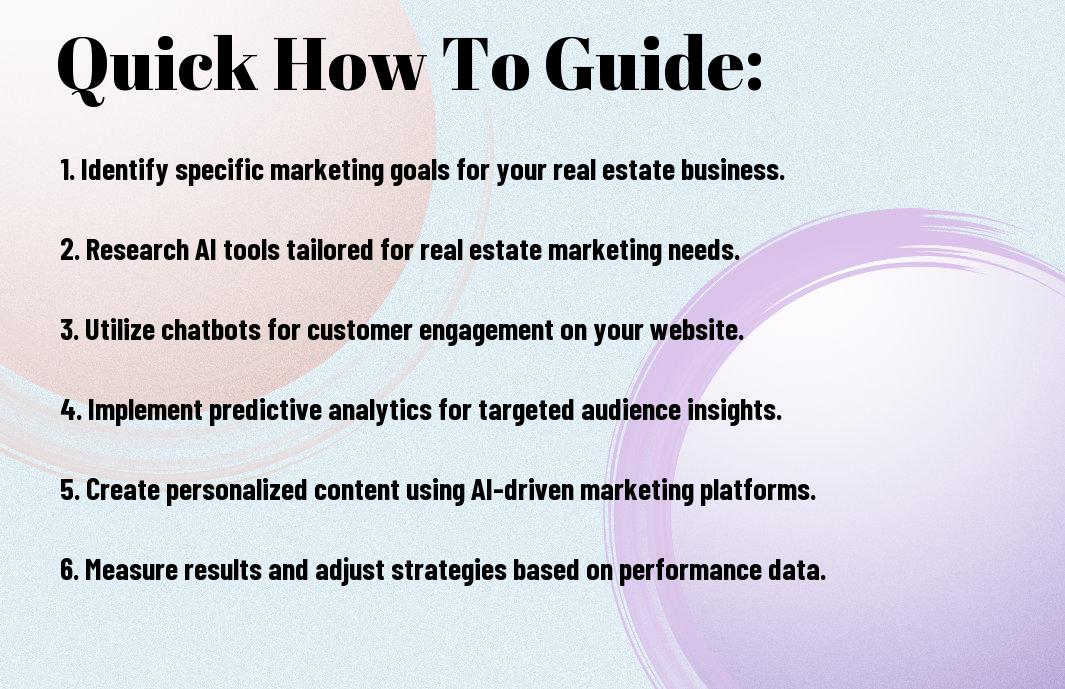
Identifying Your Marketing Goals
You should begin by clearly defining your marketing goals, as this sets the foundation for your AI initiatives. Whether you aim to enhance customer engagement, increase lead generation, or improve conversion rates, having a goal in mind will help guide your decision-making process. Establishing specific, measurable, achievable, relevant, and time-bound (SMART) goals will enable you to evaluate the performance of your AI tools effectively.
As you outline your objectives, consider how AI can assist in achieving them. For instance, if your goal is to boost lead generation, utilizing AI-driven chatbots can provide instant support to potential clients while gathering valuable information. Keeping your overall marketing strategy aligned with your goals will enable you to harness AI’s full potential.
Selecting the Right AI Tools and Technologies
Marketing with AI involves selecting the right tools and technologies to support your objectives. Begin by researching various AI solutions that are specifically designed for the real estate sector. There are numerous platforms available that offer features such as predictive analytics, personalized marketing, and customer relationship management (CRM) systems that incorporate machine learning.
This selection process should include evaluating the scalability of the tools, ease of integration with your existing systems, and the availability of customer support and resources. As each real estate business has unique needs, choosing the AI solutions that best align with your marketing goals will ensure smoother implementation and better results.
How-To Leverage AI for Targeted Marketing Campaigns
Once again, leveraging artificial intelligence in real estate marketing can significantly enhance your targeted campaigns. By utilizing sophisticated algorithms and big data, you can gain deep insights into customer behavior, preferences, and demographics. This enables you to create tailored marketing strategies that resonate with potential buyers, ensuring that you reach the right audience at the right time. For a comprehensive overview, check out 11 Innovative Ways to Use AI in Real Estate, which provides practical examples and strategies to implement AI successfully in your marketing efforts.
Utilizing Data Analytics for Customer Insights
An effective way to harness AI in your marketing campaigns is through data analytics, which provides invaluable customer insights. By examining data collected from previous interactions and transactions, you can identify patterns and trends that reveal what your clients truly desire. This data-driven approach will help you tailor your offerings and marketing messages accordingly, optimizing your chances of converting potential leads into satisfied buyers. A clear understanding of your target audience will guide your marketing efforts, leading to better engagement, higher conversion rates, and ultimately, more successful transactions (it also allows you to allocate your marketing budget more efficiently).
Creating Personalized Content with AI
To elevate your marketing strategy, consider leveraging AI to create personalized content tailored to your audience’s specific needs and preferences. With AI tools, you can analyze customer data and generate engaging content that addresses the unique circumstances of each potential client. This not only enhances the relevance of your marketing campaigns but also fosters a stronger connection with your audience, making them more likely to engage and convert.
Marketing personalization can be a game-changer in real estate. By automating content creation, AI allows you to customize emails, property listings, and social media posts, ensuring that your messaging resonates with each individual. Utilizing AI-driven insights, you can provide the right information at the right time, enhancing the customer experience and increasing the chances of closing deals. Integrating personalized content into your strategy not only sets you apart from the competition but also builds long-lasting relationships with your clients, vital for future business growth.
Tips for Optimizing Property Listings with AI
Now that you understand the power of AI, optimizing your property listings is important for attracting potential buyers and simplifying your marketing efforts. Start by leveraging machine learning algorithms to analyze market trends, audience insights, and property performance metrics. This information can enable you to fine-tune your listings, ensuring they resonate with your target demographic. To take your optimization to the next level, consider the following strategies:
- Utilize AI-driven analytics to identify the best keywords for your listings.
- Incorporate automated pricing tools to stay competitive in your local market.
- Enhance your visuals through AI-powered image editing and enhancement software.
- Explore chatbot integrations for instant communication with potential clients.
- Deploy virtual staging tools to showcase properties more effectively.
Thou should apply these tools and insights consistently to remain a step ahead in the real estate market.
Enhancing Visual Content Using AI Tools
There’s no denying that captivating visuals play a pivotal role in property marketing. By utilizing AI-based tools, you can significantly enhance the quality of images and videos within your listings. For instance, AI-driven editing software can automatically adjust lighting, remove distractions, and even stage your property digitally, allowing potential buyers to envision themselves in the space. Additionally, consider creating 3D virtual tours powered by AI to provide immersive experiences that engage your audience at a deeper level (investment in high-quality visual content can lead to quicker sales). This level of professionalism will set your listings apart from the competition.
Crafting Compelling Descriptions through AI Assistance
Listings that feature compelling and engaging descriptions can make a significant difference in attracting buyers. You may find value in AI writing tools that assist you in generating persuasive property descriptions. These tools can analyze successful listings and suggest phrases or highlight features that potential buyers typically seek. By incorporating data-driven insights, you can create narratives that not only detail the property’s attributes but also evoke emotions and desires in your readers. This approach ensures that your listings stand out and convert inquiries into viewings.
Understanding your audience’s preferences is key when crafting these descriptions. AI can guide you in selecting the right tone and language tailored to your target market. By continuously refining your approach through AI analytics, you enhance your messaging, resulting in improved engagement and higher conversion rates. The right blend of informative and enticing language can captivate potential buyers, paving the way for successful transactions.
How-To Analyze ROI from AI-Driven Marketing Efforts
Not all AI-driven marketing strategies will yield the same results, making it imperative for you to evaluate the effectiveness of your investments. The benefits of incorporating AI into your real estate marketing may include enhanced targeting, greater engagement, and ultimately improved sales figures. To fully understand the return on investment (ROI) of these initiatives, you must implement a robust framework for measuring their outcomes against your overall marketing goals.
Measuring Success Metrics
There’s a myriad of success metrics you can track to gauge the performance of your AI marketing strategies. Metrics such as conversion rates, cost per lead, and customer acquisition costs can provide valuable insights into how effectively your AI tools are working. Additionally, monitoring engagement metrics, like click-through rates and time spent on your website, can inform you about the relevance of your messaging and content to your audience, allowing you to fine-tune your approach.
Adjusting Strategies Based on Performance Data
Metrics are not just numbers; they are the foundation for optimizing your future strategies. By analyzing performance data, you can identify underperforming campaigns and make informed decisions about where to allocate your budget. This iterative process not only helps in refining your existing strategies but also enables you to test new approaches and A/B test different targeting techniques to maximize your ROI (this will help ensure you’re investing your resources wisely).
Performance analysis should become a regular part of your marketing workflow. By engaging in consistent review and adjustment cycles, you can stay agile and responsive to market changes, ensuring that your campaigns remain relevant and impactful. Embracing data-driven decision-making allows you to pivot quickly when certain strategies do not yield expected outcomes (developing a culture of adaptability is key to long-term success).
Future Trends: The Role of AI in Real Estate Marketing
Unlike traditional marketing methods that often rely on intuition and experience, the integration of AI in real estate marketing paves a new path toward data-driven decision-making. As technology continues to advance, you will see the role of AI shift from a supportive tool to a central component of marketing strategies. Predictive analytics will allow you to anticipate market trends, assess property values, and tailor your marketing messages to specific demographics, ensuring you remain one step ahead of your competition. Furthermore, AI-driven chatbots and virtual assistants will enhance customer engagement by providing instant responses to inquiries and personalized property recommendations, which can significantly improve client satisfaction and conversion rates.
Emerging Technologies on the Horizon
One of the most exciting aspects of the future is the emergence of advanced technologies like augmented reality (AR) and virtual reality (VR) that promise to reshape the way you showcase properties. These technologies allow potential buyers to experience immersive property tours without physically stepping foot inside a home. You will have the opportunity to offer virtual open houses, making your listings more accessible to a broader audience, including international buyers. By marrying these innovative tools with AI-driven analytics, you can create targeted marketing campaigns that resonate with your audience on a deeper level.
Preparing Your Business for the Next Wave of Innovation
Innovation is not just about adopting new technologies; it’s about embracing a mindset that seeks continuous improvement. Preparing your business for the next wave of innovation means investing in ongoing training and education for yourself and your team to stay informed about the latest developments in AI and related technologies. Collaborating with tech-savvy professionals or firms can also provide you with insights into how to effectively integrate these tools into your existing marketing strategies. Ultimately, your adaptability will determine how well you leverage AI to enhance your real estate marketing efforts.
Trends indicate that as you gear up for the future, focusing on a comprehensive strategy that incorporates AI insights, immersive experiences, and customer-centric marketing approaches will set you apart in the real estate landscape. By nurturing a culture that values innovation, your business will not only withstand the changes inherent in technology advancements but thrive amid them. Staying proactive in adopting emerging technologies will allow you to engage your audience more effectively and cater to their ever-evolving needs, ultimately creating a competitive edge for your real estate endeavors.
To wrap up
On the whole, leveraging AI in real estate marketing can significantly enhance your business strategy, driving efficiency and engagement like never before. By incorporating AI-driven tools for personalized marketing, predictive analytics, and market trends analysis, you can tailor your approach to better meet the needs of your clients. This means that your campaigns can be more focused, your outreach more effective, and your overall marketing efforts can yield a higher return on investment. The continuous evolution of AI offers a wealth of opportunities to enhance customer experience and engagement, positioning you ahead of the competition.
Furthermore, embracing innovative AI strategies not only elevates your marketing game but also equips you with insights that can shape your decision-making process. As you integrate these technologies into your workflow, you’ll be able to make data-informed choices that lead to improved business outcomes. Adopting these advanced tools will empower you to connect with prospects, streamline processes, and ultimately, achieve sustainable growth in your real estate venture. The future of real estate marketing is here, and by harnessing the power of AI, you can unlock new levels of productivity and success.
FAQ
Q: What are the most effective AI tools that can be utilized in real estate marketing?
A: There are several AI tools that can enhance real estate marketing efforts. Some of the most effective include predictive analytics platforms, which help in forecasting market trends and identifying potential buyers. Chatbots can provide instant customer support, answering inquiries 24/7. Additionally, AI-driven CRM systems can analyze customer behavior to tailor marketing strategies and improve engagement. Image recognition software can also aid in real estate by tagging properties effectively, making listings more discoverable in online searches.
Q: How can AI improve customer engagement in real estate marketing?
A: AI enhances customer engagement by providing personalized experiences. By analyzing data from previous interactions and preferences, AI can tailor marketing messages and property recommendations specific to individual clients. Chatbots can also facilitate real-time communication, handling inquiries instantly and following up with leads. Additionally, AI can segment audiences based on behavior and needs, allowing marketers to send targeted content that resonates more effectively with potential buyers or renters.
Q: What role does data play in leveraging AI for real estate marketing strategies?
A: Data is a foundational element in leveraging AI for real estate marketing. With vast amounts of data being generated daily, AI can sift through and analyze this information to uncover valuable insights. These insights can inform market trends, buyer preferences, and pricing strategies. Real estate professionals can use data to create targeted advertising campaigns and optimize their marketing strategies based on predictive analytics. Ultimately, data-driven approaches foster more strategic decision-making and improve overall marketing effectiveness.
Comments