

This guide will research into transformative techniques to effectively integrate AI into your real estate business, enhancing your customers’ experience and streamlining operations. By harnessing the power of artificial intelligence, you can provide personalized services, predict client needs, and improve communication. Whether you’re a seasoned professional or new to the field, these actionable strategies will empower you to stay competitive in a rapidly evolving market. Let’s explore how you can leverage AI for better engagement and satisfaction in your real estate endeavors.
Understanding AI in Real Estate
For professionals in the real estate sector, understanding how AI operates can significantly enhance the way you engage with your customers. These advanced technologies analyze data patterns and offer predictions that allow you to tailor your services to individual needs, ultimately leading to a more personalized experience. By integrating AI systems into your operations, you can streamline processes, ensuring efficient responses to customer inquiries and improving overall satisfaction (this strategy can lead to higher customer retention rates).
How AI is Transforming Customer Experience
Understanding AI’s impact on customer experience shows you how it revolutionizes various aspects of real estate interactions. AI-driven chatbots, for instance, provide instant responses to potential buyers and sellers, guiding them through initial queries and property searches at any hour. These intelligent systems enrich your customer engagement by being available 24/7, thereby enhancing the chances of converting inquiries into successful deals (consider utilizing AI tools to boost your platform’s productivity).
Key Benefits of Implementing AI
There’s a multitude of benefits associated with implementing AI in your real estate business. First and foremost, AI significantly reduces operational costs by automating routine tasks, allowing you to allocate resources more efficiently. Moreover, the ability to analyze vast datasets quickly helps you identify market trends, enabling informed decision-making and targeted marketing strategies (this understanding can provide a competitive edge in your local market).
This automated approach not only boosts your team’s productivity but also provides valuable insights into customer preferences and behaviors. By utilizing AI-driven analytics, you gain a deeper understanding of your clients’ needs, paving the way for enhanced personalization in your service offerings. Therefore, investing in AI technologies can create a more agile and responsive business environment that caters to client expectations while maximizing profitability (taking the plunge into AI can transform your customer interactions and enhance your brand reputation).
How to Identify the Right AI Tools
Now, as you venture into the world of artificial intelligence for enhancing customer experience in real estate, it’s imperative to identify the right AI tools that cater to your specific needs. For your organization, you need to evaluate various solutions based on several factors that can significantly impact your operations and customer satisfaction. These considerations may include the functionality, scalability, and cost of the AI solution, alongside how well the tool integrates with your existing systems. (Understanding your unique business requirements will guide this important decision.)
Factors to Consider When Choosing AI Solutions
- Functionality: Does the AI solution align with your business objectives and customer demands?
- Scalability: Can the tool grow with your business and handle increasing data loads?
- Cost: Is the pricing structure sustainable for your budget?
- Integration: How well will the AI tool work with your current technology stack?
This assessment will provide clarity on which tools can elevate your customer interactions most effectively.
Tips for Evaluating AI Technology Options
Factors such as feasibility, usability, and support considerations come into play when evaluating various AI technology options. Your goal should be to choose technologies that not only solve pressing issues but also enhance efficiency and user-friendly experiences. Take the time to conduct thorough research and consult with teams across different departments to gather insights and feedback. Additionally, consider trial periods or pilot programs to test the performance of these tools in real-world scenarios.
- Research: Examine case studies and user testimonials to assess the AI solutions’ effectiveness.
- Compatibility: Ensure the technology can seamlessly integrate with your existing processes.
- Support: Verify the level of customer service and technical support the vendor offers.
Assume that you approach this evaluation process with an open mind, and involve multiple stakeholders within your organization to gain diverse perspectives.
Options
Ultimately, your goal is to create a well-rounded selection of components that will solidify your AI strategy. The options you consider should stem from a holistic understanding of both your long-term goals and immediate needs. Evaluating the prospective tools against established criteria will help you streamline your choice towards those that truly resonate with your vision for customer engagement. This will ensure that you’re equipped to deliver a more personalized and efficient experience for your clients.
- List your requirements: Identify the must-have features for your AI tools.
- Assess vendor reputation: Look for vendors with proven success in the real estate sector.
- Documentation: Ensure that vendors provide comprehensive training and onboarding resources.
Assume that you continuously refine your list of options as your understanding of AI technologies expands, allowing you to stay updated on innovative solutions that can set your business apart.

Steps to Integrate AI Into Your Real Estate Strategy
Many real estate professionals are recognizing the potential of AI to transform their operations and enhance client relationships. This integration can streamline processes, provide deeper insights into market trends, and personalize customer experiences. However, effectively incorporating AI into your real estate strategy requires a clear plan and understanding of the technology’s capabilities. This ensures not only a smoother transition but also maximizes the potential benefits for your agency and clients.
How to Develop an AI Implementation Plan
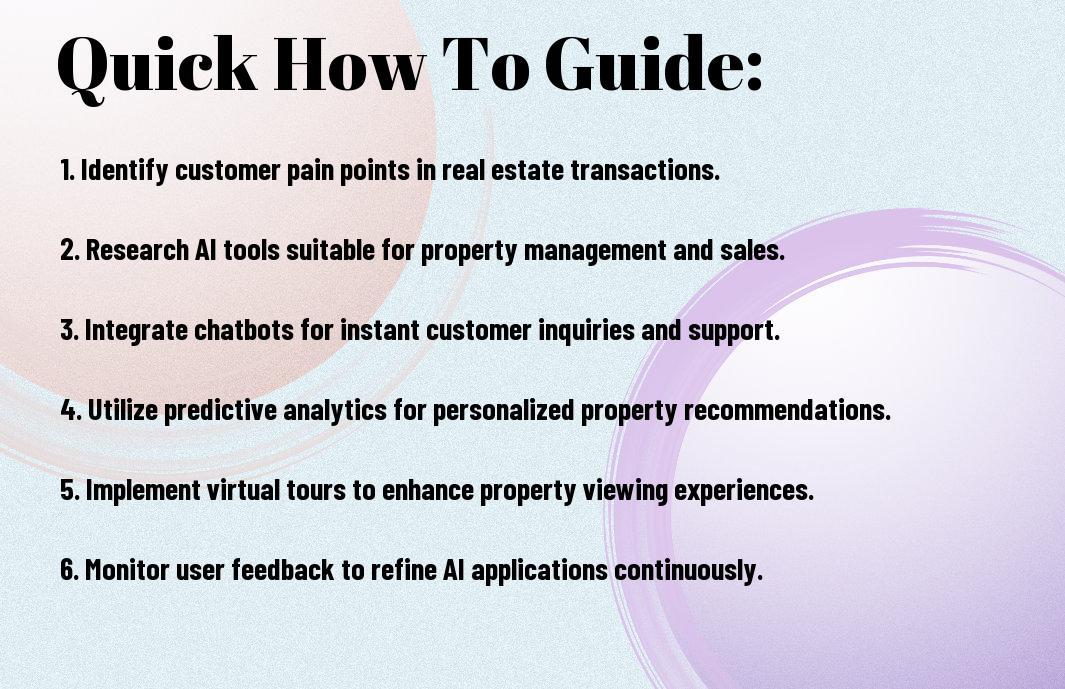
Now that you understand the importance of AI in real estate, the next step is to create a well-structured implementation plan. Start by assessing your current processes and identifying pain points where AI can address challenges or improve efficiencies. Prioritize the areas where AI can provide the most value—whether that’s through chatbots for customer service, predictive analytics for market trends, or automated property valuations. Next, establish a timeline and set specific goals to measure the success of your AI initiatives. Regularly review these goals to adjust your strategies as needed and ensure alignment with broader business objectives.
Tips for Training Your Team on AI Usage
Little to no team training can lead to underutilization of AI tools. Therefore, it’s important to prioritize educating your team on how to effectively utilize these technologies. Begin by offering comprehensive training sessions that cover the functionalities of the AI tools in place and how they enhance daily operations. Encourage open dialogue during training to address any concerns and highlight success stories of AI applications within the organization. Providing easy-to-access resources, such as user manuals and quick guides, can further empower your team to embrace AI solutions confidently.
- Conduct regular workshops to keep the team updated.
- Encourage feedback to improve the training process.
- Pair team members with AI champions for ongoing support.
The investment in team training pays off by fostering a culture of innovation.
Plus, it’s important to provide ongoing support as your team adapts to AI tools. Regular follow-ups can help address questions that may arise after initial training, which will ensure that team members feel comfortable using the technology. Create a collaborative atmosphere by setting up weekly or monthly check-ins to share insights and challenges faced during AI integration. This promotes continuous learning and improvement among team members, enhancing their confidence in leveraging AI.
- Set up a system for team members to share tips.
- Encourage the sharing of personal success stories with AI.
- Recognize team efforts in utilizing AI effectively.
The focus on collaboration will further strengthen your team’s proficiency in AI tools.
Enhancing Customer Interactions with AI
Unlike traditional methods of customer engagement, utilizing AI in real estate allows you to create a more personalized experience for your clients. By leveraging advanced algorithms and data processing capabilities, AI can analyze customer preferences and behaviors, allowing for tailored interactions that resonate with their specific needs. To explore more about how these technologies are shaping real estate, you can read about AI in Real Estate: The Next Generation of Capabilities. Implementing this personalized approach can significantly improve customer satisfaction and loyalty.
How to Use AI for Personalized Customer Engagement
Customer engagement is elevated when you implement AI strategies that focus on personalized interactions. For instance, by using AI-driven CRM systems, you can keep track of client preferences and past interactions, which enables you to provide relevant recommendations and responses during your communications. This not only enhances the user experience but also fosters a stronger connection with your clients. (A key decision is to invest in a system that integrates with existing databases for optimal results.)
Tips for Utilizing Chatbots and Virtual Assistants
To make effective use of chatbots and virtual assistants, you need to ensure they are well-programmed to handle common inquiries and provide timely assistance. Training these AI systems to understand natural language will allow them to communicate with customers more effectively, which can streamline the buying process. (Deciding on the functions and responses that align best with your clients’ needs is necessary.) Consider the following tips:
- Implement chatbots on your website for 24/7 support.
- Regularly update your virtual assistants with new information and services.
- Monitor chatbot interactions to improve their effectiveness over time.
Perceiving the potential of these digital assistants can greatly enhance your customer service and engagement strategies.
With the right approach, you can maximize the benefits of chatbots and virtual assistants for your real estate business. They can handle repetitive inquiries, freeing up your time to focus on complex customer needs and high-stakes decisions. (Ensure you continually evaluate and refine your chatbot’s capabilities for seamless user experiences.) Here are some considerations:
- Assess customer feedback to improve responses.
- Test the effectiveness of different automation strategies regularly.
- Integrate chatbots with your CRM for seamless data sharing.
Perceiving these aspects can lead to enhanced customer experiences and operational efficiency.
Measuring the Impact of AI on Customer Experience
Keep assessing the effectiveness of your AI implementations in real estate to ensure that they are truly enhancing the customer experience. You want to examine into the various metrics that can provide clear insights into how AI influences customer satisfaction, engagement, and overall service quality. By closely monitoring these metrics, you can determine if your strategies are aligned with client needs and expectations, paving the way for more targeted improvements in the future.
Key Metrics to Evaluate AI Effectiveness
With the right metrics, you can gain valuable insights into how effectively your AI tools are improving customer experience. Metrics such as Net Promoter Score (NPS), Customer Satisfaction Score (CSAT), and Customer Effort Score (CES) can provide direct feedback on how customers perceive your AI enhancements. Additionally, tracking engagement metrics, such as the average response time and resolution rates for customer inquiries, can help gauge whether AI solutions are streamlining communications or inadvertently complicating them.
Tips for Continuous Improvement and Feedback
One vital aspect of maintaining a robust customer experience with AI tools involves continuous improvement and soliciting feedback. Establishing a system for collecting real-time feedback from customers allows you to identify pain points in their journey. Implementing regular check-ins can create opportunities to adjust and optimize your AI solutions based on real user experiences. Engaging directly with customers can unveil hidden issues that you may not have considered, thus enabling you to fine-tune your tools effectively. (Deciding to prioritize customer feedback is necessary for long-term success.)
- Make feedback collection a standard part of your customer interactions.
- Actively respond to feedback and inform customers about changes made based on their input.
- Conduct regular assessments of your AI performance to ensure it meets evolving customer expectations.
- Incorporate advanced analytics to gain deeper insights into customer behavior and preferences.
Recognizing the importance of actively implementing changes based on feedback will position you to create a more enriched customer experience.
This practice of continuous improvement should also involve benchmarking your results against industry standards to stay ahead. You might want to partner with AI service providers to ensure you are leveraging the best practices while assessing new technologies that can enhance your offerings. (Ensuring consistent evaluation of these metrics is vital.)
- Keep a pulse on customer trends and preferences through surveys and focus groups.
- Utilize data analytics tools to dissect customer interactions and experiences further.
- Train your staff to be responsive to customer insights and adapt accordingly.
- Foster a culture within your organization that emphasizes the value of customer feedback and innovation.
Recognizing the need for adaptability in your approach will allow you to stay relevant in a rapidly evolving market.

Overcoming Challenges in AI Adoption
After recognizing the potential that AI brings to the real estate sector, you may encounter various hurdles that can complicate its implementation. These challenges can range from technical issues, such as integrating existing systems with new AI tools, to cultural barriers within your organization. Understanding these obstacles is the first step in finding effective solutions to ensure a smooth transition towards AI-enhanced customer experiences.
Common Obstacles in Implementing AI
Assuming you are ready to adopt AI, it’s important to acknowledge the common obstacles that many organizations face. The lack of technical expertise and knowledge about AI can make it difficult for your team to effectively utilize these technologies. Additionally, financial constraints often limit the ability to invest in the necessary infrastructure or talent needed to fully reap the benefits of AI. You may also encounter data quality issues, where the existing data is either insufficient or poorly organized, making it challenging to harness AI’s full potential.
How to Address Resistance to Change
Addressing resistance to change is important for facilitating a successful AI integration. You may find that some of your team members are hesitant due to fear of job displacement, lack of understanding of AI functionalities, or simply a preference for traditional methods. One effective way to counteract this resistance is by fostering a culture of continuous learning and open communication. Providing training and resources about AI can empower your team members, helping them to see AI as a valuable tool rather than a threat.
Obstacles to change can be tackled through robust leadership and involvement from all levels of the organization. Ensure that you actively engage your team in the AI implementation process by including them in discussions and decisions. This involvement can help demystify AI technologies and show your team how they can enhance rather than replace their roles. By successfully demonstrating the benefits of AI and fostering an environment of collaboration, you can alleviate concerns and build a collective enthusiasm for the transition.
Summing Up
Upon reflecting on the transformative techniques for implementing AI in real estate, you can see that these innovations hold the potential to significantly enhance your customer experience. By utilizing AI-driven tools such as virtual tours, chatbots, and predictive analytics, you can offer personalized services that resonate with your clients’ needs. This proactive approach not only elevates satisfaction but also establishes your brand as a leader in a competitive market, allowing you to create lasting relationships with your customers.
As you consider integrating these AI technologies, take the time to evaluate which solutions best align with your specific business goals and customer preferences. Your journey towards a more efficient and client-focused real estate practice will ultimately position you to respond adeptly to market changes and consumer expectations. Embrace the power of AI, and you will not only streamline your operations but also build a more engaging and satisfying experience for your clients.
Q: What are some AI technologies that can be used to enhance customer experience in real estate?
A: There are several AI technologies that can significantly improve customer experiences in the real estate sector. These include chatbots for 24/7 customer assistance, virtual reality (VR) tools for immersive property tours, predictive analytics to understand market trends and customer preferences, and personalized property recommendation systems that utilize machine learning algorithms. By integrating these technologies, real estate businesses can offer tailored experiences that meet the specific needs of their clients.
Q: How can AI-driven data analysis improve decision-making in real estate?
A: AI-driven data analysis provides deeper insights into market trends, customer behaviors, and property valuations, enabling real estate professionals to make informed decisions. By leveraging big data and machine learning, businesses can identify emerging trends, forecast property prices more accurately, and assess potential investment opportunities. This data-centric approach equips real estate agents with the tools needed to better understand their clientele and adapt their strategies accordingly, thus enhancing overall customer satisfaction.
Q: What steps should a real estate business take to successfully implement AI technologies?
A: To successfully implement AI technologies, a real estate business should start by assessing its current operations and identifying specific areas where AI can add value. This could involve streamlining processes, enhancing customer interactions, or improving property management. Next, businesses should invest in the right AI tools and software, ensuring they align with their objectives. Training staff to utilize these technologies effectively is also important. Lastly, companies should monitor the performance of AI systems and gather feedback to refine and enhance their solutions over time.
Comments