

Uncover the fascinating journey of AI from Turing’s Test to the rise of Deep Learning – the future is here!

Table of Contents
Artificial Intelligence, often referred to as AI, has become a ubiquitous term in today’s technological landscape. It encompasses a wide range of technologies and applications that aim to mimic human cognitive functions such as learning, problem-solving, and decision-making. The rapid advancements in AI have paved the way for transformative changes in various industries, from healthcare to finance to transportation.
Historical Context
The concept of artificial intelligence dates back to the 1950s when pioneers like Alan Turing and John McCarthy laid the foundations for the field. Turing proposed the famous Turing Test, which evaluates a machine’s ability to exhibit intelligent behavior indistinguishable from that of a human. McCarthy coined the term “artificial intelligence” and organized the Dartmouth Conference in 1956, which is considered the birth of AI as a field of study.
Current Applications
Today, AI is being actively applied in a wide array of domains, revolutionizing the way we live and work. From virtual assistants like Siri and Alexa to self-driving cars and recommendation systems, AI technologies have become an integral part of our daily lives. In healthcare, AI is being used for medical imaging analysis, drug discovery, and personalized treatment plans, leading to improved patient outcomes and efficiency in healthcare delivery.
Benefits of AI
The benefits of AI are vast and diverse. AI technologies can enhance efficiency and productivity in various tasks, enabling businesses to automate repetitive processes and focus on higher-value activities. In addition, AI can unlock new insights from vast amounts of data, driving innovation and informed decision-making. In healthcare, AI has the potential to revolutionize disease diagnosis and treatment, leading to better healthcare outcomes for patients.

Image courtesy of digitalwellbeing.org via Google Images
Challenges and Ethical Concerns
Despite its promise, AI also presents various challenges and ethical concerns that need to be addressed. One of the major challenges is the potential for bias in AI algorithms, which can lead to discriminatory outcomes. Job displacement due to automation is another concern, as AI technologies replace human workers in certain tasks. Ethical dilemmas such as privacy violations and autonomous weapon systems also pose significant challenges for the ethical deployment of AI.
Future Direction
The future of AI holds exciting possibilities as the field continues to evolve rapidly. Advancements in deep learning, a subset of AI that focuses on training neural networks with large amounts of data, have led to breakthroughs in natural language processing, computer vision, and other AI applications. The integration of AI with other emerging technologies like IoT and blockchain is expected to drive further innovation and create new opportunities for AI deployment.
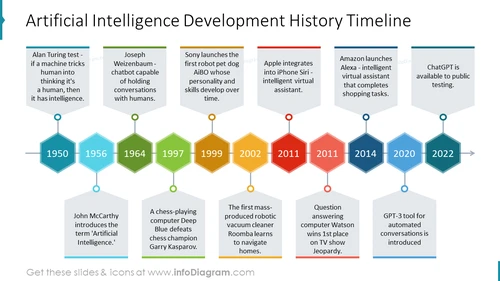
Image courtesy of www.infodiagram.com via Google Images
Can Skynet Happen?
The concept of a rogue AI system like Skynet, as depicted in the Terminator franchise, raises concerns about the potential risks of advanced AI. While the scenario of a malevolent AI entity taking over the world is still a work of fiction, experts and researchers acknowledge the importance of ensuring the responsible development and deployment of AI technologies. By implementing safeguards, regulations, and ethical guidelines, we can mitigate the risks associated with AI and prevent catastrophic scenarios like Skynet from becoming a reality.
Theoretical Scenarios
Imagining theoretical scenarios where AI surpasses human intelligence challenges us to consider the implications of such advancements. While the idea of AI superintelligence raises philosophical and ethical questions about our place in a world dominated by machines, it also highlights the potential for AI to augment human intelligence and solve complex problems in ways we never thought possible. As we explore these theoretical scenarios, it is crucial to prioritize ethical considerations and ensure that AI technologies align with human values and interests.

Image courtesy of www.linkedin.com via Google Images
Mitigating the Risks
Addressing the risks associated with AI requires a proactive approach that involves collaboration between researchers, policymakers, industry stakeholders, and the public. Establishing guidelines for responsible AI development and deployment, fostering transparency and accountability in AI systems, and promoting education and awareness about AI technologies are essential steps towards mitigating risks and ensuring that AI contributes positively to society. By working together to navigate the ethical, social, and technical challenges of AI, we can shape a future where AI serves as a force for good.
Conclusion
Artificial Intelligence continues to push the boundaries of innovation and reshape the way we interact with technology. From its humble beginnings in the 1950s to the current era of deep learning and neural networks, AI has come a long way in transforming industries and enhancing human capabilities. As we navigate the opportunities and challenges of AI in the years to come, it is imperative to approach AI development with a critical eye towards ethical concerns, societal impact, and responsible use. By harnessing the potential of AI for the greater good, we can pave the way for a future where artificial intelligence coexists harmoniously with humanity.
Generated by Texta.ai Blog Automation
Comments